Greater white-fronted goose
Amazing fact
Greater white-fronted geese are known to fly at night during migration.
University of Michigan Animal Diversity Web
No sign-up needed. You can save notes on this device.
An illustration based on the real animal.
A little discovery to share.
Greater white-fronted geese are known to fly at night during migration.
THE REAL WORLD
The real Greater white-fronted goose
- Scientific name
- Anser albifrons
- Japanese name
- マガン
- Group
- Birds
- Class
- Aves
- Order
- Anseriformes
- Family
- Anatidae
- Genus
- Anser
It raises its young on the tundra in the far north of Eurasia and North America, and spends the winter in grasslands and farm fields in places such as Japan.
Its body is dark brown and the base of its bill is white; its English name, 'white-fronted', comes from this white patch.
It mainly eats plants; in early winter it also eats rice, soybeans and other grain left in the fields after the harvest.
How the Greater white-fronted goose lives
During the breeding season, they also eat mollusks and aquatic insects. They build shallow nests on the ground from feathers and plants. In late winter, they eat newly sprouted grasses and other plants.
University of Michigan Animal Diversity Web多摩動物公園Basic data
- Size
- Total length: 65–86 cmWingspan: 130–165 cm多摩動物公園
- Weight
- 1.7–3 kg多摩動物公園
- Active
- At night (nocturnal)University of Michigan Animal Diversity Web
- Diet
- Grass leaves, stems, roots, and seeds多摩動物公園
- Range
- Northern Eurasia, northern North America, western Greenland, and elsewhere多摩動物公園
Where the Greater white-fronted goose has been recorded
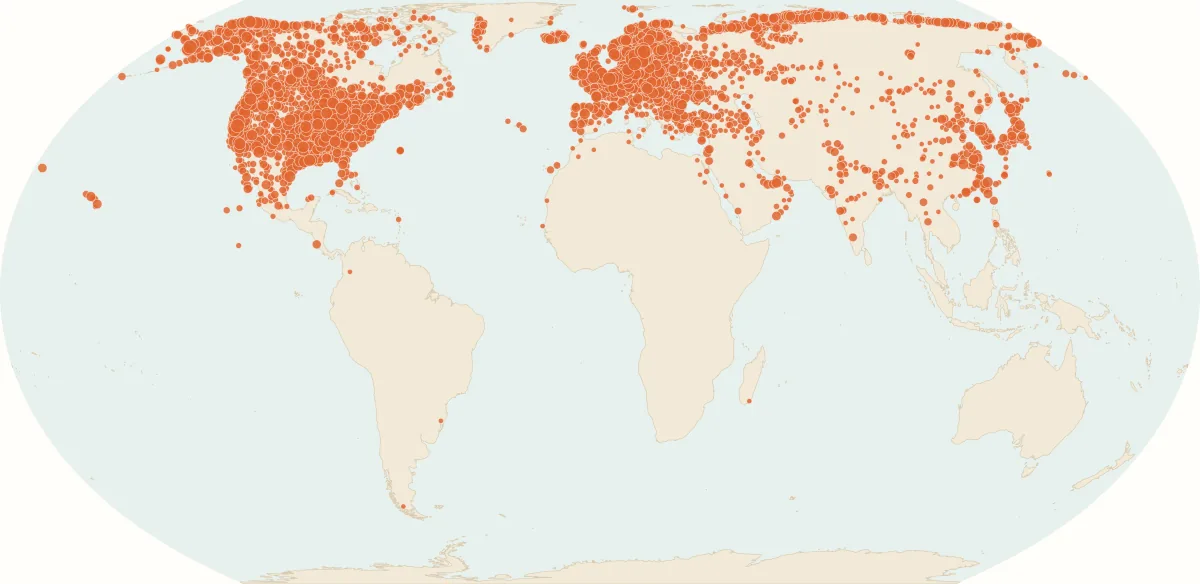
Records: GBIF.org (CC0 and CC BY 4.0 records, retrieved 2026-11-07). Map: Natural EarthSee the records on GBIF
Watch wild animals from a distance. Do not touch or feed them, and take care of the places where they live.
Names around the world
- 日本語
- マガン
- 简体中文
- 白额雁
- 繁體中文
- 白額雁
- 한국어
- 쇠기러기
- Español
- Ánsar careto
- Français
- Oie rieuse
- Deutsch
- Blässgans
- Português (Brasil)
- Ganso-grande-de-testa-branca
- Italiano
- Oca lombardella maggiore
- العربية
- وزة غراء
- Tiếng Việt
- Ngỗng trán trắng lớn
- Русский
- Белолобый гусь
- Türkçe
- Sakarca
- বাংলা
- বড় ধলাকপাল রাজহাঁস
Names come from Wikidata and iNaturalist records. Where a language has no recorded name, we use the scientific name.
Sources and how we check
- 多摩動物公園 — マガンChecked: 2026-11-03
- University of Michigan Animal Diversity Web — Anser albifronsChecked: 2026-11-03
We check each fact against its source. The illustrations simplify how the real animal looks.
The classification (class, order, family, genus) follows Wikidata records, checked against GBIF. Classifications can change as research goes on.
The basic data are the values given in each source. They vary with how the animal is measured, whether it is male or female, and whether it lives in the wild or in captivity.
This page was translated from the original Japanese with the help of AI.
Report a mistakeWhen you meet the Greater white-fronted goose, look for this
- Look for the black spots on an adult’s belly.
Animals do different things from day to day, so you may not always see this.
多摩動物公園EXHIBIT INFORMATION
Places that keep or show the Greater white-fronted goose
Zoos, aquariums and other places whose official websites say they keep or show this animal.
Kanto
Displays can change with the animals’ health and the seasons. Check each facility’s official website before you go.
RELATIVES
Others in Anatidae


MORE TO MEET


