Bean goose
Amazing fact
Bean geese sometimes nest near peregrine falcons or rough-legged hawks.
University of Michigan Animal Diversity Web
No sign-up needed. You can save notes on this device.
An illustration based on the real animal.
A little discovery to share.
Bean geese sometimes nest near peregrine falcons or rough-legged hawks.
THE REAL WORLD
The real Bean goose
- Scientific name
- Anser fabalis
- Japanese name
- ヒシクイ
- Group
- Birds
- Class
- Aves
- Order
- Anseriformes
- Family
- Anatidae
- Genus
- Anser
In summer it raises its young in the taiga and tundra of northern Eurasia, and in winter it flies to East Asia and Europe.
It builds its nest of grass and down in a hollow in the ground, usually at a spot high enough to stay dry even in a flood.
How the Bean goose lives
They are usually active during the day. They eat grass leaves, stems and roots, as well as water plants and seeds. After the breeding season, they replace their feathers.
University of Michigan Animal Diversity Web多摩動物公園Basic data
- Size
- Total length: 66–89 cmWingspan: 142–175 cm
- Weight
- 3.2–3.9 kg
- Diet
- Grass leaves, stems, roots, seeds, aquatic plants, and grains
- Range
- Northern Eurasia, East Asia, Kazakhstan, and Europe
- Conservation status in Japan
- Near Threatened (NT)Assessed as Anser fabalis serrirostrisMinistry of the Environment of Japan, 5th Red List (2026)
Where the Bean goose has been recorded
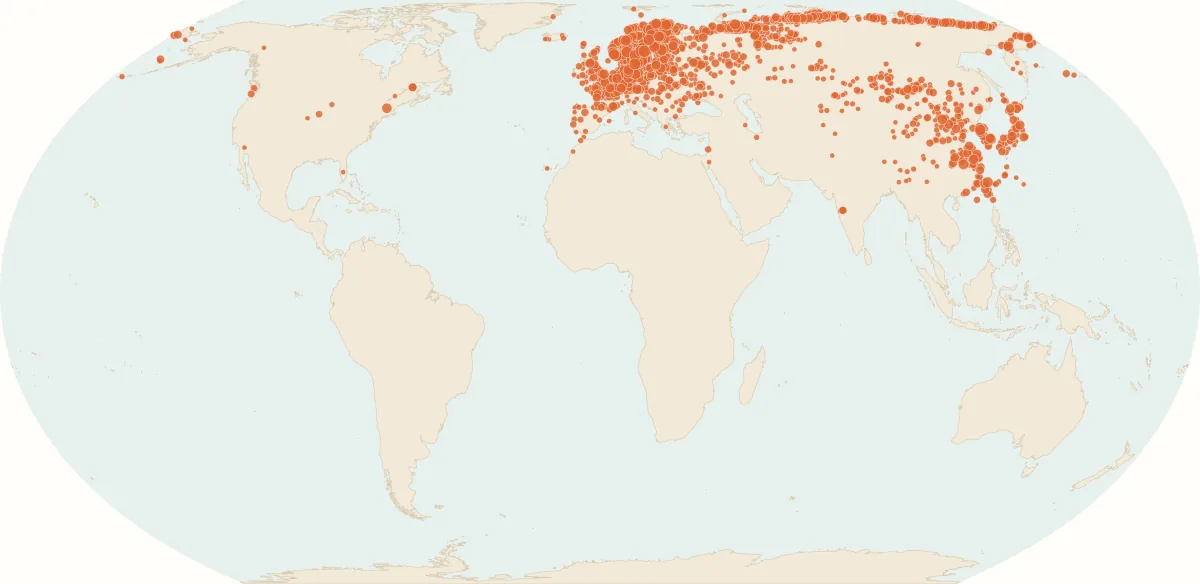
Records: GBIF.org (CC0 and CC BY 4.0 records, retrieved 2026-11-07). Map: Natural EarthSee the records on GBIF
Watch wild animals from a distance. Do not touch or feed them, and take care of the places where they live.
Names around the world
- 日本語
- ヒシクイ
- 简体中文
- 豆雁
- 繁體中文
- 豆雁
- 한국어
- 큰부리큰기러기
- Español
- Ánsar campestre
- Français
- Oie des moissons
- Deutsch
- Saatgans
- Português (Brasil)
- Ganso-campestre
- Italiano
- Oca granaiola della taiga
- العربية
- إوز الفول
- Tiếng Việt
- Ngỗng đậu taiga
- Русский
- Гуменник
- Türkçe
- Tarla kazı
- বাংলা
- শুঁটি রাজহাঁস
Names come from Wikidata and iNaturalist records. Where a language has no recorded name, we use the scientific name.
Sources and how we check
- 多摩動物公園 — ヒシクイChecked: 2026-11-03
- University of Michigan Animal Diversity Web — Anser fabalisChecked: 2026-11-03
- Ministry of the Environment of Japan, 5th Red List (2026)Checked: 2026-11-07
We check each fact against its source. The illustrations simplify how the real animal looks.
The classification (class, order, family, genus) follows Wikidata records, checked against GBIF. Classifications can change as research goes on.
The basic data are the values given in each source. They vary with how the animal is measured, whether it is male or female, and whether it lives in the wild or in captivity.
The conservation status in Japan is the category in the Red Lists of the Ministry of the Environment of Japan, which assess the risk of extinction for wild animals in Japan.
This page was translated from the original Japanese with the help of AI.
Report a mistakeWhen you meet the Bean goose, look for this
- Look for its orange legs.
- Notice that its belly has no black spots.
Animals do different things from day to day, so you may not always see this.
University of Michigan Animal Diversity Web多摩動物公園EXHIBIT INFORMATION
Places that keep or show the Bean goose
Zoos, aquariums and other places whose official websites say they keep or show this animal.
Kanto
Displays can change with the animals’ health and the seasons. Check each facility’s official website before you go.
RELATIVES
Others in Anatidae


MORE TO MEET


