Bar-headed goose
Amazing fact
When the leading bar-headed goose tires, it drops to the back and another goose takes the lead.
University of Michigan Animal Diversity Web
No sign-up needed. You can save notes on this device.
An illustration based on the real animal.
A little discovery to share.
When the leading bar-headed goose tires, it drops to the back and another goose takes the lead.
THE REAL WORLD
The real Bar-headed goose
- Scientific name
- Anser indicus
- Japanese name
- インドガン
- Group
- Birds
- Class
- Aves
- Order
- Anseriformes
- Family
- Anatidae
- Genus
- Anser
It spends the winter in India and raises its young on the Tibetan Plateau, so it migrates over the Himalayas.
It has black bars on the back of its white head, and its English name, 'bar-headed', comes from these markings.
Because it flies over the Himalayas, its body has special ways of coping with the thin, low-oxygen air high in the sky.
How the Bar-headed goose lives
They eat highland grasses around the lakes and streams where they nest. They make nests in shallow hollows in the ground at high elevations. They migrate in family groups or large colonies.
University of Michigan Animal Diversity WebBasic data
- Size
- Total length: 71–76 cm
- Weight
- 1.9–2.4 kg
- Diet
- Grass leaves, stems, roots, seeds, and aquatic plants
- Range
- Tibetan Plateau, Mongolian Plateau, and India
Where the Bar-headed goose has been recorded
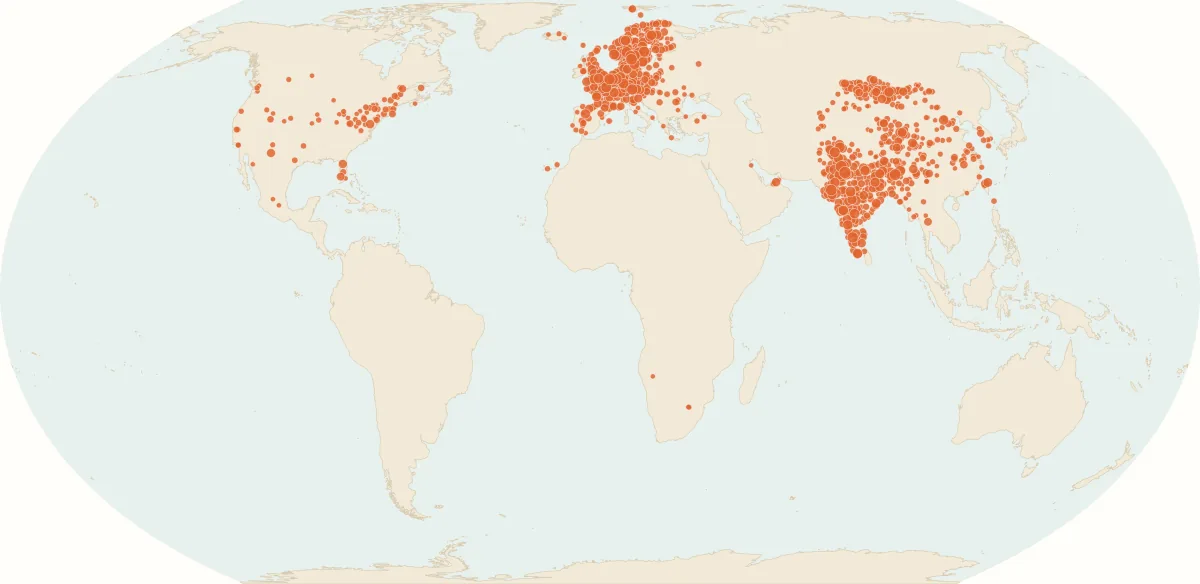
Records: GBIF.org (CC0 and CC BY 4.0 records, retrieved 2026-11-07). Map: Natural EarthSee the records on GBIF
Watch wild animals from a distance. Do not touch or feed them, and take care of the places where they live.
Names around the world
- 日本語
- インドガン
- 简体中文
- 斑头雁
- 繁體中文
- 斑頭雁
- 한국어
- 줄기러기
- Español
- Ánsar indio
- Français
- Oie à tête barrée
- Deutsch
- Streifengans
- Português (Brasil)
- Ganso-de-cabeça-listada
- Italiano
- Oca indiana
- हिन्दी
- बिर्वा
- العربية
- إوزة مخططة الرأس
- Bahasa Indonesia
- Angsa kepala bergaris
- Tiếng Việt
- Ngỗng đầu sọc
- Русский
- Горный гусь
- Türkçe
- Hint kazı
- ไทย
- ห่านหัวลาย
- বাংলা
- দাগি রাজহাঁস
Names come from Wikidata and iNaturalist records. Where a language has no recorded name, we use the scientific name.
Sources and how we check
- 多摩動物公園 — インドガンChecked: 2026-11-03
- University of Michigan Animal Diversity Web — Anser indicusChecked: 2026-11-03
We check each fact against its source. The illustrations simplify how the real animal looks.
The classification (class, order, family, genus) follows Wikidata records, checked against GBIF. Classifications can change as research goes on.
The basic data are the values given in each source. They vary with how the animal is measured, whether it is male or female, and whether it lives in the wild or in captivity.
This page was translated from the original Japanese with the help of AI.
Report a mistakeWhen you meet the Bar-headed goose, look for this
- Look for the orange legs and black-and-white neck.
Animals do different things from day to day, so you may not always see this.
University of Michigan Animal Diversity WebEXHIBIT INFORMATION
Places that keep or show the Bar-headed goose
Zoos, aquariums and other places whose official websites say they keep or show this animal.
Kanto
Displays can change with the animals’ health and the seasons. Check each facility’s official website before you go.
RELATIVES
Others in Anatidae


MORE TO MEET


