Green pheasant

No sign-up needed. You can save notes on this device.
An illustration based on the real animal.
A little discovery to share.
A male green pheasant spreads his tail feathers like a fan during courtship.
THE REAL WORLD
The real Green pheasant
- Scientific name
- Phasianus versicolor
- Japanese name
- キジ
- Group
- Birds
- Class
- Aves
- Order
- Galliformes
- Family
- Phasianidae
- Genus
- Phasianus
It is Japan's national bird and lives in open woods, farmland and grassy fields from Honshu to Kyushu.
The male has feathers that shine green and purple, and a patch of red skin on its face shaped like a heart turned on its side.
In the breeding season the male calls 'ke-ke-keen' while beating his wings to make a 'dororororo' drumming sound.
How the Green pheasant lives
It eats plant shoots, leaves and seeds, as well as insects. During the breeding season, females settle in a male's territory. Outside the breeding season, males and females live separately in small groups.
京都市動物園新潟県Basic data
- Size
- Total length: males 80 cm, females 60 cm
- Range
- Honshu to Kyushu
Where the Green pheasant has been recorded
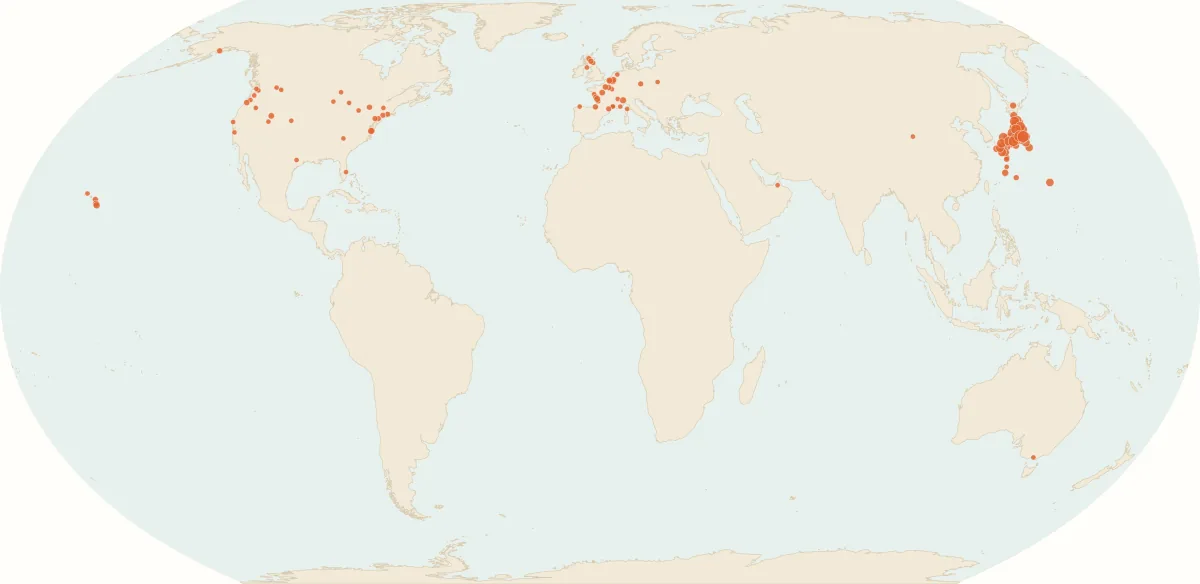
Records: GBIF.org (CC0 and CC BY 4.0 records, retrieved 2026-11-07). Map: Natural EarthSee the records on GBIF
Watch wild animals from a distance. Do not touch or feed them, and take care of the places where they live.
Names around the world
- 日本語
- キジ
- 简体中文
- 绿雉
- 繁體中文
- 綠雉
- 한국어
- 일본꿩
- Español
- Faisán verde
- Français
- Faisan versicolore
- Deutsch
- Buntfasan
- Português (Brasil)
- Faisão-verde
- Italiano
- Fagiano versicolore
- العربية
- تدرج أخضر
- Bahasa Indonesia
- Pegar hijau
- Русский
- Зелёный фазан
- Türkçe
- Yeşil sülün
Names come from Wikidata and iNaturalist records. Where a language has no recorded name, we use the scientific name.
Sources and how we check
- 新潟県 — 展示鳥類剥製(キジ)Checked: 2026-11-03
- 京都市動物園 — ニホンキジChecked: 2026-11-05
We check each fact against its source. The illustrations simplify how the real animal looks.
The classification (class, order, family, genus) follows Wikidata records, checked against GBIF. Classifications can change as research goes on.
The basic data are the values given in each source. They vary with how the animal is measured, whether it is male or female, and whether it lives in the wild or in captivity.
This page was translated from the original Japanese with the help of AI.
Report a mistakeRELATIVES
Others in Phasianidae


MORE TO MEET


