Edwards's pheasant
Amazing fact
Edwards’s pheasants take dust baths to remove parasites from their feathers.
Emerald Park
No sign-up needed. You can save notes on this device.
An illustration based on the real animal.
A little discovery to share.
Edwards’s pheasants take dust baths to remove parasites from their feathers.
THE REAL WORLD
The real Edwards's pheasant
- Scientific name
- Lophura edwardsi
- Japanese name
- コサンケイ
- Group
- Birds
- Class
- Aves
- Order
- Galliformes
- Family
- Phasianidae
- Genus
- Lophura
Where the name “Edwards's pheasant” comes from
Its English name honors Alphonse Milne-Edwards, a French researcher of birds.
ZooParc de TrégomeurA member of the pheasant family that lives in humid forests and is endemic to Vietnam, found nowhere else.
The male has glossy blue-green feathers and a white crest on its head. The female is plain brown, but like the male, it has red skin on its face.
Besides plant foods such as seeds, fruit and leaves, it also eats small creatures like earthworms and termites.
How the Edwards's pheasant lives
They scratch the ground with their long claws to find bugs or seeds beneath the surface. They lay eggs in shallow nests on the ground, hidden by vegetation. Chicks leave the nest soon after hatching and follow the female while learning to find food. At night, they roost in trees for safety.
Emerald ParkToronto ZooBasic data
- Size
- Total length: males 58–65 cm, females 58–65 cm
- Weight
- males 1.1 kg, females 1 kg
- Diet
- Seeds, fruit, flower buds, leaves, earthworms, millipedes, termites, and other foods
- Range
- Central Vietnam
Where the Edwards's pheasant has been recorded
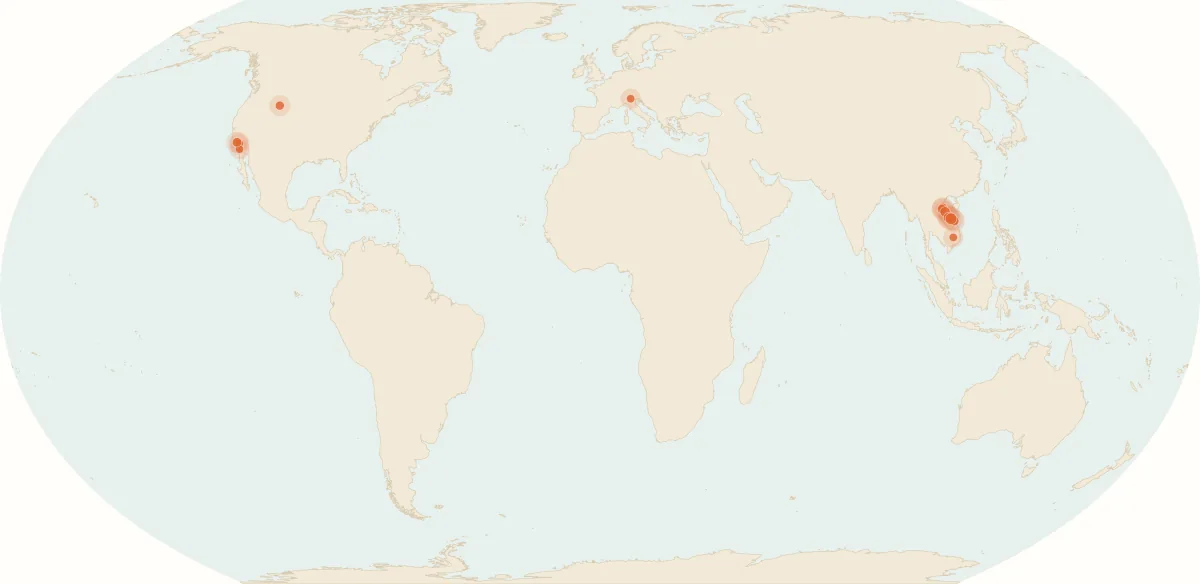
Records: GBIF.org (CC0 and CC BY 4.0 records, retrieved 2026-11-07). Map: Natural EarthSee the records on GBIF
Watch wild animals from a distance. Do not touch or feed them, and take care of the places where they live.
Names around the world
- 日本語
- コサンケイ
- 简体中文
- 爱氏鹇
- 繁體中文
- 愛氏鷴
- 한국어
- 쇠산계
- Español
- Faisán de Vietnam
- Français
- Faisan d'Edwards
- Deutsch
- Edwardsfasan
- Português (Brasil)
- Faisão-de-eduardo
- Italiano
- Fagiano di Edwards
- العربية
- تدرج إدواردس
- Tiếng Việt
- Gà lôi lam mào trắng
- Русский
- Лофура Эдвардса
Names come from Wikidata and iNaturalist records. Where a language has no recorded name, we use the scientific name.
Sources and how we check
- 上野動物園 — コサンケイChecked: 2026-11-03
- ZooParc de Trégomeur — Edwards’s PheasantChecked: 2026-11-07
- Toronto Zoo — Edwards’s pheasantChecked: 2026-11-07
- Emerald Park — Edwards pheasant / Vietnam pheasantChecked: 2026-11-07
We check each fact against its source. The illustrations simplify how the real animal looks.
The classification (class, order, family, genus) follows Wikidata records, checked against GBIF. Classifications can change as research goes on.
The basic data are the values given in each source. They vary with how the animal is measured, whether it is male or female, and whether it lives in the wild or in captivity.
This page was translated from the original Japanese with the help of AI.
Report a mistakeWhen you meet the Edwards's pheasant, look for this
- Look for the red legs that both males and females have.
Animals do different things from day to day, so you may not always see this.
Emerald ParkEXHIBIT INFORMATION
Places that keep or show the Edwards's pheasant
Zoos, aquariums and other places whose official websites say they keep or show this animal.
Displays can change with the animals’ health and the seasons. Check each facility’s official website before you go.
RELATIVES
Others in Phasianidae


MORE TO MEET


