Chinese bamboo partridge
Amazing fact
Female Chinese bamboo partridges incubate the eggs, and both parents raise the chicks.
上野動物園
No sign-up needed. You can save notes on this device.
An illustration based on the real animal.
A little discovery to share.
Female Chinese bamboo partridges incubate the eggs, and both parents raise the chicks.
THE REAL WORLD
The real Chinese bamboo partridge
- Scientific name
- Bambusicola thoracicus
- Japanese name
- コジュケイ
- Group
- Birds
- Class
- Aves
- Order
- Galliformes
- Family
- Phasianidae
- Genus
- Bambusicola
Originally from China, this member of the pheasant family was released in Japan for hunting and has settled there.
Unusually for the pheasant family, males and females have the same colors. Its body is round and its tail is short.
How the Chinese bamboo partridge lives
It eats leaves and seeds, as well as insects and spiders. It breeds from spring to early summer. It digs a hollow under low shrubs or bamboo grass and lines it with grass to make a nest.
上野動物園国立環境研究所Basic data
- Size
- Total length: 31 cm
- Weight
- 200–342 g
- Diet
- Leaves, seeds, insects, and spiders
- Range
- Southern China
Where the Chinese bamboo partridge has been recorded
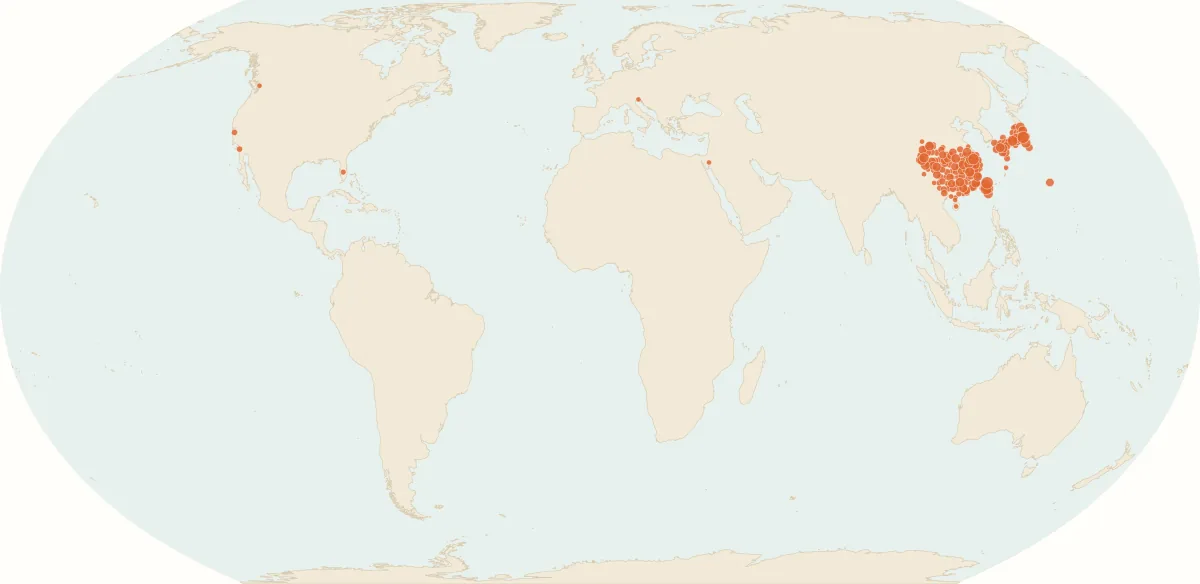
Records: GBIF.org (CC0 and CC BY 4.0 records, retrieved 2026-11-07). Map: Natural EarthSee the records on GBIF
Watch wild animals from a distance. Do not touch or feed them, and take care of the places where they live.
Names around the world
- 日本語
- コジュケイ
- 简体中文
- 灰胸竹鸡
- 繁體中文
- 灰胸竹雞
- 한국어
- 중국대나무자고새
- Español
- Bambusícola china
- Français
- Bambusicole de Chine
- Deutsch
- Graubrauen-Bambushuhn
- Português (Brasil)
- Perdiz-do-bambuzal-chinesa
- Italiano
- Pernice del bambù della Cina
- العربية
- حجل الخيزران الصيني
- বাংলা
- চীনা বাঁশবন-তিতির
Names come from Wikidata and iNaturalist records. Where a language has no recorded name, we use the scientific name.
Sources and how we check
- 上野動物園 — コジュケイChecked: 2026-11-03
- 国立環境研究所 — コジュケイChecked: 2026-11-05
We check each fact against its source. The illustrations simplify how the real animal looks.
The classification (class, order, family, genus) follows Wikidata records, checked against GBIF. Classifications can change as research goes on.
The basic data are the values given in each source. They vary with how the animal is measured, whether it is male or female, and whether it lives in the wild or in captivity.
This page was translated from the original Japanese with the help of AI.
Report a mistakeWhen you meet the Chinese bamboo partridge, look for this
- Look for the dark brown spots on its belly.
Animals do different things from day to day, so you may not always see this.
国立環境研究所EXHIBIT INFORMATION
Places that keep or show the Chinese bamboo partridge
Zoos, aquariums and other places whose official websites say they keep or show this animal.
Displays can change with the animals’ health and the seasons. Check each facility’s official website before you go.
RELATIVES
Others in Phasianidae


MORE TO MEET


