Crested ibis
Amazing fact
A crested ibis rubs shed dark skin from its neck onto its feathers, turning its head and back grey-black.
多摩動物公園
No sign-up needed. You can save notes on this device.
An illustration based on the real animal.
A little discovery to share.
A crested ibis rubs shed dark skin from its neck onto its feathers, turning its head and back grey-black.
THE REAL WORLD
The real Crested ibis
- Scientific name
- Nipponia nippon
- Japanese name
- トキ
- Group
- Birds
- Class
- Aves
- Order
- Pelecaniformes
- Family
- Threskiornithidae
- Genus
- Nipponia
Where the name “Crested ibis” comes from
The scientific name Nipponia nippon comes from “Nippon,” the Japanese name for Japan.
University of Michigan Animal Diversity WebIts wings are a pale orange-red known in Japanese as 'toki-iro' (ibis color). Its face is bare of feathers and red.
Its long, thin, down-curved bill helps it poke around in the mud to find the creatures living there.
By day it catches loaches, frogs and other creatures in shallow water such as rice paddies. When it gets dark, it rests up in the trees.
How the Crested ibis lives
It walks slowly through shallow mud, probing with its bill for food. After catching food, it shakes it in the water before swallowing. After the chicks hatch, the male and female raise them together.
University of Michigan Animal Diversity Web多摩動物公園Basic data
- Size
- Total length: about 75 cmWingspan: about 140 cm
- Weight
- about 1.5–2 kg
- Diet
- Loaches, freshwater crabs, frogs, freshwater snails, insects, and other foods
- Range
- Japan, China, and the Korean Peninsula
- Conservation status in Japan
- Endangered (EN)Ministry of the Environment of Japan, 5th Red List (2026)
Where the Crested ibis has been recorded
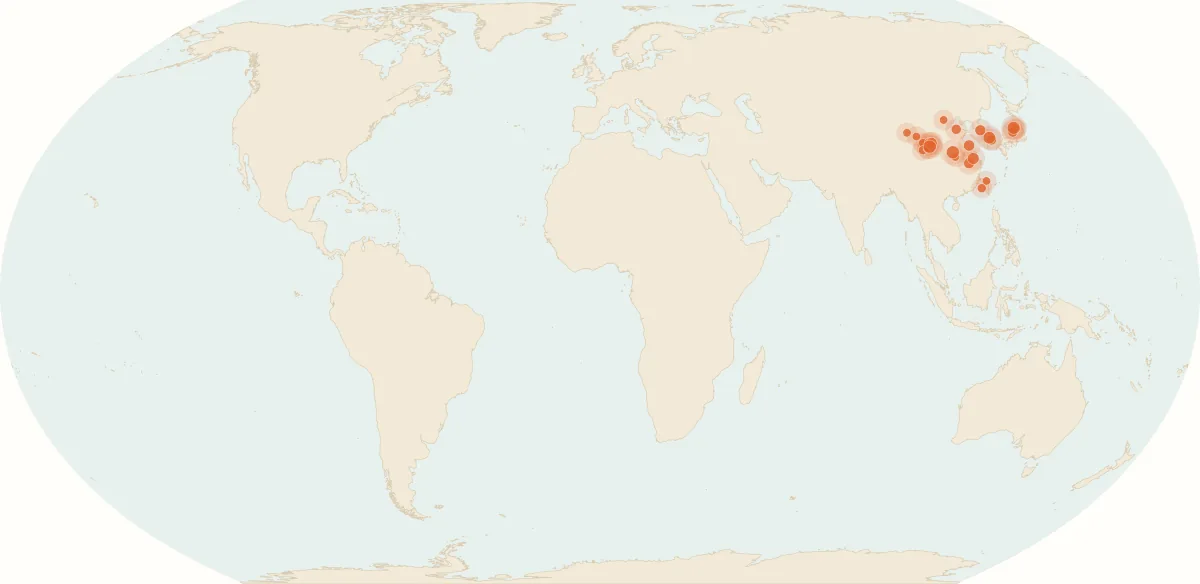
Records: GBIF.org (CC0 and CC BY 4.0 records, retrieved 2026-11-07). Map: Natural EarthSee the records on GBIF
Watch wild animals from a distance. Do not touch or feed them, and take care of the places where they live.
Names around the world
- 日本語
- トキ
- 简体中文
- 朱鹮
- 繁體中文
- 朱鷺
- 한국어
- 따오기
- Español
- Ibis nipón
- Français
- Ibis nippon
- Deutsch
- Nipponibis
- Português (Brasil)
- Íbis-de-crista
- Italiano
- Ibis giapponese
- العربية
- أبو منجل المتوج الياباني
- Русский
- Красноногий ибис
- Türkçe
- Asian crested ibis
Names come from Wikidata and iNaturalist records. Where a language has no recorded name, we use the scientific name.
Sources and how we check
- 多摩動物公園 — トキChecked: 2026-11-03
- University of Michigan Animal Diversity Web — Nipponia nipponChecked: 2026-11-03
- Ministry of the Environment of Japan, 5th Red List (2026)Checked: 2026-11-07
We check each fact against its source. The illustrations simplify how the real animal looks.
The classification (class, order, family, genus) follows Wikidata records, checked against GBIF. Classifications can change as research goes on.
The basic data are the values given in each source. They vary with how the animal is measured, whether it is male or female, and whether it lives in the wild or in captivity.
The conservation status in Japan is the category in the Red Lists of the Ministry of the Environment of Japan, which assess the risk of extinction for wild animals in Japan.
This page was translated from the original Japanese with the help of AI.
Report a mistakeWhen you meet the Crested ibis, look for this
- Look for the red tip of its bill.
Animals do different things from day to day, so you may not always see this.
University of Michigan Animal Diversity WebEXHIBIT INFORMATION
Places that keep or show the Crested ibis
Zoos, aquariums and other places whose official websites say they keep or show this animal.
Kanto
Displays can change with the animals’ health and the seasons. Check each facility’s official website before you go.
RELATIVES
Others in Threskiornithidae


MORE TO MEET


