Mountain hawk-eagle

No sign-up needed. You can save notes on this device.
An illustration based on the real animal.
A little discovery to share.
The mountain hawk-eagle swoops quickly from a tree to catch prey on the ground.
THE REAL WORLD
The real Mountain hawk-eagle
- Scientific name
- Nisaetus nipalensis
- Japanese name
- クマタカ
- Group
- Birds
- Class
- Aves
- Order
- Accipitriformes
- Family
- Accipitridae
- Genus
- Nisaetus
A member of the hawk family found in Japan, southern China, Nepal, the Indochinese Peninsula and other places.
A crest on its head is a key feature. Its tail and the undersides of its wings are striped black and white.
It hunts mammals and birds. It builds its nest in big trees, and in Japan it starts nest-building in winter.
How the Mountain hawk-eagle lives
It waits for prey in forest hiding places or in trees at the forest edge. It also searches the ground while flying slowly overhead. During the breeding season, it calls with a series of high notes.
上野動物園国土交通省中国地方整備局Basic data
- Size
- Total length: 67–86 cmWingspan: 130–165 cm
- Weight
- 1.8–3.5 kg
- Diet
- Small and medium-sized mammals and birds
- Range
- Japan, southern China, southern India, Nepal, and the Indochinese Peninsula
- Conservation status in Japan
- Endangered (EN)Assessed as Nisaetus nipalensis orientalisMinistry of the Environment of Japan, 5th Red List (2026)
Where the Mountain hawk-eagle has been recorded
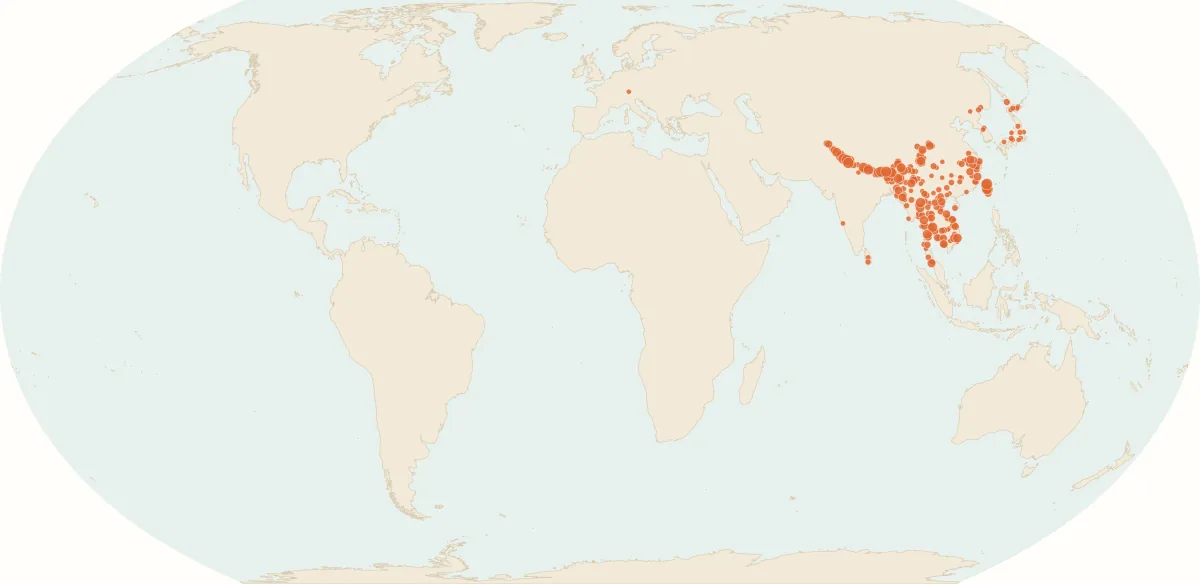
Records: GBIF.org (CC0 and CC BY 4.0 records, retrieved 2026-11-07). Map: Natural EarthSee the records on GBIF
Watch wild animals from a distance. Do not touch or feed them, and take care of the places where they live.
Names around the world
- 日本語
- クマタカ
- 简体中文
- 鹰雕
- 繁體中文
- 熊鷹
- 한국어
- 뿔매
- Español
- Águila-azor montañesa
- Français
- Aigle montagnard
- Deutsch
- Nepalhaubenadler
- Português (Brasil)
- Gavião-montês
- Italiano
- Aquila dal ciuffo di Hodgson
- العربية
- أفياء جبلي
- Tiếng Việt
- Diều núi
- Русский
- Горный хохлатый орёл
- Türkçe
- Nepal Atmaca Kartalı
- ไทย
- เหยี่ยวภูเขา
- বাংলা
- পাহাড়ি বাজ
Names come from Wikidata and iNaturalist records. Where a language has no recorded name, we use the scientific name.
Sources and how we check
- 上野動物園 — クマタカChecked: 2026-11-03
- 国土交通省中国地方整備局 — クマタカChecked: 2026-11-05
- Ministry of the Environment of Japan, 5th Red List (2026)Checked: 2026-11-07
We check each fact against its source. The illustrations simplify how the real animal looks.
The classification (class, order, family, genus) follows Wikidata records, checked against GBIF. Classifications can change as research goes on.
The basic data are the values given in each source. They vary with how the animal is measured, whether it is male or female, and whether it lives in the wild or in captivity.
The conservation status in Japan is the category in the Red Lists of the Ministry of the Environment of Japan, which assess the risk of extinction for wild animals in Japan.
This page was translated from the original Japanese with the help of AI.
Report a mistakeWhen you meet the Mountain hawk-eagle, look for this
- Look for spots and stripes on its white belly.
Animals do different things from day to day, so you may not always see this.
上野動物園EXHIBIT INFORMATION
Places that keep or show the Mountain hawk-eagle
Zoos, aquariums and other places whose official websites say they keep or show this animal.
Displays can change with the animals’ health and the seasons. Check each facility’s official website before you go.
RELATIVES
Others in Accipitridae


MORE TO MEET


