Walrus
Amazing fact
A walrus sometimes crushes shellfish open with its rounded teeth.
University of Michigan Animal Diversity Web
No sign-up needed. You can save notes on this device.
An illustration based on the real animal.
A little discovery to share.
A walrus sometimes crushes shellfish open with its rounded teeth.
THE REAL WORLD
The real Walrus
- Scientific name
- Odobenus rosmarus
- Japanese name
- セイウチ
- Group
- Ocean animals
- Class
- Mammalia
- Order
- Carnivora
- Family
- Odobenidae
- Genus
- Odobenus
This page covers the walrus as a species. Those living in the Pacific are treated as a subspecies, the Pacific walrus.
A large animal of icy Arctic seas. It prefers shallow water, where food is easy to reach.
Its long tusks are upper canine teeth that have grown long. They are used for fighting and defense, and also for climbing out onto the ice.
It searches the sea floor for food using its whiskers and snout, and when it finds a clam, it sucks out the soft insides.
How the Walrus lives
It swims using its hind flippers for propulsion and its front flippers to steer. It comes ashore on rocky or sandy beaches to rest and sleep. It migrates north in summer and south in winter.
University of Michigan Animal Diversity WebBasic data
- Size
- 270–320 cm, average 300 cmUniversity of Michigan Animal Diversity Web
- Weight
- 600–1,500 kg, average 1,000 kgUniversity of Michigan Animal Diversity Web
- Lifespan
- 30–40 years in the wild, up to 30 years in captivityUniversity of Michigan Animal Diversity Web
- Diet
- Small invertebrates, especially bivalve mollusksUniversity of Michigan Animal Diversity Web
- Range
- Arctic Ocean鳥羽水族館
Where the Walrus has been recorded
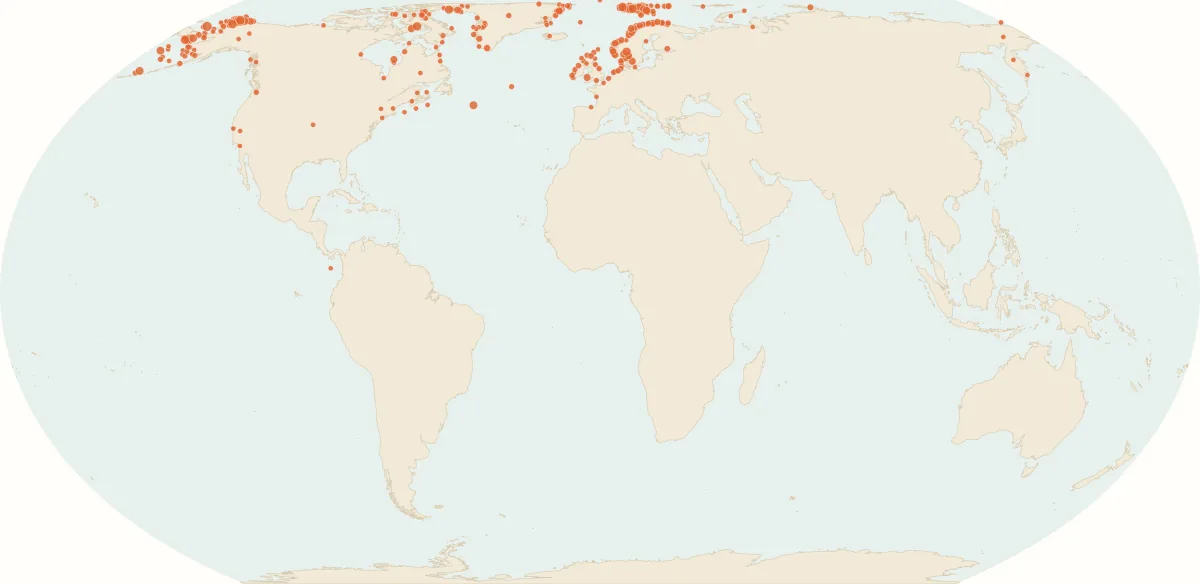
Records: GBIF.org (CC0 and CC BY 4.0 records, retrieved 2026-11-07). Map: Natural EarthSee the records on GBIF
Watch wild animals from a distance. Do not touch or feed them, and take care of the places where they live.
Names around the world
- 日本語
- セイウチ
- 简体中文
- 海象
- 繁體中文
- 海象
- 한국어
- 바다코끼리
- Español
- Morsa
- Français
- Morse
- Deutsch
- Walross
- Português (Brasil)
- Morsa
- Italiano
- Tricheco
- हिन्दी
- वालरस
- العربية
- فظ
- Bahasa Indonesia
- Walrus
- Tiếng Việt
- Hải tượng
- Русский
- Морж
- Türkçe
- Mors
- ไทย
- วอลรัส
- বাংলা
- সিন্ধুঘোটক
Names come from Wikidata and iNaturalist records. Where a language has no recorded name, we use the scientific name.
Sources and how we check
- 鳥羽水族館 — タイヘイヨウセイウチChecked: 2026-11-03
- University of Michigan Animal Diversity Web — Odobenus rosmarusChecked: 2026-11-03
We check each fact against its source. The illustrations simplify how the real animal looks.
The classification (class, order, family, genus) follows Wikidata records, checked against GBIF. Classifications can change as research goes on.
The basic data are the values given in each source. They vary with how the animal is measured, whether it is male or female, and whether it lives in the wild or in captivity.
This page was translated from the original Japanese with the help of AI.
Report a mistakeRELATIVES
Others in Carnivora


MORE TO MEET


