White-naped crane
Amazing fact
When white-naped cranes call together as a pair, the male raises his wings while the female keeps hers folded at her sides.
Smithsonian National Zoo
No sign-up needed. You can save notes on this device.
An illustration based on the real animal.
A little discovery to share.
When white-naped cranes call together as a pair, the male raises his wings while the female keeps hers folded at her sides.
THE REAL WORLD
The real White-naped crane
- Scientific name
- Grus vipio
- Japanese name
- マナヅル
- Group
- Birds
- Class
- Aves
- Order
- Gruiformes
- Family
- Gruidae
- Genus
- Grus
It raises its young in marshes and other places in northeastern China and Mongolia, and flies to Japan and other places for the winter.
Its body is grey, the back of its neck up to the back of its head is white, and the area around its eyes is red.
How the White-naped crane lives
They dig up and eat the swollen underground parts of sedges. In spring, they use nests made of piled-up dried sedges and grasses in open wetlands. Males and females both build the nest and incubate the eggs. Both parents feed the chicks.
Smithsonian National ZooBasic data
- Size
- Total length: about 125 cmWingspan: 200–210 cm
- Weight
- 4.8–6.5 kg
- Diet
- Grass roots, rhizomes, seeds, insects, fish, frogs, and rodents
- Range
- Northeastern China, Mongolia, southeastern Russia, and elsewhere
- Conservation status in Japan
- Vulnerable (VU)Assessed as Antigone vipioMinistry of the Environment of Japan, 5th Red List (2026)
Where the White-naped crane has been recorded
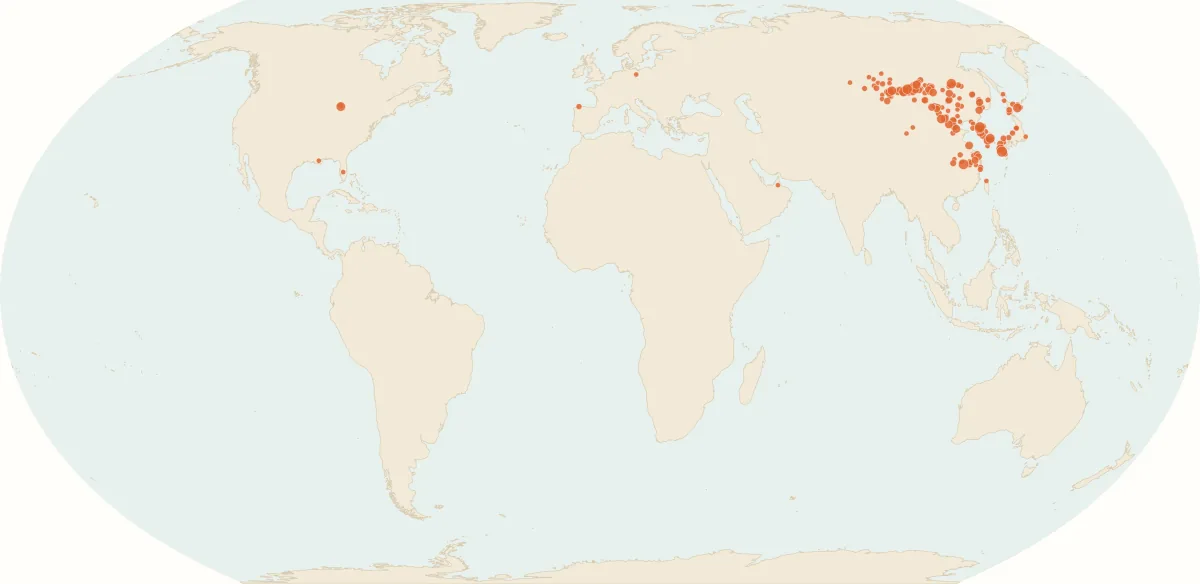
Records: GBIF.org (CC0 and CC BY 4.0 records, retrieved 2026-11-07). Map: Natural EarthSee the records on GBIF
Watch wild animals from a distance. Do not touch or feed them, and take care of the places where they live.
Names around the world
- 日本語
- マナヅル
- 简体中文
- 白枕鹤
- 繁體中文
- 白枕鶴
- 한국어
- 재두루미
- Español
- Grulla cuelliblanca
- Français
- Grue à cou blanc
- Deutsch
- Weißnackenkranich
- Português (Brasil)
- Grou-de-nuca-branca
- Italiano
- Gru nucabianca
- Русский
- Даурский журавль
Names come from Wikidata and iNaturalist records. Where a language has no recorded name, we use the scientific name.
Sources and how we check
- 多摩動物公園 — マナヅルChecked: 2026-11-03
- Smithsonian National Zoo — White-naped craneChecked: 2026-11-06
- Ministry of the Environment of Japan, 5th Red List (2026)Checked: 2026-11-07
We check each fact against its source. The illustrations simplify how the real animal looks.
The classification (class, order, family, genus) follows Wikidata records, checked against GBIF. Classifications can change as research goes on.
The basic data are the values given in each source. They vary with how the animal is measured, whether it is male or female, and whether it lives in the wild or in captivity.
The conservation status in Japan is the category in the Red Lists of the Ministry of the Environment of Japan, which assess the risk of extinction for wild animals in Japan.
This page was translated from the original Japanese with the help of AI.
Report a mistakeRELATIVES
Others in Gruidae


MORE TO MEET


