Masked palm civet
Amazing fact
A masked palm civet has white marks above and below its eyes as well as a white stripe from head to nose.
University of Michigan Animal Diversity Web
No sign-up needed. You can save notes on this device.
An illustration based on the real animal.
A little discovery to share.
A masked palm civet has white marks above and below its eyes as well as a white stripe from head to nose.
THE REAL WORLD
The real Masked palm civet
- Scientific name
- Paguma larvata
- Japanese name
- ハクビシン
- Group
- Land mammals
- Class
- Mammalia
- Order
- Carnivora
- Family
- Viverridae
- Genus
- Paguma
It belongs to the civet family. The ones living in Japan turned out to descend from animals that came from Taiwan through human activity.
The white stripe along its nose gives it its kanji name, meaning “white nose line.” It has rough soles and is good at climbing trees.
It is nocturnal and usually rests in trees or thickets during the day. It is often found near places where people live.
How the Masked palm civet lives
It eats mainly fruit, as well as insects and small vertebrates. It builds no nest in its daytime resting places and does not reuse them. It lives alone.
University of Michigan Animal Diversity WebBasic data
- Size
- Head and body length: about 60 cm井の頭自然文化園
- Lifespan
- up to 20 years in captivityUniversity of Michigan Animal Diversity Web
- Active
- At night (nocturnal)井の頭自然文化園
- Diet
- Fruit, seeds, and small animals such as insects井の頭自然文化園
Where the Masked palm civet has been recorded
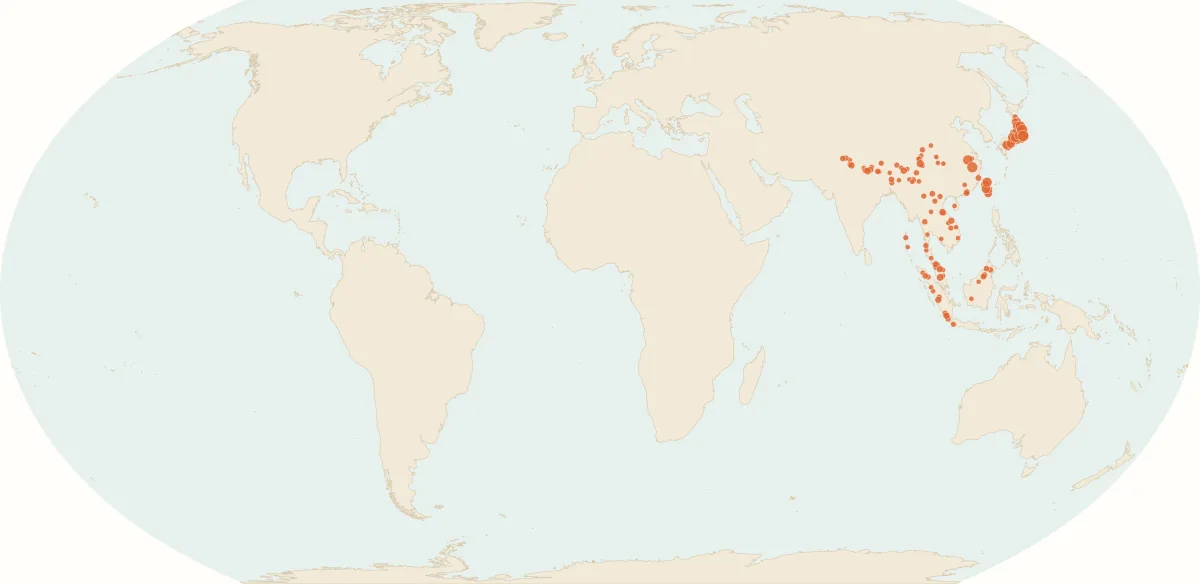
Records: GBIF.org (CC0 and CC BY 4.0 records, retrieved 2026-11-07). Map: Natural EarthSee the records on GBIF
Watch wild animals from a distance. Do not touch or feed them, and take care of the places where they live.
Names around the world
- 日本語
- ハクビシン
- 简体中文
- 果子狸
- 繁體中文
- 花面貍
- 한국어
- 가면팜사향고양이
- Français
- Civette palmiste à masque
- Deutsch
- Larvenroller
- Português (Brasil)
- Civeta-Mascarada
- Italiano
- Civetta delle palme mascherata
- العربية
- زباد النخل المقنع
- Bahasa Indonesia
- Musang galing
- Tiếng Việt
- Cầy vòi mốc
- Русский
- Гималайская цивета
- ไทย
- อีเห็นเครือ
- বাংলা
- মুখোশধারী গন্ধগোকুল
Names come from Wikidata and iNaturalist records. Where a language has no recorded name, we use the scientific name.
Sources and how we check
- 井の頭自然文化園 — ハクビシンChecked: 2026-11-03
- University of Michigan Animal Diversity Web — Paguma larvataChecked: 2026-11-03
We check each fact against its source. The illustrations simplify how the real animal looks.
The classification (class, order, family, genus) follows Wikidata records, checked against GBIF. Classifications can change as research goes on.
The basic data are the values given in each source. They vary with how the animal is measured, whether it is male or female, and whether it lives in the wild or in captivity.
This page was translated from the original Japanese with the help of AI.
Report a mistakeWhen you meet the Masked palm civet, look for this
- Look for its blackish feet.
Animals do different things from day to day, so you may not always see this.
University of Michigan Animal Diversity WebEXHIBIT INFORMATION
Places that keep or show the Masked palm civet
Zoos, aquariums and other places whose official websites say they keep or show this animal.
Kanto
Displays can change with the animals’ health and the seasons. Check each facility’s official website before you go.
RELATIVES
Others in Carnivora


MORE TO MEET


