Kawakawa

No sign-up needed. You can save notes on this device.
An illustration based on the real animal.
A little discovery to share.
The kawakawa extends fins tucked into grooves in its body when it turns.
THE REAL WORLD
The real Kawakawa
- Scientific name
- Euthynnus affinis
- Japanese name
- スマ
- Group
- Ocean animals
- Order
- Scombriformes
- Family
- Scombridae
- Genus
- Euthynnus
Where the name “Kawakawa” comes from
It is also called “yaito” because the dark spots near its pectoral fin resemble moxibustion marks.
新潟市水族館 マリンピア日本海It keeps swimming its whole life. When swimming fast, it tucks some of its fins into grooves in its body to cut down water resistance.
It catches small fish such as horse mackerel and sardines, as well as squid, and swallows them whole.
How the Kawakawa lives
It swims from the surface to the middle waters near shore. It does not often form large schools.
葛西臨海水族園名古屋港水族館Basic data
- Size
- Total length: 100 cm
- Diet
- Small fish and squid
- Range
- Temperate to tropical Indian and Pacific Oceans
Where the Kawakawa has been recorded
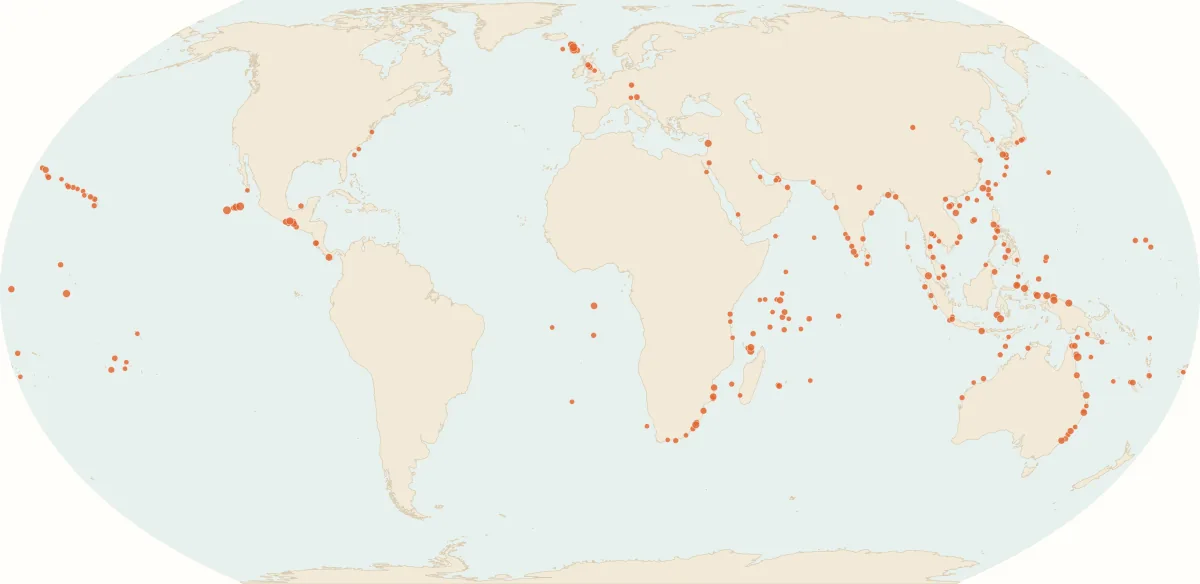
Records: GBIF.org (CC0 and CC BY 4.0 records, retrieved 2026-11-07). Map: Natural EarthSee the records on GBIF
Watch wild animals from a distance. Do not touch or feed them, and take care of the places where they live.
Names around the world
- 日本語
- スマ
- 简体中文
- 巴鲣
- 繁體中文
- 巴鰹
- 한국어
- 점다랑어
- Español
- Bacoreta Oriental
- Français
- Bonite
- Italiano
- Tonnetto indopacifico
- العربية
- بلاميطة
- Bahasa Indonesia
- Tongkol
- Русский
- Малый восточный тунец
- ไทย
- ปลาโอลาย
Names come from Wikidata and iNaturalist records. Where a language has no recorded name, we use the scientific name.
Sources and how we check
- 葛西臨海水族園 — スマChecked: 2026-11-03
- 名古屋港水族館 — スマChecked: 2026-11-05
- 新潟市水族館 マリンピア日本海 — スマChecked: 2026-11-05
We check each fact against its source. The illustrations simplify how the real animal looks.
The classification (class, order, family, genus) follows Wikidata records, checked against GBIF. Classifications can change as research goes on.
The basic data are the values given in each source. They vary with how the animal is measured, whether it is male or female, and whether it lives in the wild or in captivity.
This page was translated from the original Japanese with the help of AI.
Report a mistakeWhen you meet the Kawakawa, look for this
- Look for the black spots below its pectoral fin.
Animals do different things from day to day, so you may not always see this.
名古屋港水族館EXHIBIT INFORMATION
Places that keep or show the Kawakawa
Zoos, aquariums and other places whose official websites say they keep or show this animal.
Kanto
Displays can change with the animals’ health and the seasons. Check each facility’s official website before you go.
RELATIVES
Others in Scombridae


MORE TO MEET


