Indian mackerel

No sign-up needed. You can save notes on this device.
An illustration based on the real animal.
A little discovery to share.
Indian mackerel gather plankton to eat by opening their mouths wide.
THE REAL WORLD
The real Indian mackerel
- Scientific name
- Rastrelliger kanagurta
- Japanese name
- グルクマ
- Group
- Ocean animals
- Order
- Scombriformes
- Family
- Scombridae
- Genus
- Rastrelliger
Where the name “Indian mackerel” comes from
The Japanese name gurukuma comes from gurukumaa, its name in Okinawa.
新潟市水族館 マリンピア日本海Adults live in coastal bays, harbors and lagoons, forming schools in murky water rich in plankton.
How the Indian mackerel lives
They swim around near the surface in coastal waters. They are thought to spawn in the sea around the Andaman Islands. They are thought to release their eggs in batches during the spawning season.
新潟市水族館 マリンピア日本海Indian Council of Agricultural ResearchBasic data
- Diet
- Phytoplankton (diatoms) and small zooplankton
- Range
- Yakushima, Ryukyu Islands, Guangdong, Hainan, and Indo-West Pacific
Where the Indian mackerel has been recorded
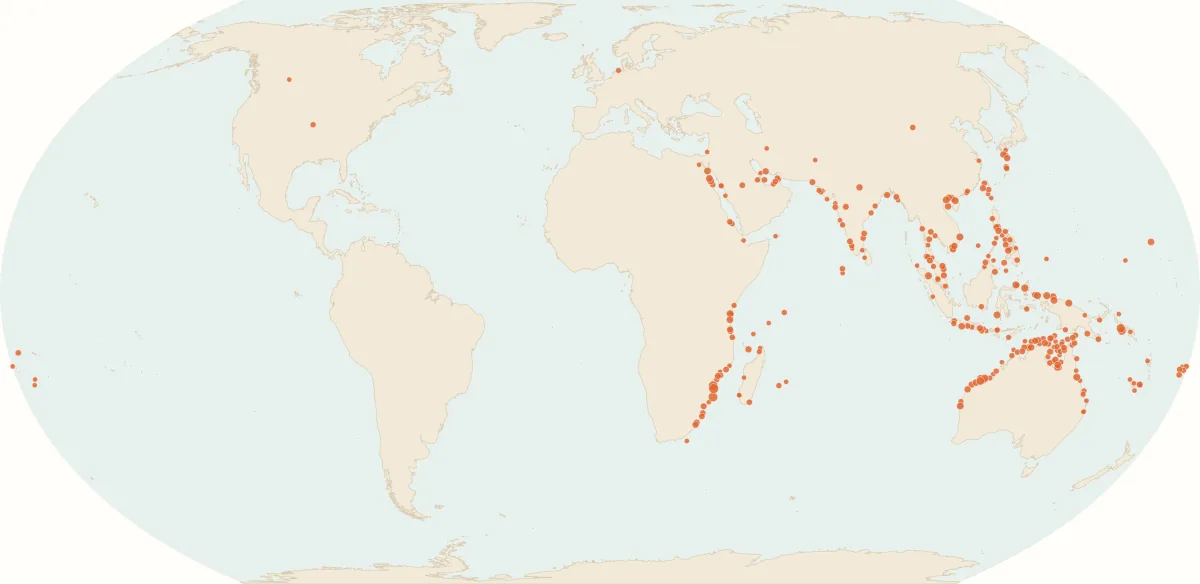
Records: GBIF.org (CC0 and CC BY 4.0 records, retrieved 2026-11-07). Map: Natural EarthSee the records on GBIF
Watch wild animals from a distance. Do not touch or feed them, and take care of the places where they live.
Names around the world
- 日本語
- グルクマ
- 简体中文
- 羽鳃鲐
- 繁體中文
- 金帶花鯖
- 한국어
- 줄무늬고등어
- Español
- Caballa de la India
- Français
- Maquereau de l'Indo-Pacifique
- Deutsch
- Indische Makrele
- Português (Brasil)
- Bonito-anão-do-Indo-Pacífico
- Italiano
- Sgombro indopacifico
- العربية
- سمكة القرفة الهندية
- Bahasa Indonesia
- Kembung lelaki
- Tiếng Việt
- Cá bạc má
- Türkçe
- Hint Uskumrusu
- ไทย
- ปลาลัง
- اردو
- بانگڑہ مچھلی
Names come from Wikidata and iNaturalist records. Where a language has no recorded name, we use the scientific name.
Sources and how we check
- 鳥羽水族館 — グルクマChecked: 2026-11-04
- 新潟市水族館 マリンピア日本海 — グルクマChecked: 2026-11-07
- 海遊館 — グルクマChecked: 2026-11-07
- Indian Council of Agricultural Research — OBSERVATIONS ON THE BIOLOGY AND FISHERY OF THE INDIAN MACKEREL RASTRELUGER KANAGURTA (CUVIER) FROM ANDAMAN ISLANDSChecked: 2026-11-07
We check each fact against its source. The illustrations simplify how the real animal looks.
The classification (class, order, family, genus) follows Wikidata records, checked against GBIF. Classifications can change as research goes on.
The basic data are the values given in each source. They vary with how the animal is measured, whether it is male or female, and whether it lives in the wild or in captivity.
This page was translated from the original Japanese with the help of AI.
Report a mistakeRELATIVES
Others in Scombridae


MORE TO MEET


