Siberian chipmunk
Amazing fact
Siberian chipmunks groom themselves from back to tail and sometimes clean another chipmunk.
University of Michigan Animal Diversity Web
No sign-up needed. You can save notes on this device.
An illustration based on the real animal.
A little discovery to share.
Siberian chipmunks groom themselves from back to tail and sometimes clean another chipmunk.
THE REAL WORLD
The real Siberian chipmunk
- Scientific name
- Tamias sibiricus
- Japanese name
- シマリス
- Group
- Land mammals
- Class
- Mammalia
- Order
- Rodentia
- Family
- Sciuridae
- Genus
- Tamias
This page covers the Siberian chipmunk as a species; those living in Hokkaido are treated as the subspecies Ezo chipmunk.
A chipmunk of the forests of Russia, northeastern China, the Korean Peninsula and nearby areas; in Japan it is native to Hokkaido.
It has stripes running down its back, and its head is gray to reddish brown with small spots.
In autumn it stores lots of nuts and seeds in its underground nest, then hibernates, waking now and then to eat.
How the Siberian chipmunk lives
They are active during the day and sleep at night. They eat fungi, fruit and insects, among other foods. They live mainly on forest floors with plenty of cover and are also skilled climbers. They give birth from spring to summer.
University of Michigan Animal Diversity Web国立環境研究所 侵入生物DBBasic data
- Size
- 12–17 cmUniversity of Michigan Animal Diversity Web
- Weight
- 50–150 gUniversity of Michigan Animal Diversity Web
- Active
- By day (diurnal)University of Michigan Animal Diversity Web
- Diet
- Seeds of trees and grasses, insects, land snails and others国立環境研究所 侵入生物DB
Where the Siberian chipmunk has been recorded
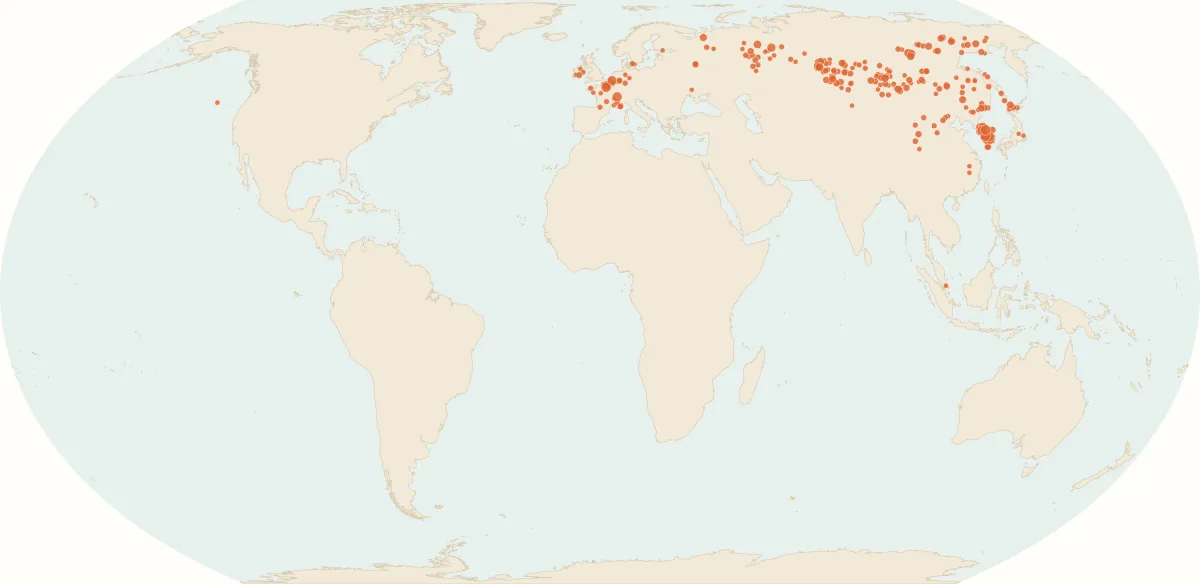
Records: GBIF.org (CC0 and CC BY 4.0 records, retrieved 2026-11-07). Map: Natural EarthSee the records on GBIF
Watch wild animals from a distance. Do not touch or feed them, and take care of the places where they live.
Names around the world
- 日本語
- シマリス
- 简体中文
- 北花松鼠
- 繁體中文
- 花鼠
- 한국어
- 시베리아다람쥐
- Español
- Ardilla de Siberia
- Français
- Tamia strié, tamia de sibérie
- Deutsch
- Burunduk
- Português (Brasil)
- Esquilo-da-sibéria
- Italiano
- Tamia siberiano
- العربية
- صيدناني سيبيري
- Русский
- Азиатский бурундук
- Türkçe
- Sibirya orman gelengisi
Names come from Wikidata and iNaturalist records. Where a language has no recorded name, we use the scientific name.
Sources and how we check
- 国立環境研究所 侵入生物DB — シマリスChecked: 2026-11-03
- University of Michigan Animal Diversity Web — Tamias sibiricusChecked: 2026-11-03
We check each fact against its source. The illustrations simplify how the real animal looks.
The classification (class, order, family, genus) follows Wikidata records, checked against GBIF. Classifications can change as research goes on.
The basic data are the values given in each source. They vary with how the animal is measured, whether it is male or female, and whether it lives in the wild or in captivity.
This page was translated from the original Japanese with the help of AI.
Report a mistakeRELATIVES
Others in Sciuridae


MORE TO MEET


