Japanese giant flying squirrel
Amazing fact
The Japanese giant flying squirrel stretches to reach distant branches without moving its hind feet.
University of Michigan Animal Diversity Web
No sign-up needed. You can save notes on this device.
An illustration based on the real animal.
A little discovery to share.
The Japanese giant flying squirrel stretches to reach distant branches without moving its hind feet.
THE REAL WORLD
The real Japanese giant flying squirrel
- Scientific name
- Petaurista leucogenys
- Japanese name
- ムササビ
- Group
- Land mammals
- Class
- Mammalia
- Order
- Rodentia
- Family
- Sciuridae
- Genus
- Petaurista
It lives on Honshu, Shikoku and Kyushu in Japan, and often lives in the woods around shrines and temples.
It is a kind of squirrel that glides from tree to tree by spreading the gliding membrane between its front legs, hind legs and tail.
It is nocturnal and spends the day resting in nests it makes in tree hollows; it keeps several nests.
How the Japanese giant flying squirrel lives
It often starts its activity after sunset. It grips slender branches with its forepaws. In winter, it eats buds and cones.
多摩動物公園University of Michigan Animal Diversity WebBasic data
- Size
- Head and body length: 30–45 cm
- Weight
- 800–1,000 g
- Active
- At night (nocturnal)
- Diet
- Tree buds, leaves, fruit, and flowers
- Range
- Japan, the Korean Peninsula, China, the Malay Peninsula, and elsewhere
Where the Japanese giant flying squirrel has been recorded
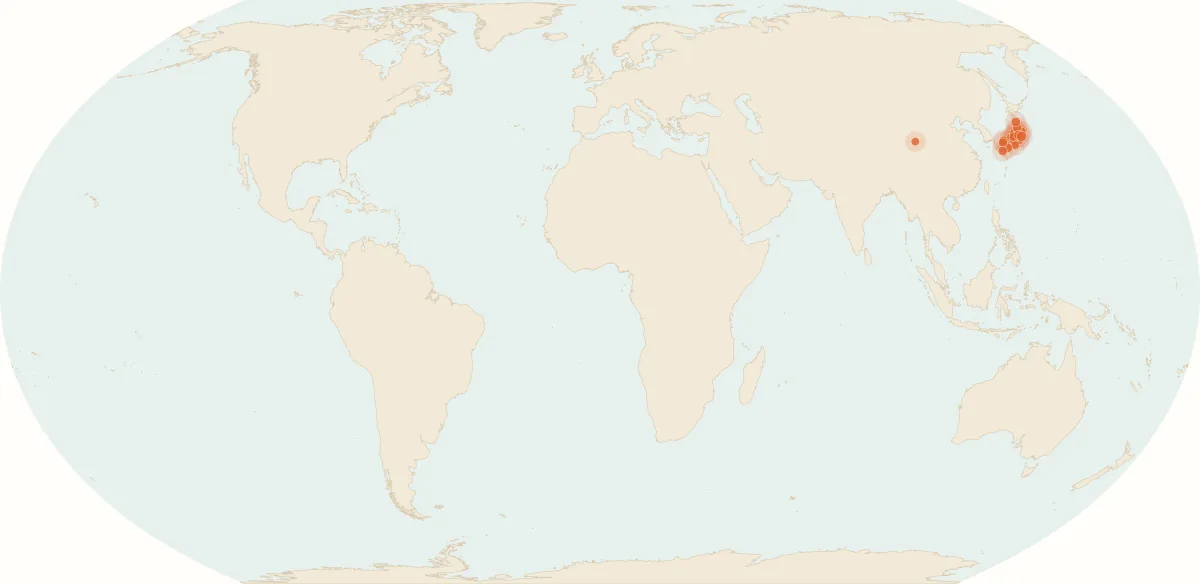
Records: GBIF.org (CC0 and CC BY 4.0 records, retrieved 2026-11-07). Map: Natural EarthSee the records on GBIF
Watch wild animals from a distance. Do not touch or feed them, and take care of the places where they live.
Names around the world
- 日本語
- ムササビ
- 简体中文
- 白颊鼯鼠
- 繁體中文
- 白頰鼯鼠
- 한국어
- 일본자이언트날다람쥐
- Italiano
- Petaurista del Giappone
- Русский
- Японская гигантская летяга
Names come from Wikidata and iNaturalist records. Where a language has no recorded name, we use the scientific name.
Sources and how we check
- 多摩動物公園 — ムササビChecked: 2026-11-03
- University of Michigan Animal Diversity Web — Petaurista leucogenysChecked: 2026-11-03
We check each fact against its source. The illustrations simplify how the real animal looks.
The classification (class, order, family, genus) follows Wikidata records, checked against GBIF. Classifications can change as research goes on.
The basic data are the values given in each source. They vary with how the animal is measured, whether it is male or female, and whether it lives in the wild or in captivity.
This page was translated from the original Japanese with the help of AI.
Report a mistakeWhen you meet the Japanese giant flying squirrel, look for this
- Look for the black bands around its eyes.
Animals do different things from day to day, so you may not always see this.
University of Michigan Animal Diversity WebEXHIBIT INFORMATION
Places that keep or show the Japanese giant flying squirrel
Zoos, aquariums and other places whose official websites say they keep or show this animal.
Kanto
Displays can change with the animals’ health and the seasons. Check each facility’s official website before you go.
RELATIVES
Others in Sciuridae


MORE TO MEET


