African wild dog
Amazing fact
The African wild dog’s scientific name means painted wolf.
University of Michigan Animal Diversity Web
No sign-up needed. You can save notes on this device.
An illustration based on the real animal.
A little discovery to share.
The African wild dog’s scientific name means painted wolf.
THE REAL WORLD
The real African wild dog
- Scientific name
- Lycaon pictus
- Japanese name
- リカオン
- Group
- Land mammals
- Class
- Mammalia
- Order
- Carnivora
- Family
- Canidae
- Genus
- Lycaon
It lives on the grasslands and savannas of Africa south of the Sahara, in groups called packs.
Its fur looks painted with patches of brown, black, yellow and white, and each dog's pattern is different. Its ears are large and rounded.
Pack members hunt together as a team, and males and females share both the hunting and the raising of the pups.
How the African wild dog lives
It is mainly active by day and hunts in the morning and early evening. It finds prey by sight and chases it. After a hunt, it regurgitates food for the pups.
University of Michigan Animal Diversity WebBasic data
- Size
- Body length: 80–110 cmよこはま動物園ズーラシア
- Weight
- 18–36 kgよこはま動物園ズーラシア
- Active
- By day (diurnal)University of Michigan Animal Diversity Web
- Range
- Grasslands and savannas of Africa south of the Saharaよこはま動物園ズーラシア
Where the African wild dog has been recorded
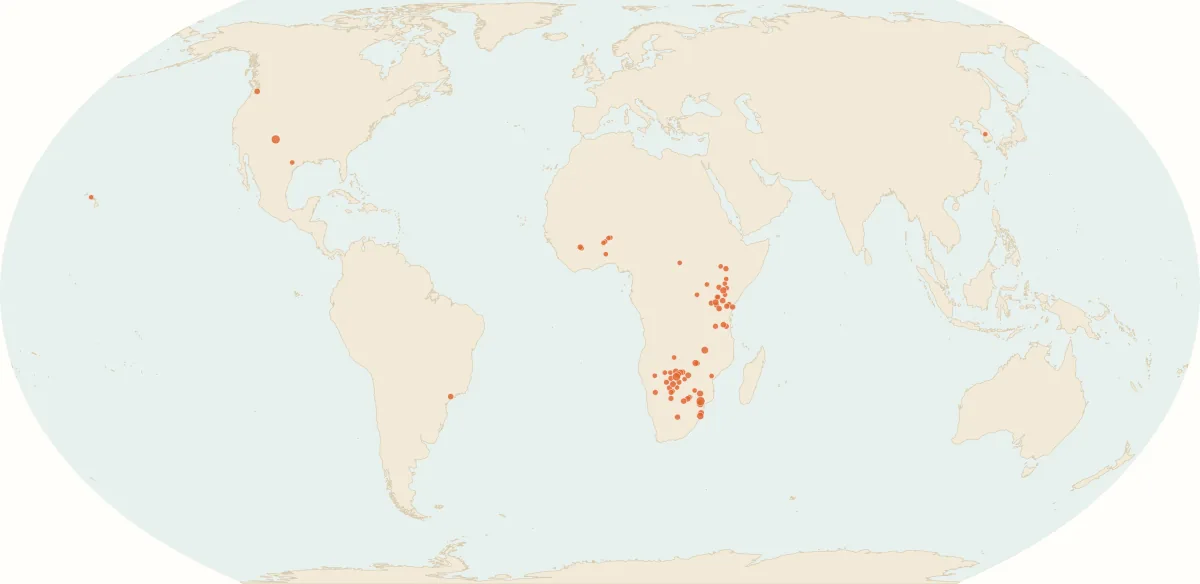
Records: GBIF.org (CC0 and CC BY 4.0 records, retrieved 2026-11-07). Map: Natural EarthSee the records on GBIF
Watch wild animals from a distance. Do not touch or feed them, and take care of the places where they live.
Names around the world
- 日本語
- リカオン
- 简体中文
- 非洲野犬
- 繁體中文
- 非洲野犬
- 한국어
- 리카온
- Español
- Licaón
- Français
- Cynhyene
- Deutsch
- Afrikanischer Wildhund
- Português (Brasil)
- Mabeco
- Italiano
- Licaone
- हिन्दी
- अफ़्रीकी जंगली कुत्ता
- العربية
- السِّمْعُ
- Bahasa Indonesia
- Iganyana
- Tiếng Việt
- Chó hoang châu Phi
- Русский
- Гиеновидная собака
- Türkçe
- Afrika yaban köpeği
- বাংলা
- আফ্রিকান বন্য কুকুর
Names come from Wikidata and iNaturalist records. Where a language has no recorded name, we use the scientific name.
Sources and how we check
- よこはま動物園ズーラシア — リカオンChecked: 2026-11-03
- University of Michigan Animal Diversity Web — Lycaon pictusChecked: 2026-11-03
We check each fact against its source. The illustrations simplify how the real animal looks.
The classification (class, order, family, genus) follows Wikidata records, checked against GBIF. Classifications can change as research goes on.
The basic data are the values given in each source. They vary with how the animal is measured, whether it is male or female, and whether it lives in the wild or in captivity.
This page was translated from the original Japanese with the help of AI.
Report a mistakeRELATIVES
Others in Canidae


MORE TO MEET


