
No sign-up needed. You can save notes on this device.
An illustration based on the real animal.
A little discovery to share.
A degu’s teeth are orange.
THE REAL WORLD
The real Degu
- Scientific name
- Octodon degus
- Japanese name
- デグー
- Group
- Land mammals
- Class
- Mammalia
- Order
- Rodentia
- Family
- Octodontidae
- Genus
- Octodon
In the hills of central Chile, it lives in small groups and digs complex burrows in the ground.
Its back is yellowish brown, it has a pale ring around each eye, and its tail has a tuft of hair.
It eats grasses, bark and seeds, and uses different calls to communicate with its companions.
How the Degu lives
It is active during the day, especially in the morning and evening. It sometimes climbs into shrub branches while looking for food. It rolls in sand to take a dust bath. Degus sleep close together.
University of Michigan Animal Diversity WebSmithsonian National ZooBasic data
- Size
- 325–440 mmUniversity of Michigan Animal Diversity Web
- Weight
- 170–300 gUniversity of Michigan Animal Diversity Web
- Active
- By day (diurnal)University of Michigan Animal Diversity Web
- Diet
- Grass, bark, seeds and others長崎バイオパーク
- Range
- Central Chile埼玉県こども動物自然公園
Where the Degu has been recorded
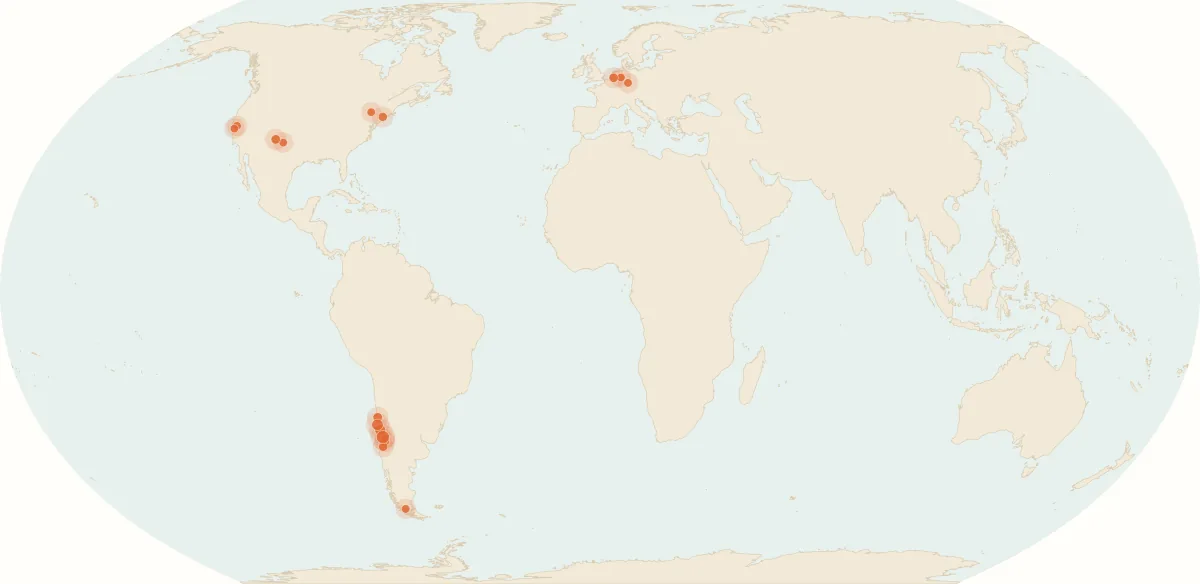
Records: GBIF.org (CC0 and CC BY 4.0 records, retrieved 2026-11-07). Map: Natural EarthSee the records on GBIF
Watch wild animals from a distance. Do not touch or feed them, and take care of the places where they live.
Names around the world
- 日本語
- デグー
- 简体中文
- 智利八齿鼠
- 繁體中文
- 智利八齒鼠
- 한국어
- 데구
- Español
- Degú
- Deutsch
- Gemeiner Degu
- Italiano
- Degu
- العربية
- داغي شائع
- Bahasa Indonesia
- Degu
- Русский
- Дегу
Names come from Wikidata and iNaturalist records. Where a language has no recorded name, we use the scientific name.
Sources and how we check
- 埼玉県こども動物自然公園 — デグーChecked: 2026-11-03
- 長崎バイオパーク — デグーChecked: 2026-11-03
- University of Michigan Animal Diversity Web — Octodon degusChecked: 2026-11-03
- Smithsonian National Zoo — DeguChecked: 2026-11-05
We check each fact against its source. The illustrations simplify how the real animal looks.
The classification (class, order, family, genus) follows Wikidata records, checked against GBIF. Classifications can change as research goes on.
The basic data are the values given in each source. They vary with how the animal is measured, whether it is male or female, and whether it lives in the wild or in captivity.
This page was translated from the original Japanese with the help of AI.
Report a mistakeRELATIVES
Others in Rodentia


MORE TO MEET


