Patagonian mara

No sign-up needed. You can save notes on this device.
An illustration based on the real animal.
A little discovery to share.
Patagonian maras share burrows with other pairs to raise their young.
THE REAL WORLD
The real Patagonian mara
- Scientific name
- Dolichotis patagonum
- Japanese name
- マーラ
- Group
- Land mammals
- Class
- Mammalia
- Order
- Rodentia
- Family
- Caviidae
- Genus
- Dolichotis
Where the name “Patagonian mara” comes from
The genus name Dolichotis means “long ear”.
University of Michigan Animal Diversity WebIt looks like a rabbit or a deer, but it is a close relative of guinea pigs. It lives in the grasslands and other open country of Argentina.
With its long legs it can run very fast. Its ears are long, like a rabbit's.
Unusually for a rodent, a male and female are said to stay paired for life, and they take turns keeping watch while they feed.
How the Patagonian mara lives
They are active by day and travel in male-female pairs. They eat cacti as well as grass. Pairs take turns visiting the den to nurse their young.
University of Michigan Animal Diversity WebBasic data
- Size
- Head and body length: about 70 cm井の頭自然文化園
- Active
- By day (diurnal)University of Michigan Animal Diversity Web
- Diet
- Grass井の頭自然文化園
- Range
- Mainly Argentina井の頭自然文化園
Where the Patagonian mara has been recorded
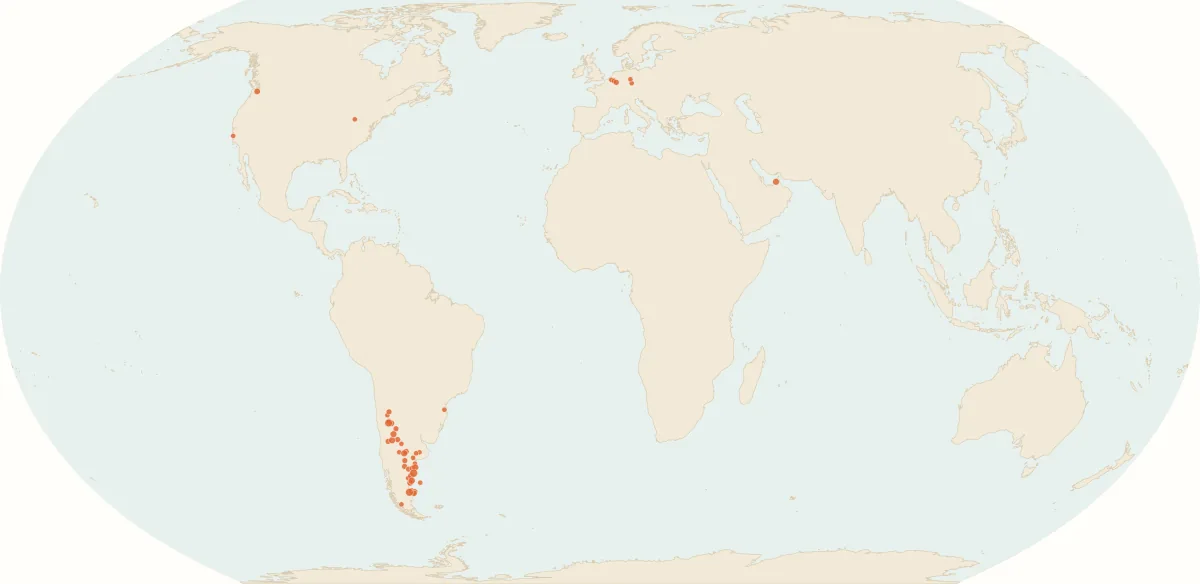
Records: GBIF.org (CC0 and CC BY 4.0 records, retrieved 2026-11-07). Map: Natural EarthSee the records on GBIF
Watch wild animals from a distance. Do not touch or feed them, and take care of the places where they live.
Names around the world
- 日本語
- マーラ
- 简体中文
- 阿根廷长耳豚鼠
- 繁體中文
- 阿根廷長耳豚鼠
- 한국어
- 파타고니안 캐비
- Español
- Mara
- Français
- Mara
- Deutsch
- Großer Pampashase
- Português (Brasil)
- Mara
- Italiano
- Marà della Patagonia
- العربية
- كابياء باتاغونية
- Bahasa Indonesia
- Mara patagonia
- Tiếng Việt
- Chuột lang Patagon
- Русский
- Патагонская мара
- Türkçe
- Patagonya Marası
Names come from Wikidata and iNaturalist records. Where a language has no recorded name, we use the scientific name.
Sources and how we check
- 井の頭自然文化園 — マーラChecked: 2026-11-03
- University of Michigan Animal Diversity Web — Dolichotis patagonumChecked: 2026-11-03
We check each fact against its source. The illustrations simplify how the real animal looks.
The classification (class, order, family, genus) follows Wikidata records, checked against GBIF. Classifications can change as research goes on.
The basic data are the values given in each source. They vary with how the animal is measured, whether it is male or female, and whether it lives in the wild or in captivity.
This page was translated from the original Japanese with the help of AI.
Report a mistakeWhen you meet the Patagonian mara, look for this
- Look for the white fur on the rump.
Animals do different things from day to day, so you may not always see this.
University of Michigan Animal Diversity WebEXHIBIT INFORMATION
Places that keep or show the Patagonian mara
Zoos, aquariums and other places whose official websites say they keep or show this animal.
Kanto
Displays can change with the animals’ health and the seasons. Check each facility’s official website before you go.
RELATIVES
Others in Caviidae


MORE TO MEET


