Bongo
Amazing fact
Bongos sometimes eat burned wood to obtain salt or minerals.
University of Michigan Animal Diversity Web
No sign-up needed. You can save notes on this device.
An illustration based on the real animal.
A little discovery to share.
Bongos sometimes eat burned wood to obtain salt or minerals.
THE REAL WORLD
The real Bongo
- Scientific name
- Tragelaphus eurycerus
- Japanese name
- ボンゴ
- Group
- Land mammals
- Class
- Mammalia
- Order
- Artiodactyla
- Family
- Bovidae
- Genus
- Tragelaphus
Where the name “Bongo” comes from
The genus name comes from Greek words meaning goat and deer. The species name comes from Greek words meaning broad and horns.
University of Michigan Animal Diversity WebIt lives in lowland forests from West Africa to Central Africa, staying among the shrubs and bushes.
Its body has pale stripes, and both males and females have long, spiraling horns.
By day it hides in the thickets, and at night it comes out to salt licks; it grasps leaves with its long tongue.
How the Bongo lives
Bongos favor young leaves when feeding. They use their horns to pull down or break high branches. They may forage together in herds.
University of Michigan Animal Diversity WebBasic data
- Weight
- 210–405 kg
- Range
- West Africa, Zaire to southern Sudan, Kenya and the Congo
Where the Bongo has been recorded
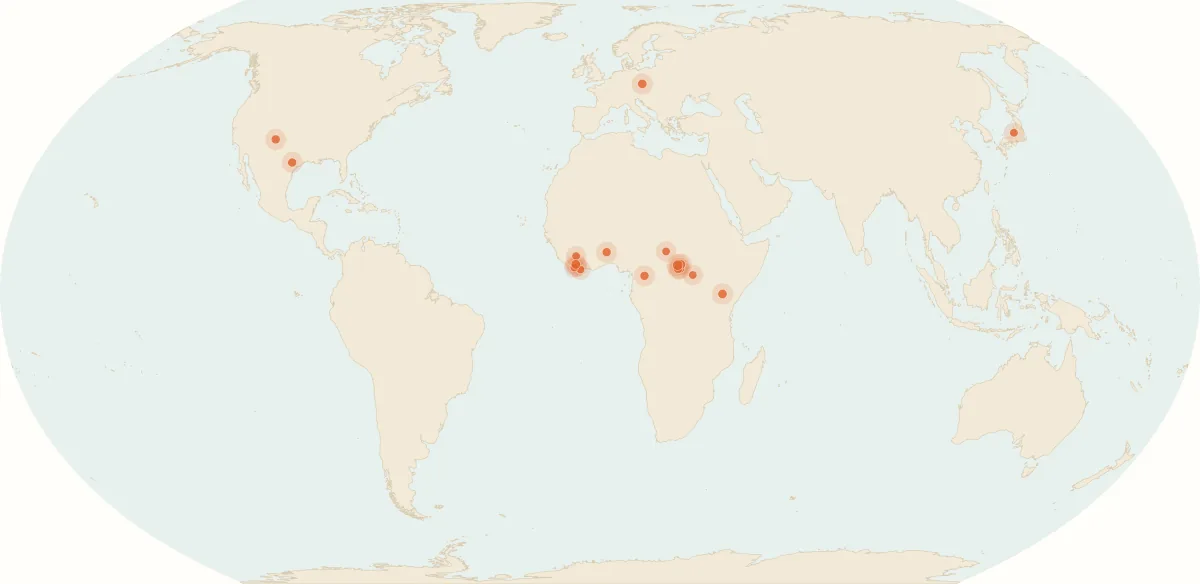
Records: GBIF.org (CC0 and CC BY 4.0 records, retrieved 2026-11-07). Map: Natural EarthSee the records on GBIF
Watch wild animals from a distance. Do not touch or feed them, and take care of the places where they live.
Names around the world
- 日本語
- ボンゴ
- 简体中文
- 紫羚
- 繁體中文
- 紫羚
- 한국어
- 봉고
- Español
- Bongo
- Français
- Bongo
- Deutsch
- Bongo
- Português (Brasil)
- Bongo
- Italiano
- Bongo
- العربية
- بونغو
- Bahasa Indonesia
- Bongo
- Tiếng Việt
- Linh dương vằn Bongo
- Русский
- Бонго
Names come from Wikidata and iNaturalist records. Where a language has no recorded name, we use the scientific name.
Sources and how we check
- University of Michigan Animal Diversity Web — Tragelaphus eurycerusChecked: 2026-11-03
We check each fact against its source. The illustrations simplify how the real animal looks.
The classification (class, order, family, genus) follows Wikidata records, checked against GBIF. Classifications can change as research goes on.
The basic data are the values given in each source. They vary with how the animal is measured, whether it is male or female, and whether it lives in the wild or in captivity.
This page was translated from the original Japanese with the help of AI.
Report a mistakeRELATIVES
Others in Bovidae


MORE TO MEET


