Water buffalo
Amazing fact
A water buffalo may submerge with just its nostrils and eyes above water.
University of Michigan Animal Diversity Web
No sign-up needed. You can save notes on this device.
An illustration based on the real animal.
A little discovery to share.
A water buffalo may submerge with just its nostrils and eyes above water.
THE REAL WORLD
The real Water buffalo
- Scientific name
- Bubalus bubalis
- Japanese name
- スイギュウ
- Group
- Land mammals
- Class
- Mammalia
- Order
- Artiodactyla
- Family
- Bovidae
- Genus
- Bubalus
The water buffalo is a domestic animal descended from the wild Asian water buffalo.
It is stronger than cattle and horses and copes well with heat, so in Asia it has long been used to plow rice paddies and fields.
It lives on land but depends heavily on water, spending much of its time wallowing in rivers and mud holes.
Its large feet have widely spread hooves. Its face is long and narrow, and it has large horns.
How the Water buffalo lives
It often grazes in the morning and evening. It also eats leaves and other vegetation growing along the water. During hotter hours, it may rest in dense cover.
University of Michigan Animal Diversity WebBasic data
- Size
- Body length: 240–300 cm
- Lifespan
- up to 25 years in the wild
- Active
- By day and by night
- Diet
- Grasses, herbs, aquatic plants, leaves, crops and other vegetation
Where the Water buffalo has been recorded
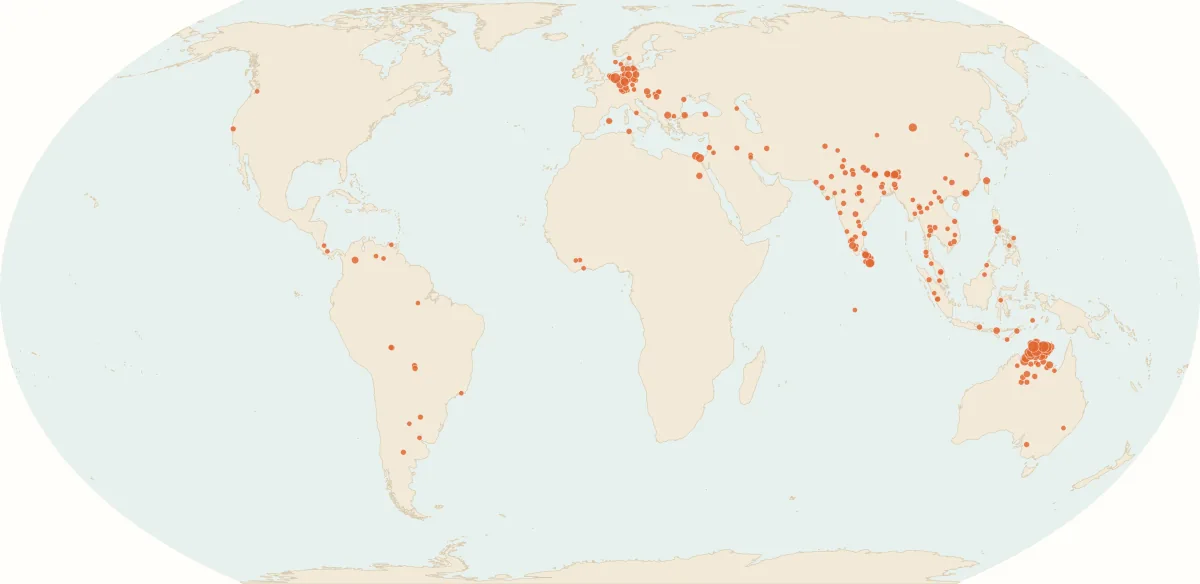
Records: GBIF.org (CC0 and CC BY 4.0 records, retrieved 2026-11-07). Map: Natural EarthSee the records on GBIF
Watch wild animals from a distance. Do not touch or feed them, and take care of the places where they live.
Names around the world
- 日本語
- スイギュウ
- 简体中文
- 水牛
- 繁體中文
- 水牛
- 한국어
- 물소
- Español
- Búfalo de agua
- Français
- Buffle domestique
- Deutsch
- Wasserbüffel
- Português (Brasil)
- Búfalo-asiático
- Italiano
- Bufalo d'acqua
- हिन्दी
- भैंस
- العربية
- جاموس الماء
- Bahasa Indonesia
- Kerbau
- Tiếng Việt
- Trâu
- Русский
- Азиатский буйвол
- Türkçe
- Asya mandası
- ไทย
- ควาย
- বাংলা
- মহিষ
- اردو
- بھینس
Names come from Wikidata and iNaturalist records. Where a language has no recorded name, we use the scientific name.
Sources and how we check
- 多摩動物公園 — スイギュウChecked: 2026-11-03
- University of Michigan Animal Diversity Web — Bubalus bubalisChecked: 2026-11-03
We check each fact against its source. The illustrations simplify how the real animal looks.
The classification (class, order, family, genus) follows Wikidata records, checked against GBIF. Classifications can change as research goes on.
The basic data are the values given in each source. They vary with how the animal is measured, whether it is male or female, and whether it lives in the wild or in captivity.
This page was translated from the original Japanese with the help of AI.
Report a mistakeWhen you meet the Water buffalo, look for this
- Look for its bushy tail tip.
Animals do different things from day to day, so you may not always see this.
University of Michigan Animal Diversity WebEXHIBIT INFORMATION
Places that keep or show the Water buffalo
Zoos, aquariums and other places whose official websites say they keep or show this animal.
Kanto
Displays can change with the animals’ health and the seasons. Check each facility’s official website before you go.
RELATIVES
Others in Bovidae


MORE TO MEET


