Great spotted woodpecker

No sign-up needed. You can save notes on this device.
An illustration based on the real animal.
A little discovery to share.
The great spotted woodpecker flies in a bouncing, wavy path.
THE REAL WORLD
The real Great spotted woodpecker
- Scientific name
- Dendrocopos major
- Japanese name
- アカゲラ
- Group
- Birds
- Class
- Aves
- Order
- Piciformes
- Family
- Picidae
- Genus
- Dendrocopos
This woodpecker lives in woods from the lowlands to the mountains. It catches insects and their larvae, and in autumn and winter it often eats tree fruits and nuts too.
It is boldly patterned in black and white. Males have red on the back of the head, and both males and females are red on the lower belly.
It digs a new nest hole every year, and its old holes are used by animals that cannot dig their own, such as tits, squirrels and flying squirrels.
How the Great spotted woodpecker lives
In spring, it makes a rapid drumming sound. Spiders are also part of its diet. It spends much of its time clinging to tree trunks and branches. In winter, it also comes to the plains.
RSPB新潟県Basic data
- Size
- Total length: 23 cm
- Diet
- Insects, their larvae and fruit
Where the Great spotted woodpecker has been recorded
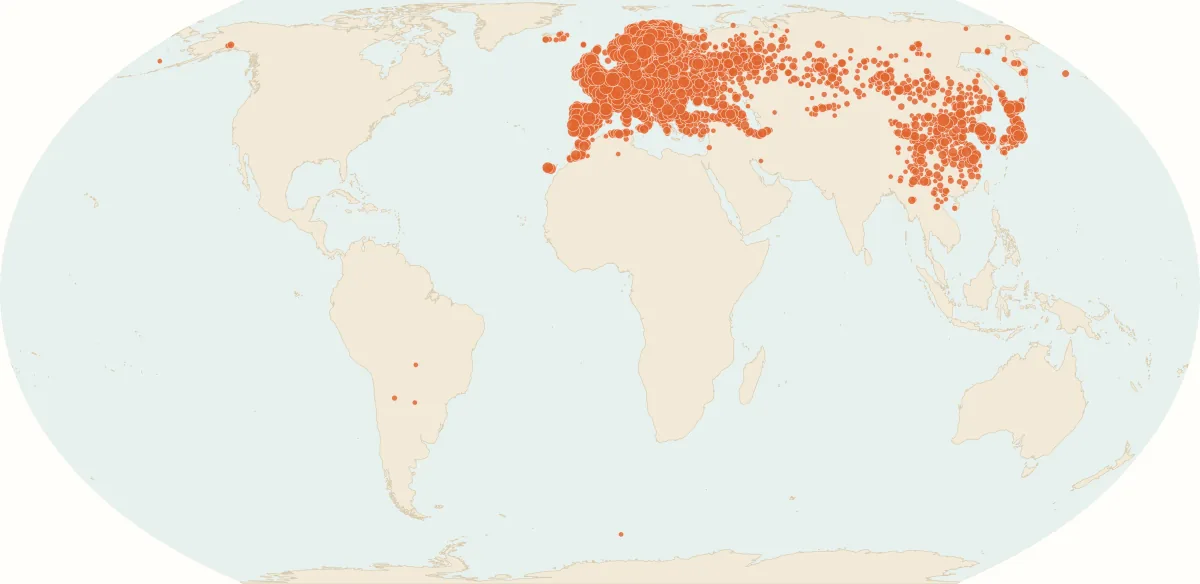
Records: GBIF.org (CC0 and CC BY 4.0 records, retrieved 2026-11-07). Map: Natural EarthSee the records on GBIF
Watch wild animals from a distance. Do not touch or feed them, and take care of the places where they live.
Names around the world
- 日本語
- アカゲラ
- 简体中文
- 大斑啄木鸟
- 繁體中文
- 大斑啄木鳥
- 한국어
- 오색딱따구리
- Español
- Pico picapinos
- Français
- Pic épeiche
- Deutsch
- Buntspecht
- Português (Brasil)
- Pica-pau-malhado-grande
- Italiano
- Picchio rosso maggiore
- العربية
- نقار خشب مرقط كبير
- Bahasa Indonesia
- Pelatuk tutul besar
- Tiếng Việt
- Gõ kiến nhỏ sườn đỏ
- Русский
- Большой пёстрый дятел
- Türkçe
- Göknar ağaçkakanı
Names come from Wikidata and iNaturalist records. Where a language has no recorded name, we use the scientific name.
Sources and how we check
- 新潟県 — 展示鳥類剥製(アカゲラ)Checked: 2026-11-03
- RSPB — Great Spotted WoodpeckerChecked: 2026-11-03
We check each fact against its source. The illustrations simplify how the real animal looks.
The classification (class, order, family, genus) follows Wikidata records, checked against GBIF. Classifications can change as research goes on.
The basic data are the values given in each source. They vary with how the animal is measured, whether it is male or female, and whether it lives in the wild or in captivity.
This page was translated from the original Japanese with the help of AI.
Report a mistakeRELATIVES
Others in Picidae


MORE TO MEET


