Hairfinned Leatherjacket
Amazing fact
Male hairfinned leatherjackets have thread-like extensions on their tail fins.
宇久井ビジターセンター
No sign-up needed. You can save notes on this device.
An illustration based on the real animal.
A little discovery to share.
Male hairfinned leatherjackets have thread-like extensions on their tail fins.
THE REAL WORLD
The real Hairfinned Leatherjacket
- Scientific name
- Paramonacanthus japonicus
- Japanese name
- ヨソギ
- Group
- Ocean animals
- Order
- Tetraodontiformes
- Family
- Monacanthidae
- Genus
- Paramonacanthus
It lives in shallow seas, around sandy and muddy bottoms, rocky reefs and human-made structures.
Basic data
- Diet
- Crustaceans, polychaetes, mollusks, and other animals
- Range
- South of Sagami Bay
Where the Hairfinned Leatherjacket has been recorded
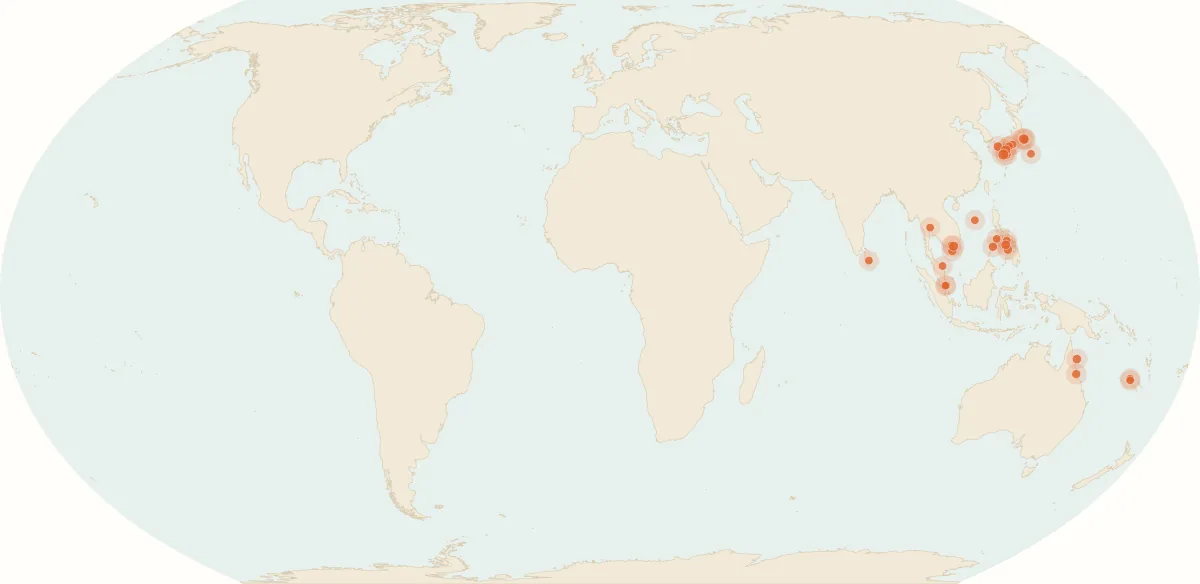
Records: GBIF.org (CC0 and CC BY 4.0 records, retrieved 2026-11-07). Map: Natural EarthSee the records on GBIF
Watch wild animals from a distance. Do not touch or feed them, and take care of the places where they live.
Names around the world
- 日本語
- ヨソギ
- 简体中文
- 日本副单棘鲀
- 繁體中文
- 日本副單棘魨
- 한국어
- 새양쥐치
- Português (Brasil)
- Peixe-porco-japonês
Names come from Wikidata and iNaturalist records. Where a language has no recorded name, we use the scientific name.
Sources and how we check
- 鳥羽水族館 — ヨソギChecked: 2026-11-04
- 宇久井ビジターセンター — ヨソギChecked: 2026-11-07
We check each fact against its source. The illustrations simplify how the real animal looks.
The classification (class, order, family, genus) follows Wikidata records, checked against GBIF. Classifications can change as research goes on.
The basic data are the values given in each source. They vary with how the animal is measured, whether it is male or female, and whether it lives in the wild or in captivity.
This page was translated from the original Japanese with the help of AI.
Report a mistakeRELATIVES
Others in Monacanthidae


MORE TO MEET


