Cattle
Amazing fact
Among Holstein cattle, each animal has a different pattern of spots.
University of Michigan Animal Diversity Web
No sign-up needed. You can save notes on this device.
An illustration based on the real animal.
A little discovery to share.
Among Holstein cattle, each animal has a different pattern of spots.
THE REAL WORLD
The real Cattle
- Scientific name
- Bos taurus
- Japanese name
- ウシ
- Group
- Land mammals
- Class
- Mammalia
- Order
- Artiodactyla
- Family
- Bovidae
- Genus
- Bos
Cattle are domestic animals that people tamed from a wild ancestor.
It is a farm animal people keep for milk and meat. The milk we drink comes from mother cows.
It brings swallowed grass back up into its mouth to chew it again, and tiny living things in its stomach break the grass down.
It wraps grass around its tongue and cuts it off with its lower teeth; it has no upper front teeth.
How the Cattle lives
Cattle are active during the day. They move their jaws in a circle to grind tough plants. The herd has a ranking, and cattle yield to those above them. Females share the care of young within the herd.
University of Michigan Animal Diversity WebBasic data
- Weight
- 147–1,363 kg
- Active
- By day (diurnal)
Where the Cattle has been recorded
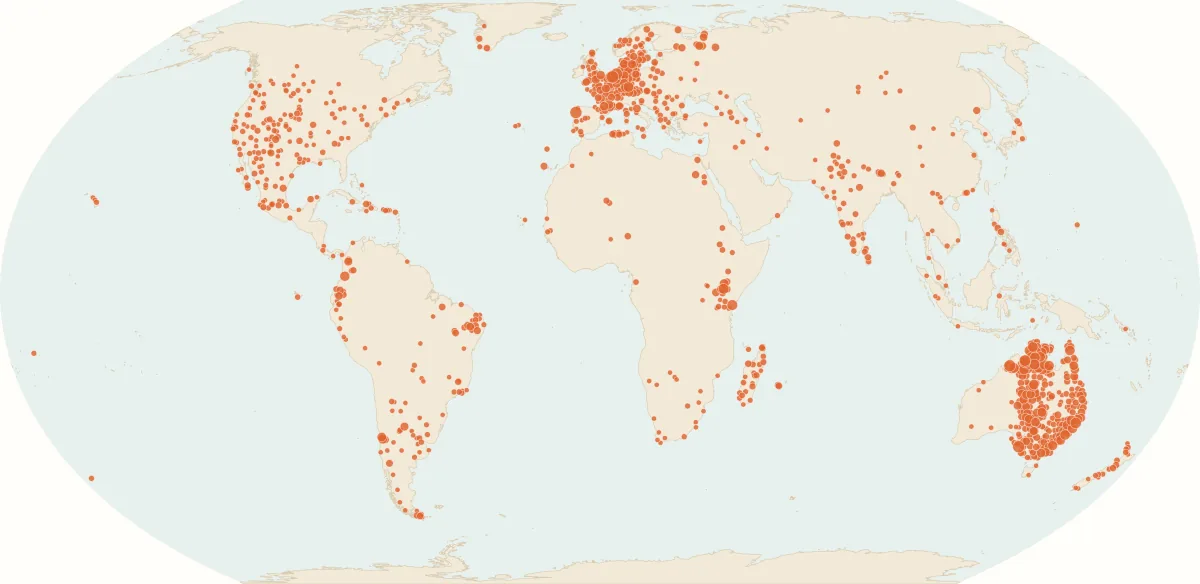
Records: GBIF.org (CC0 and CC BY 4.0 records, retrieved 2026-11-07). Map: Natural EarthSee the records on GBIF
Watch wild animals from a distance. Do not touch or feed them, and take care of the places where they live.
Names around the world
- 日本語
- ウシ
Names come from Wikidata and iNaturalist records. Where a language has no recorded name, we use the scientific name.
Sources and how we check
- 農林水産省 — 牛乳はどこからくるのかな?Checked: 2026-11-03
- University of Michigan Animal Diversity Web — Bos taurusChecked: 2026-11-03
We check each fact against its source. The illustrations simplify how the real animal looks.
The classification (class, order, family, genus) follows Wikidata records, checked against GBIF. Classifications can change as research goes on.
The basic data are the values given in each source. They vary with how the animal is measured, whether it is male or female, and whether it lives in the wild or in captivity.
This page was translated from the original Japanese with the help of AI.
Report a mistakeRELATIVES
Others in Bovidae


MORE TO MEET


