Sumatran orangutan
Amazing fact
Young Sumatran orangutans swing from branch to branch using their arms.
University of Michigan Animal Diversity Web
No sign-up needed. You can save notes on this device.
An illustration based on the real animal.
A little discovery to share.
Young Sumatran orangutans swing from branch to branch using their arms.
THE REAL WORLD
The real Sumatran orangutan
- Scientific name
- Pongo abelii
- Japanese name
- スマトラオランウータン
- Group
- Land mammals
- Class
- Mammalia
- Order
- Primates
- Family
- Hominidae
- Genus
- Pongo
It lives in the forests of northern Sumatra and spends almost all its time in the trees.
Compared with the Bornean orangutan, it has longer fur and a slimmer build, and both males and females have long beards.
Males have a large throat sac that lets them make loud calls, which help them claim their territory.
How the Sumatran orangutan lives
They are active during the day. They follow the fruiting season of trees and eat the fruit when it is ripe. In the dry season, when fruit is scarce, they eat other vegetation too. Each night they build a new sleeping nest in a tree with bent branches, sticks and leaves.
University of Michigan Animal Diversity WebBasic data
- Size
- 1.3–1.8 m
- Weight
- 30–90 kg
- Lifespan
- 44–58 years in the wild, up to 55 years in captivity
- Active
- By day (diurnal)
- Range
- Sumatra, Indonesia
Where the Sumatran orangutan has been recorded
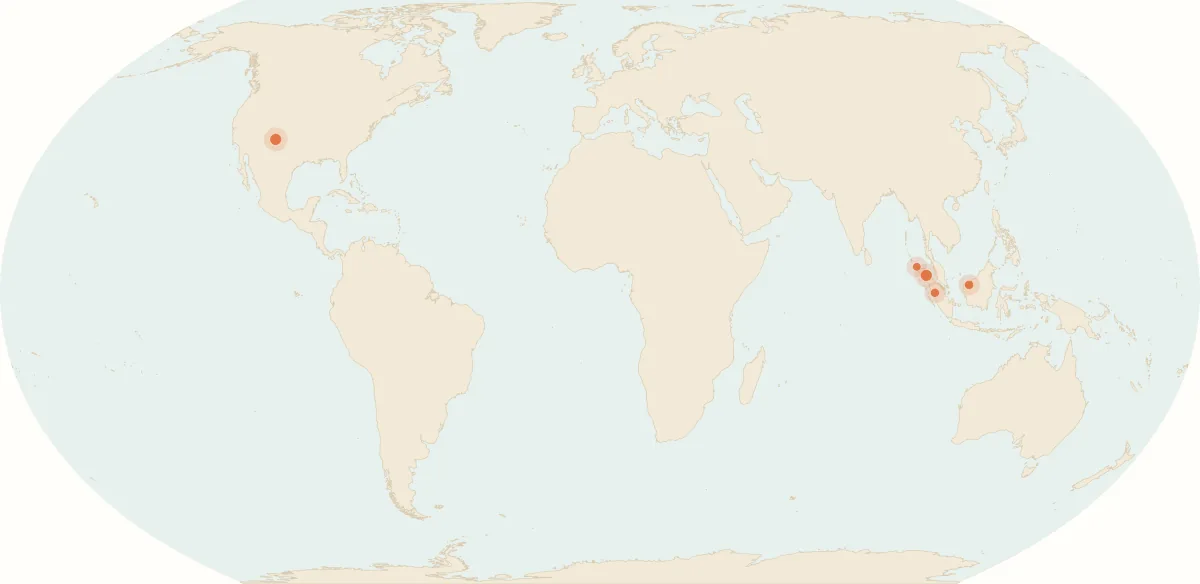
Records: GBIF.org (CC0 and CC BY 4.0 records, retrieved 2026-11-07). Map: Natural EarthSee the records on GBIF
Watch wild animals from a distance. Do not touch or feed them, and take care of the places where they live.
Names around the world
- 日本語
- スマトラオランウータン
- 简体中文
- 苏门答腊猩猩
- 繁體中文
- 蘇門答臘猩猩
- 한국어
- 수마트라오랑우탄
- Español
- Orangután de Sumatra
- Français
- Orang-outan de Sumatra
- Deutsch
- Sumatra-Orang-Utan
- Português (Brasil)
- Orangotango-de-sumatra
- Italiano
- Orango di Sumatra
- العربية
- إنسان الغاب السومطري
- Bahasa Indonesia
- Orangutan sumatera
- Tiếng Việt
- Đười ươi Sumatra
- Русский
- Суматранский орангутан
- Türkçe
- Sumatra orangutanı
Names come from Wikidata and iNaturalist records. Where a language has no recorded name, we use the scientific name.
Sources and how we check
- University of Michigan Animal Diversity Web — Pongo abeliiChecked: 2026-11-03
We check each fact against its source. The illustrations simplify how the real animal looks.
The classification (class, order, family, genus) follows Wikidata records, checked against GBIF. Classifications can change as research goes on.
The basic data are the values given in each source. They vary with how the animal is measured, whether it is male or female, and whether it lives in the wild or in captivity.
This page was translated from the original Japanese with the help of AI.
Report a mistakeRELATIVES
Others in Hominidae


MORE TO MEET


