Red-flanked bluetail

No sign-up needed. You can save notes on this device.
An illustration based on the real animal.
A little discovery to share.
Red-flanked bluetails live alone in their own territories during winter.
THE REAL WORLD
The real Red-flanked bluetail
- Scientific name
- Tarsiger cyanurus
- Japanese name
- ルリビタキ
- Group
- Birds
- Class
- Aves
- Order
- Passeriformes
- Family
- Muscicapidae
- Genus
- Tarsiger
In the breeding season it stays high in the mountains; in winter it comes down to the lowlands, living in woods and parks with many trees.
Males are blue from the head down the back, while females are olive with just the top of the tail blue. It takes a male a few years to turn a beautiful blue.
It eats insects, earthworms and spiders both in trees and on the ground, and it wags its tail rhythmically.
How the Red-flanked bluetail lives
They use dimmer places in the woods than Daurian redstarts do. They call “hit, hit” and sing “pichu chuririri”. During the breeding season, they live as pairs in the woods.
新潟県Basic data
- Size
- Total length: 14 cm
- Diet
- Insects, earthworms, spiders and other animals
Where the Red-flanked bluetail has been recorded
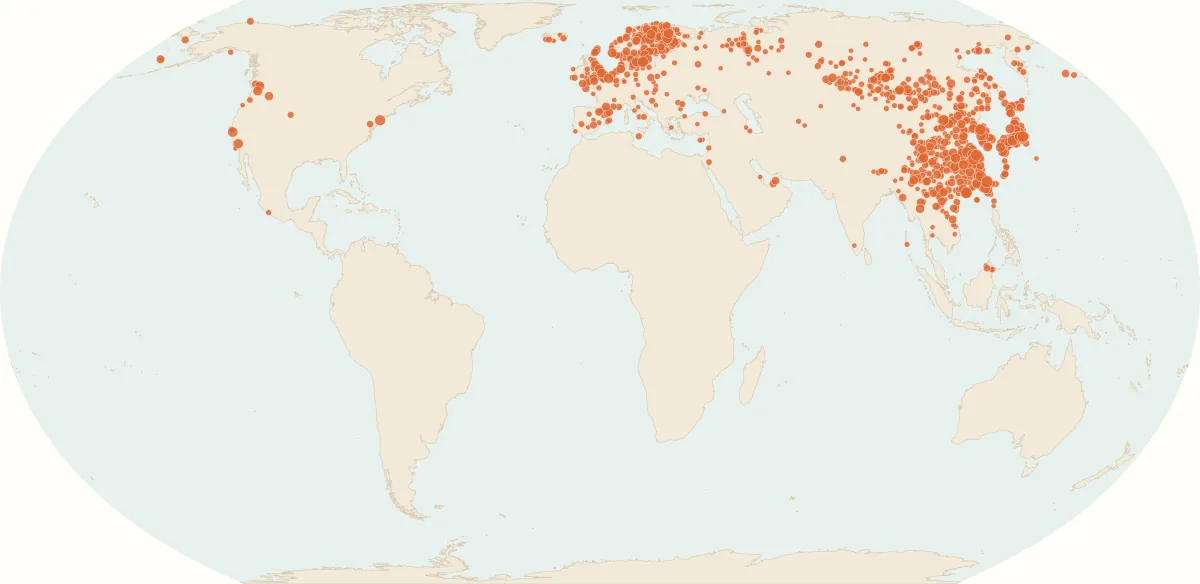
Records: GBIF.org (CC0 and CC BY 4.0 records, retrieved 2026-11-07). Map: Natural EarthSee the records on GBIF
Watch wild animals from a distance. Do not touch or feed them, and take care of the places where they live.
Names around the world
- 日本語
- ルリビタキ
- 简体中文
- 红胁蓝尾鸲
- 繁體中文
- 藍尾歌鴝
- 한국어
- 유리딱새
- Español
- Ruiseñor coliazul
- Français
- Robin à flancs roux
- Deutsch
- Blauschwanz
- Português (Brasil)
- Pisco-de-flanco-ruivo
- Italiano
- Codazzurro
- Bahasa Indonesia
- Berkecet-semak pinggul-jingga
- Tiếng Việt
- Oanh đuôi nhọn hông đỏ
- Русский
- Синехвостка
- Türkçe
- Mavi Kuyruklu Bülbül
Names come from Wikidata and iNaturalist records. Where a language has no recorded name, we use the scientific name.
Sources and how we check
- 新潟県 — 展示鳥類剥製(ルリビタキ)Checked: 2026-11-03
- 神奈川県自然環境保全センター — 野外施設で秋から冬にみられる鳥Checked: 2026-11-03
We check each fact against its source. The illustrations simplify how the real animal looks.
The classification (class, order, family, genus) follows Wikidata records, checked against GBIF. Classifications can change as research goes on.
The basic data are the values given in each source. They vary with how the animal is measured, whether it is male or female, and whether it lives in the wild or in captivity.
This page was translated from the original Japanese with the help of AI.
Report a mistakeRELATIVES
Others in Muscicapidae


MORE TO MEET


