Greater rhea
Amazing fact
Greater rheas swallow small stones to help grind food in their gizzards.
University of Michigan Animal Diversity Web
No sign-up needed. You can save notes on this device.
An illustration based on the real animal.
A little discovery to share.
Greater rheas swallow small stones to help grind food in their gizzards.
THE REAL WORLD
The real Greater rhea
- Scientific name
- Rhea americana
- Japanese name
- レア
- Group
- Birds
- Class
- Aves
- Order
- Rheiformes
- Family
- Rheidae
- Genus
- Rhea
It is a flightless bird of grasslands and dry scrubland in southeastern South America.
It uses its long wings like an airplane's rudder, helping it dodge predators and keep its balance while running.
The male makes a nest on the ground, and it is also the male that keeps the eggs warm and raises the chicks.
How the Greater rhea lives
Outside the breeding season, greater rheas forage during the day. They feed while walking slowly with their heads close to the ground. They sleep at night and commonly rest with an S-shaped neck and their bill on their throat. When dust-bathing, they scoop up dirt or dust with their bill and toss it onto their wings with their neck.
University of Michigan Animal Diversity WebBasic data
- Size
- Height: 0.9–1.5 m
- Weight
- 15–30 kg
- Diet
- Broad-leafed plants, clover, seeds, roots, fruit, insects and small vertebrates
- Range
- Southeastern South America, including Brazil, Bolivia, Uruguay, Paraguay and Argentina
Where the Greater rhea has been recorded
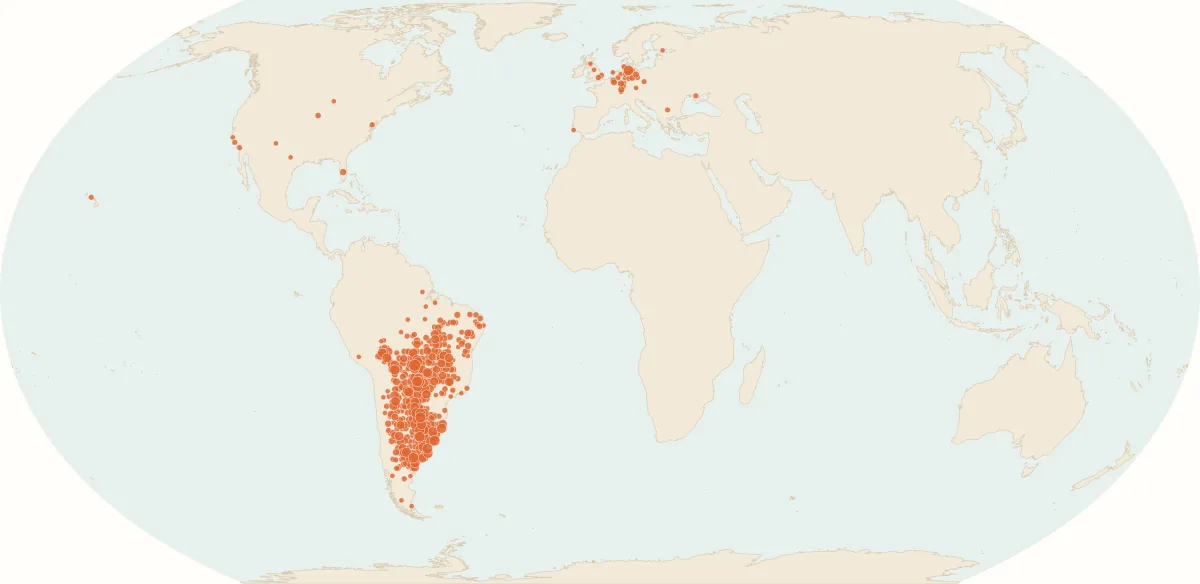
Records: GBIF.org (CC0 and CC BY 4.0 records, retrieved 2026-11-07). Map: Natural EarthSee the records on GBIF
Watch wild animals from a distance. Do not touch or feed them, and take care of the places where they live.
Names around the world
- 日本語
- レア
- 简体中文
- 大美洲鸵
- 繁體中文
- 美洲鴕鳥
- 한국어
- 아메리카레아
- Español
- Ñandú común
- Français
- Nandou d'Amérique
- Deutsch
- Nandu
- Português (Brasil)
- Ema
- Italiano
- Ñandú
- العربية
- ريا أميركي
- Bahasa Indonesia
- Nyandu besar
- Tiếng Việt
- Đà điểu Nam Mỹ lớn
- Русский
- Обыкновенный нанду
- Türkçe
- Büyük Rea
Names come from Wikidata and iNaturalist records. Where a language has no recorded name, we use the scientific name.
Sources and how we check
- Smithsonian National Zoo — Greater rheaChecked: 2026-11-03
- University of Michigan Animal Diversity Web — Rhea americanaChecked: 2026-11-03
We check each fact against its source. The illustrations simplify how the real animal looks.
The classification (class, order, family, genus) follows Wikidata records, checked against GBIF. Classifications can change as research goes on.
The basic data are the values given in each source. They vary with how the animal is measured, whether it is male or female, and whether it lives in the wild or in captivity.
This page was translated from the original Japanese with the help of AI.
Report a mistakeMORE TO MEET


