Okapi

No sign-up needed. You can save notes on this device.
An illustration based on the real animal.
A little discovery to share.
An okapi can turn its ears independently to listen in front and behind.
THE REAL WORLD
The real Okapi
- Scientific name
- Okapia johnstoni
- Japanese name
- オカピ
- Group
- Land mammals
- Class
- Mammalia
- Order
- Artiodactyla
- Family
- Giraffidae
- Genus
- Okapia
It lives in the rainforests of the Democratic Republic of the Congo; it is often mistaken for a kind of zebra, but it belongs to the giraffe family.
Males have short horns covered with skin, and females are slightly larger than males.
It uses its long tongue to pull in leaves, feeding on buds, leaves and twigs.
How the Okapi lives
It is most active from afternoon through evening. When searching for food, it often travels along trails worn by okapis. It spreads its legs and bends its knees to drink water. A mother hides her newborn calf and returns regularly to nurse it.
San Diego ZooUniversity of Michigan Animal Diversity WebBasic data
- Size
- 180–250 cmUniversity of Michigan Animal Diversity Web
- Weight
- 210–350 kgUniversity of Michigan Animal Diversity Web
- Lifespan
- up to 29 years in captivityUniversity of Michigan Animal Diversity Web
- Active
- By day (diurnal)University of Michigan Animal Diversity Web
- Diet
- Leavesよこはま動物園ズーラシア
- Range
- Eastern Democratic Republic of the Congoよこはま動物園ズーラシア
Where the Okapi has been recorded
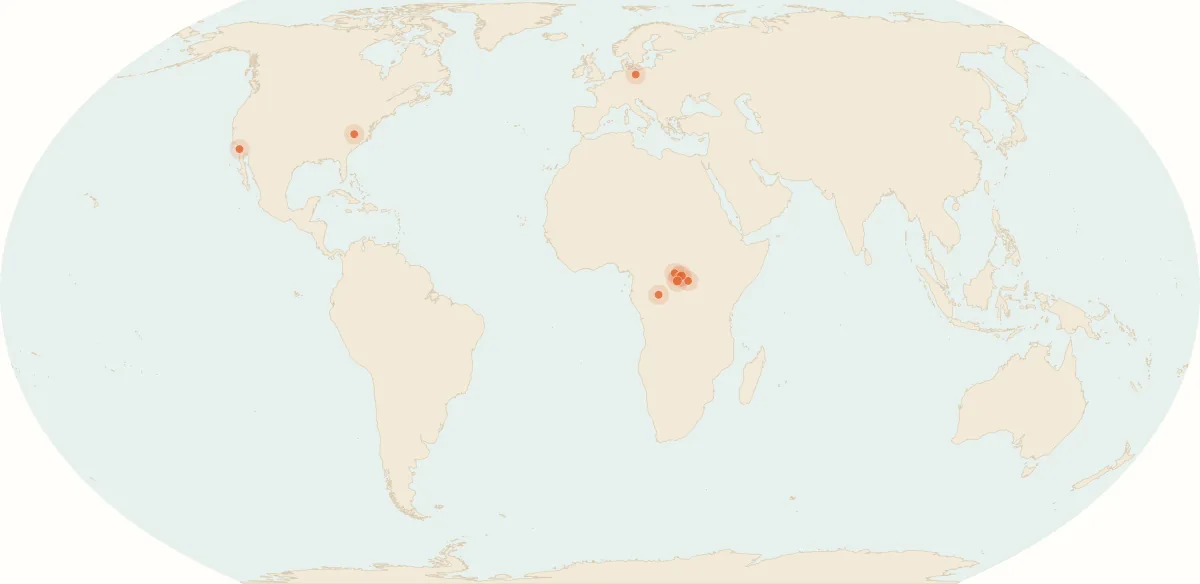
Records: GBIF.org (CC0 and CC BY 4.0 records, retrieved 2026-11-07). Map: Natural EarthSee the records on GBIF
Watch wild animals from a distance. Do not touch or feed them, and take care of the places where they live.
Names around the world
- 日本語
- オカピ
- 简体中文
- 霍加狓
- 繁體中文
- 㺢㹢狓
- 한국어
- 오카피
- Español
- Okapi
- Français
- Okapi
- Deutsch
- Okapi
- Português (Brasil)
- Ocapi
- Italiano
- Okapi
- हिन्दी
- ओकापी
- العربية
- أكاب
- Bahasa Indonesia
- Okapi
- Tiếng Việt
- Hươu đùi vằn
- Русский
- Окапи
- Türkçe
- Okapi
- ไทย
- โอคาพี
- বাংলা
- ওকাপি
Names come from Wikidata and iNaturalist records. Where a language has no recorded name, we use the scientific name.
Sources and how we check
- よこはま動物園ズーラシア — オカピChecked: 2026-11-03
- University of Michigan Animal Diversity Web — Okapia johnstoniChecked: 2026-11-03
- San Diego Zoo — OkapiChecked: 2026-11-05
We check each fact against its source. The illustrations simplify how the real animal looks.
The classification (class, order, family, genus) follows Wikidata records, checked against GBIF. Classifications can change as research goes on.
The basic data are the values given in each source. They vary with how the animal is measured, whether it is male or female, and whether it lives in the wild or in captivity.
This page was translated from the original Japanese with the help of AI.
Report a mistakeRELATIVES
Others in Giraffidae

MORE TO MEET


