Common carp
Amazing fact
Carp suck up mud from the bottom, expel it, and select food from the suspended material.
University of Michigan Animal Diversity Web
No sign-up needed. You can save notes on this device.
An illustration based on the real animal.
A little discovery to share.
Carp suck up mud from the bottom, expel it, and select food from the suspended material.
THE REAL WORLD
The real Common carp
- Scientific name
- Cyprinus carpio
- Japanese name
- コイ
- Group
- Freshwater animals
- Order
- Cypriniformes
- Family
- Cyprinidae
- Genus
- Cyprinus
A fish of the middle and lower reaches of large rivers, lakes, and ponds across a wide area from eastern Europe to East Asia.
Its snout is longer than a crucian carp's, its mouth is pointed, and it has whiskers around the mouth.
An omnivore that eats many things, mainly small animals living on the bottom, such as shellfish and midge larvae, as well as water plants.
How the Common carp lives
It lives near the bottom in slow-flowing places and over sand or mud. In winter, carp gather in deep, still water. When spawning, the female approaches water plants and beats the water with her tail fin. Her eggs are laid on the water plants.
国立環境研究所 侵入生物DBBasic data
- Size
- Total length: 60 cm国立環境研究所 侵入生物DB
- Weight
- up to 20 kgUniversity of Michigan Animal Diversity Web
- Lifespan
- 13–20 years in the wild, up to 47 years in captivityUniversity of Michigan Animal Diversity Web
- Diet
- Mollusks, midge larvae, tubificid worms, polychaetes, attached diatoms and aquatic plants国立環境研究所 侵入生物DB
- Range
- Eurasia from eastern Europe to East Asia国立環境研究所 侵入生物DB
Where the Common carp has been recorded
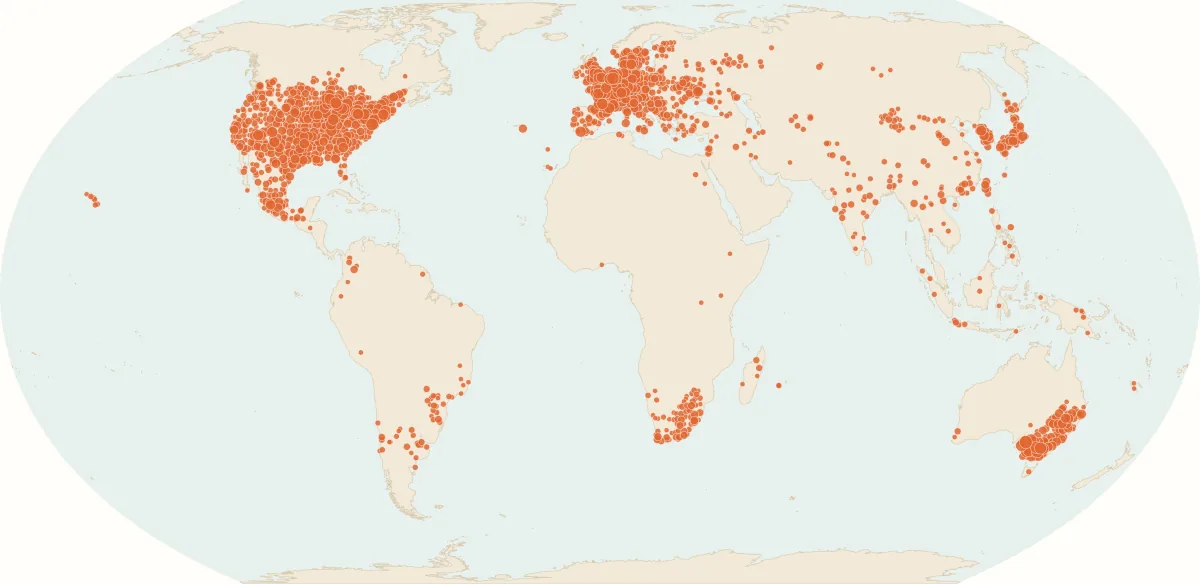
Records: GBIF.org (CC0 and CC BY 4.0 records, retrieved 2026-11-07). Map: Natural EarthSee the records on GBIF
Watch wild animals from a distance. Do not touch or feed them, and take care of the places where they live.
Names around the world
- 日本語
- コイ
- 简体中文
- 德国镜鲤
- 繁體中文
- 歐洲鯉
- 한국어
- 잉어
- Español
- Carpa
- Français
- Carpe commune
- Deutsch
- Gemeine Karpfen
- Português (Brasil)
- Carpa-comum
- Italiano
- Carpa
- العربية
- شبوط شائع
- Bahasa Indonesia
- Ikan mas
- Tiếng Việt
- Cá chép
- Русский
- Сазан
- Türkçe
- Sazan
- ไทย
- ปลาไน
- বাংলা
- পাতি কার্পু
Names come from Wikidata and iNaturalist records. Where a language has no recorded name, we use the scientific name.
Sources and how we check
- 国立環境研究所 侵入生物DB — コイChecked: 2026-11-03
- University of Michigan Animal Diversity Web — Cyprinus carpioChecked: 2026-11-03
We check each fact against its source. The illustrations simplify how the real animal looks.
The classification (class, order, family, genus) follows Wikidata records, checked against GBIF. Classifications can change as research goes on.
The basic data are the values given in each source. They vary with how the animal is measured, whether it is male or female, and whether it lives in the wild or in captivity.
This page was translated from the original Japanese with the help of AI.
Report a mistakeRELATIVES
Others in Cyprinidae


MORE TO MEET


