Greenbottle

No sign-up needed. You can save notes on this device.
An illustration based on the real animal.
A little discovery to share.
The greenbottle has stiff bristles on the upper side of its thorax.
THE REAL WORLD
The real Greenbottle
- Scientific name
- Lucilia caesar
- Japanese name
- キンバエ
- Group
- Insects
- Class
- Insecta
- Order
- Diptera
- Family
- Calliphoridae
- Genus
- Lucilia
A fly whose whole body is golden green with a strong metallic shine. It is found throughout Japan.
In males the two compound eyes sit close together, but in females they are set wide apart.
Its larvae grow on things like dead animals. It is more common along woodland edges near towns than in the town itself.
How the Greenbottle lives
Adults can be seen from spring through autumn.
まちだエコライフ推進公社Basic data
- Size
- Body length: 7–10 mm名古屋市
- Range
- Hokkaido to the Nansei Islandsまちだエコライフ推進公社
Where the Greenbottle has been recorded
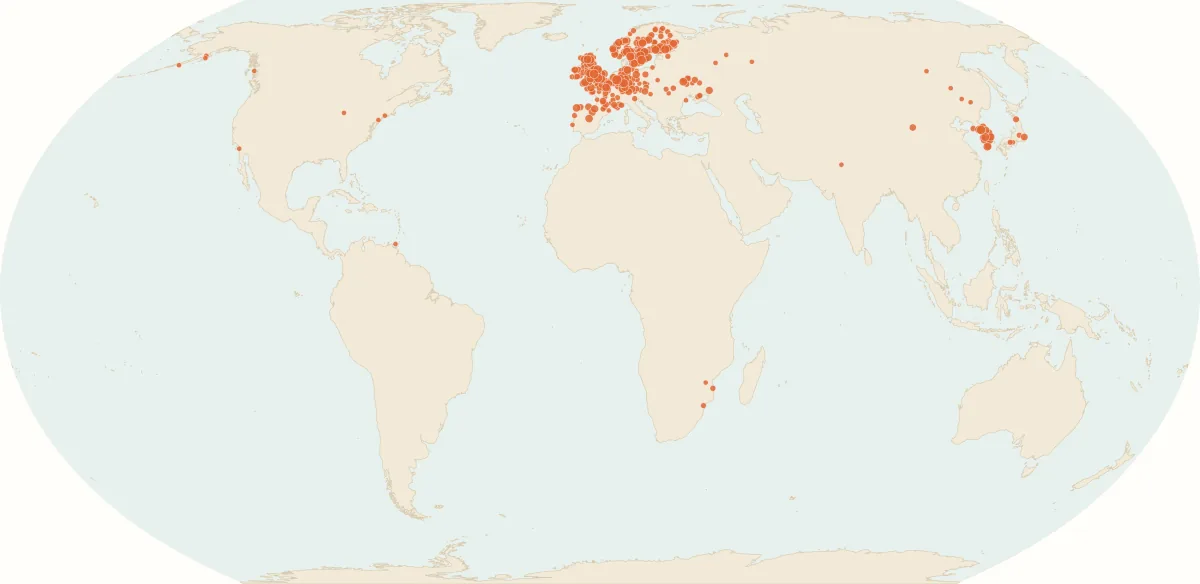
Records: GBIF.org (CC0 and CC BY 4.0 records, retrieved 2026-11-07). Map: Natural EarthSee the records on GBIF
Watch wild animals from a distance. Do not touch or feed them, and take care of the places where they live.
Names around the world
- 日本語
- キンバエ
- 简体中文
- 凯撒绿蝇
- 繁體中文
- 凱撒綠蠅
- 한국어
- 금파리
- Français
- Lucilie impériale
- Deutsch
- Goldfliege
- Português (Brasil)
- Varejeira-verde
- Italiano
- Mosca verde
- العربية
- لقاعة قيصرية
Names come from Wikidata and iNaturalist records. Where a language has no recorded name, we use the scientific name.
Sources and how we check
- 名古屋市 — キンバエ・クロバエ類Checked: 2026-11-04
- まちだエコライフ推進公社 — まちだのいきものたち キンバエChecked: 2026-11-04
We check each fact against its source. The illustrations simplify how the real animal looks.
The classification (class, order, family, genus) follows Wikidata records, checked against GBIF. Classifications can change as research goes on.
The basic data are the values given in each source. They vary with how the animal is measured, whether it is male or female, and whether it lives in the wild or in captivity.
This page was translated from the original Japanese with the help of AI.
Report a mistakeRELATIVES
Others in Diptera

MORE TO MEET


