Silkworm
Amazing fact
A silkworm caterpillar sheds its skin repeatedly as it grows.
Horniman Museum and Gardens
No sign-up needed. You can save notes on this device.
An illustration based on the real animal.
A little discovery to share.
A silkworm caterpillar sheds its skin repeatedly as it grows.
THE REAL WORLD
The real Silkworm
- Scientific name
- Bombyx mori
- Japanese name
- カイコ
- Group
- Insects
- Class
- Insecta
- Order
- Lepidoptera
- Family
- Bombycidae
- Genus
- Bombyx
The silkworm is an insect domesticated by people for silk. The wild silk moth (kuwako) is a very close relative.
A moth that people have raised for a very long time to make silk.
The caterpillar spins silk thread from its mouth and wraps it around its body to make a cocoon.
The caterpillars feed mainly on mulberry leaves. The adult moths cannot fly.
How the Silkworm lives
Before making a cocoon, the larva climbs to find a place to attach it. Inside the cocoon it becomes a pupa, and later a moth emerges. The adult does not eat, and after mating the female lays eggs.
Fondazione Museo Civico di RoveretoBasic data
- Size
- Wingspan: 4 cm
- Range
- Asia
Where the Silkworm has been recorded
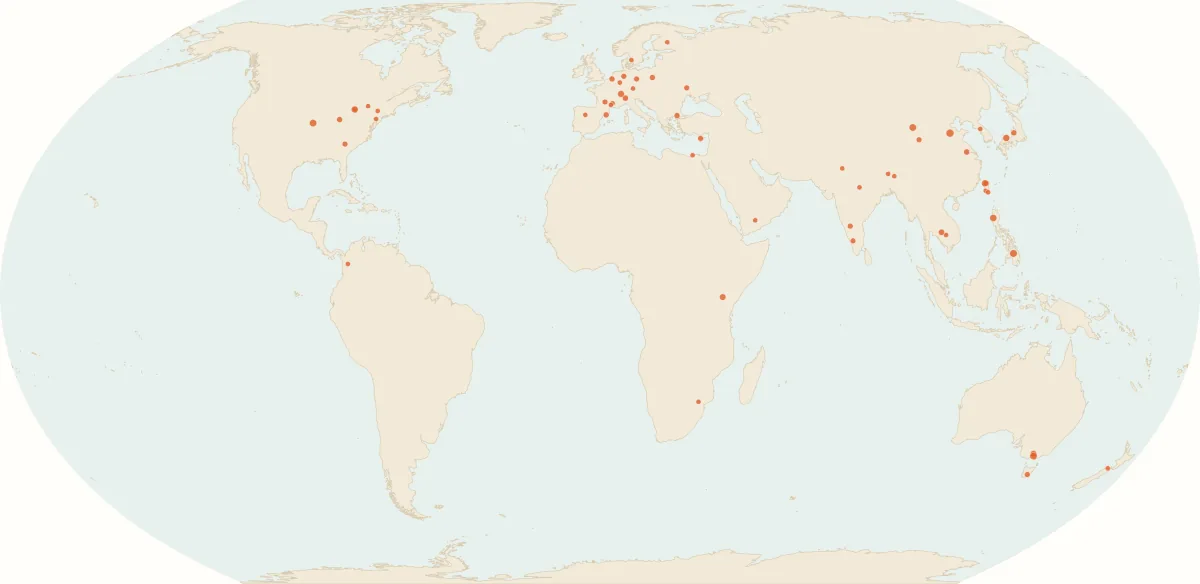
Records: GBIF.org (CC0 and CC BY 4.0 records, retrieved 2026-11-07). Map: Natural EarthSee the records on GBIF
Watch wild animals from a distance. Do not touch or feed them, and take care of the places where they live.
Names around the world
- 日本語
- カイコ
- 简体中文
- 蚕
- 繁體中文
- 家蠶
- 한국어
- 누에
- Español
- Gusano de seda
- Français
- Bombyx du mûrier
- Deutsch
- Seidenspinner
- Português (Brasil)
- Bicho-da-seda
- Italiano
- Baco da seta
- हिन्दी
- रेशम कीट
- العربية
- دودة القز
- Bahasa Indonesia
- Ngengat sutra
- Tiếng Việt
- Tằm tơ
- Русский
- Тутовый шелкопряд
- Türkçe
- İpek böceği
- ไทย
- ไหม
- বাংলা
- তুঁত রেশম
- اردو
- ریشم کا کیڑا
Names come from Wikidata and iNaturalist records. Where a language has no recorded name, we use the scientific name.
Sources and how we check
- University of Michigan Animal Diversity Web — Bombyx moriChecked: 2026-11-03
- Fondazione Museo Civico di Rovereto — THE SILKWORMChecked: 2026-11-05
- Horniman Museum and Gardens — Bombyx moriChecked: 2026-11-05
We check each fact against its source. The illustrations simplify how the real animal looks.
The classification (class, order, family, genus) follows Wikidata records, checked against GBIF. Classifications can change as research goes on.
The basic data are the values given in each source. They vary with how the animal is measured, whether it is male or female, and whether it lives in the wild or in captivity.
This page was translated from the original Japanese with the help of AI.
Report a mistakeRELATIVES
Others in Lepidoptera


MORE TO MEET


