Hercules beetle
Amazing fact
Hercules beetles make a huffing sound by rubbing the abdomen against the front wings.
University of Michigan Animal Diversity Web
No sign-up needed. You can save notes on this device.
An illustration based on the real animal.
A little discovery to share.
Hercules beetles make a huffing sound by rubbing the abdomen against the front wings.
THE REAL WORLD
The real Hercules beetle
- Scientific name
- Dynastes hercules
- Japanese name
- ヘラクレスオオカブト
- Group
- Insects
- Class
- Insecta
- Order
- Coleoptera
- Family
- Scarabaeidae
- Genus
- Dynastes
A beetle of the tropics of Central and South America. The larvae eat rotting wood, and adults eat fallen, rotting fruit.
Males have long horns growing from the chest and head that together look and work like a big pincer.
Its hard front wings look yellowish when the air is dry and turn black as it gets damp.
How the Hercules beetle lives
Larvae live in decaying wood. Adults can fly. Adults are observed mainly in the undergrowth and on the forest floor.
University of Michigan Animal Diversity WebBasic data
- Size
- 44–180 mm
- Weight
- 11.5–37.5 g
- Diet
- Fallen, rotting fruit
- Range
- Tropics of Central and South America
Where the Hercules beetle has been recorded
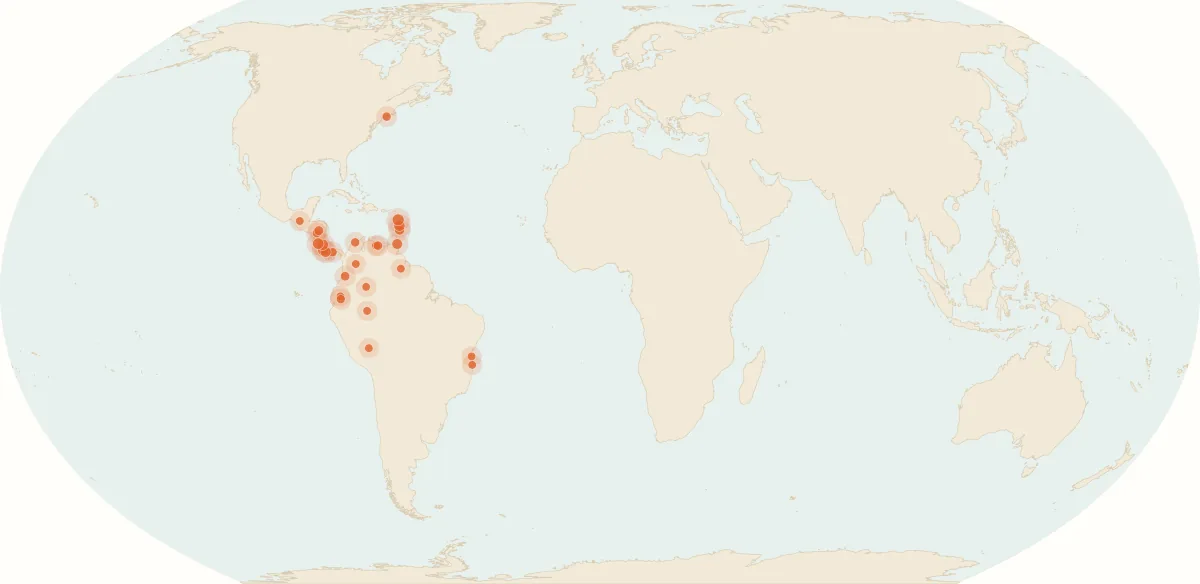
Records: GBIF.org (CC0 and CC BY 4.0 records, retrieved 2026-11-07). Map: Natural EarthSee the records on GBIF
Watch wild animals from a distance. Do not touch or feed them, and take care of the places where they live.
Names around the world
- 日本語
- ヘラクレスオオカブト
- 简体中文
- 长戟大兜虫
- 繁體中文
- 長戟大兜蟲
- 한국어
- 헤라클레스장수풍뎅이
- Español
- Escarabajo hércules
- Français
- Dynaste Hercule
- Deutsch
- Herkuleskäfer
- Português (Brasil)
- Besouro-hércules
- Italiano
- Scarabeo Ercole
- العربية
- خنفساء هرقلية
- Bahasa Indonesia
- Kumbang herkules
- Русский
- Жук-геркулес
- বাংলা
- হারকিউলিস গুবরেপোকা
Names come from Wikidata and iNaturalist records. Where a language has no recorded name, we use the scientific name.
Sources and how we check
- University of Michigan Animal Diversity Web — Dynastes herculesChecked: 2026-11-03
We check each fact against its source. The illustrations simplify how the real animal looks.
The classification (class, order, family, genus) follows Wikidata records, checked against GBIF. Classifications can change as research goes on.
The basic data are the values given in each source. They vary with how the animal is measured, whether it is male or female, and whether it lives in the wild or in captivity.
This page was translated from the original Japanese with the help of AI.
Report a mistakeRELATIVES
Others in Scarabaeidae


MORE TO MEET


