
No sign-up needed. You can save notes on this device.
An illustration based on the real animal.
A little discovery to share.
Young red firegobies may share the same hole.
THE REAL WORLD
The real Fire goby
- Scientific name
- Nemateleotris magnifica
- Japanese name
- ハタタテハゼ
- Group
- Ocean animals
- Order
- Perciformes
- Family
- Ptereleotridae
- Genus
- Nemateleotris
Where the name “Fire goby” comes from
The Japanese name Hatatate-haze comes from its long dorsal fin.
鴨川シーワールドIt lives from the Izu and Ryukyu Islands to Taiwan and across the Indian and Pacific Oceans, except the Red Sea.
How the Fire goby lives
It hovers just above the seabed. It faces into the current to eat zooplankton. Adults usually occupy burrows in pairs or alone.
Australian MuseumBasic data
- Range
- Indo-Pacific excluding the Red Sea, and elsewhere
Where the Fire goby has been recorded
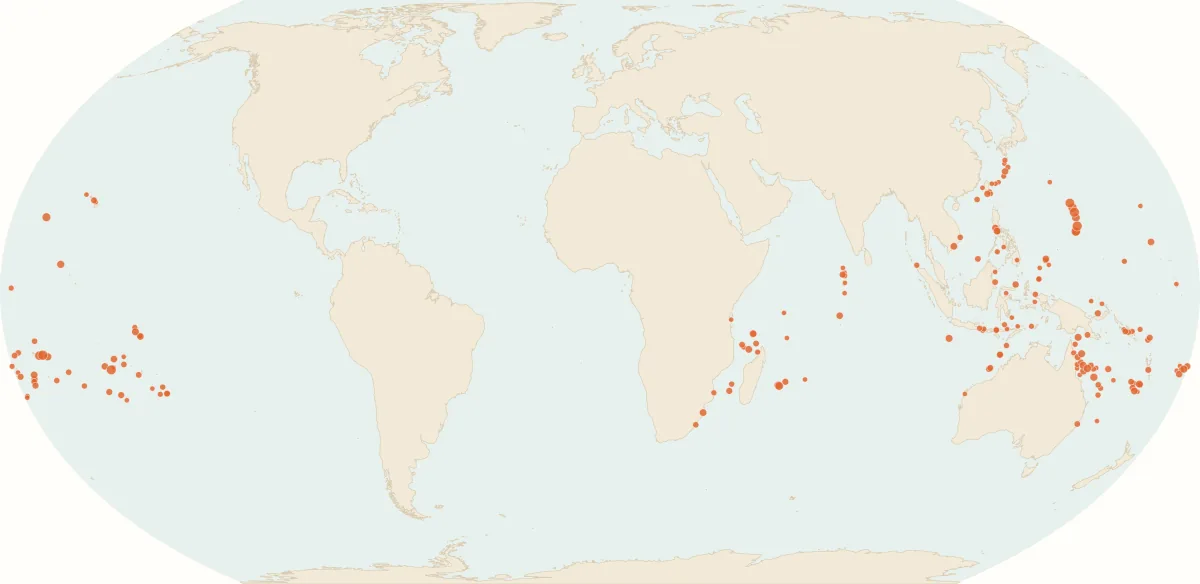
Records: GBIF.org (CC0 and CC BY 4.0 records, retrieved 2026-11-07). Map: Natural EarthSee the records on GBIF
Watch wild animals from a distance. Do not touch or feed them, and take care of the places where they live.
Names around the world
- 日本語
- ハタタテハゼ
- 简体中文
- 大口线塘鳢
- 繁體中文
- 絲鰭線塘鱧
- Español
- Gobio dardo de fuego
- Français
- Poisson de feu
- Deutsch
- Feuer-Schwertgrundel
- Português (Brasil)
- Peixe-fogo-vermelho
- Italiano
- Ghiozzo di fuoco magnifico
- Bahasa Indonesia
- Ikan bunglon api
- Русский
- Огненная рыба
- ไทย
- ปลาบู่หางแดง
Names come from Wikidata and iNaturalist records. Where a language has no recorded name, we use the scientific name.
Sources and how we check
- 鳥羽水族館 — ハタタテハゼChecked: 2026-11-04
- Australian Museum — Red Firegoby, Nemateleotris magnifica Fowler, 1938Checked: 2026-11-07
- 鴨川シーワールド — Vol.115 ~ハタタテハゼ~Checked: 2026-11-07
We check each fact against its source. The illustrations simplify how the real animal looks.
The classification (class, order, family, genus) follows Wikidata records, checked against GBIF. Classifications can change as research goes on.
The basic data are the values given in each source. They vary with how the animal is measured, whether it is male or female, and whether it lives in the wild or in captivity.
This page was translated from the original Japanese with the help of AI.
Report a mistakeRELATIVES
Others in Ptereleotridae


MORE TO MEET


