
No sign-up needed. You can save notes on this device.
An illustration based on the real animal.
A little discovery to share.
An emu’s feathers have loose strands that hang like hair.
THE REAL WORLD
The real Emu
- Scientific name
- Dromaius novaehollandiae
- Japanese name
- エミュー
- Group
- Birds
- Class
- Aves
- Order
- Casuariiformes
- Family
- Casuariidae
- Genus
- Dromaius
It lives in Australia, and among living birds it ranks second in size, after the ostrich.
Its wings are very small and reduced. Its feet are built like those of other running birds, with no backward-pointing toe.
The female lays dark green eggs, and it is the male that sits on the eggs and cares for the chicks.
How the Emu lives
Emus look for food during the day. After rain, they eat new grass shoots and caterpillars. Flocks sometimes travel long distances for food and water. The male builds a ground nest from twigs, leaves and grass.
San Diego ZooBasic data
- Size
- Total length: 150–190 cm上野動物園
- Weight
- 30–55 kg上野動物園
- Lifespan
- 5–10 years in the wild, 15–20 years in captivityUniversity of Michigan Animal Diversity Web
- Active
- By day (diurnal)University of Michigan Animal Diversity Web
- Diet
- Seeds, fruit, shoots, grasses, and insects上野動物園
- Range
- Mainland Australia上野動物園
Where the Emu has been recorded
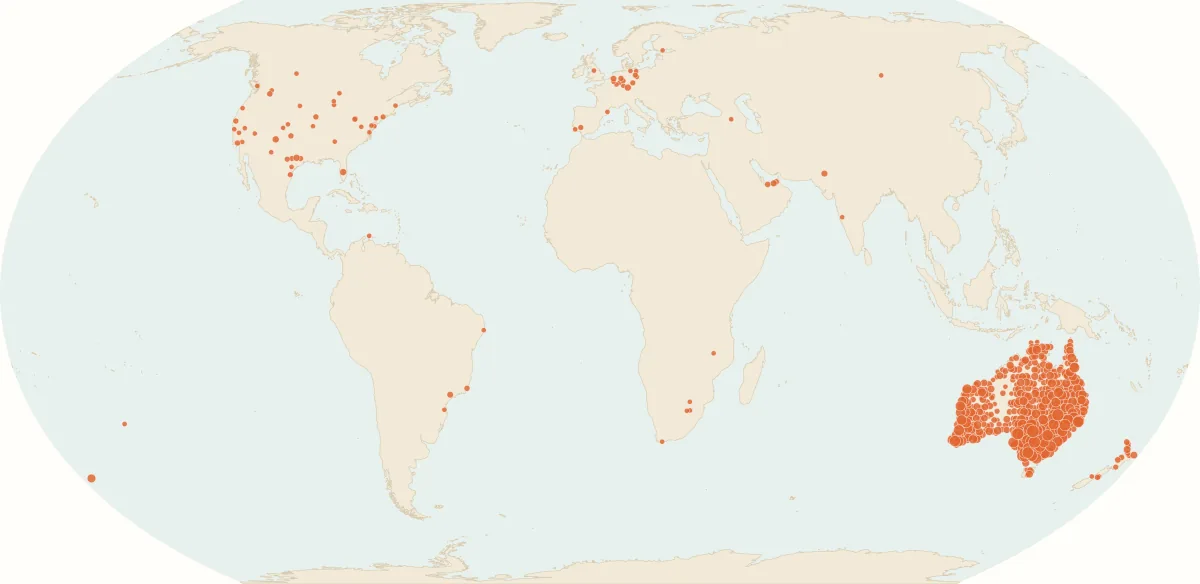
Records: GBIF.org (CC0 and CC BY 4.0 records, retrieved 2026-11-07). Map: Natural EarthSee the records on GBIF
Watch wild animals from a distance. Do not touch or feed them, and take care of the places where they live.
Names around the world
- 日本語
- エミュー
- 简体中文
- 鸸鹋
- 繁體中文
- 鴯鶓
- 한국어
- 에뮤
- Español
- Emú común
- Français
- Émeu d'Australie
- Deutsch
- Emu
- Português (Brasil)
- Emu
- Italiano
- Emù
- हिन्दी
- एमू
- العربية
- الإِيمُو
- Bahasa Indonesia
- Emu
- Tiếng Việt
- Đà điểu châu Úc
- Русский
- Эму
- Türkçe
- Emu
- ไทย
- นกอีมู
- বাংলা
- এমু
Names come from Wikidata and iNaturalist records. Where a language has no recorded name, we use the scientific name.
Sources and how we check
- 上野動物園 — エミューChecked: 2026-11-03
- University of Michigan Animal Diversity Web — Dromaius novaehollandiaeChecked: 2026-11-03
- San Diego Zoo — EmuChecked: 2026-11-05
We check each fact against its source. The illustrations simplify how the real animal looks.
The classification (class, order, family, genus) follows Wikidata records, checked against GBIF. Classifications can change as research goes on.
The basic data are the values given in each source. They vary with how the animal is measured, whether it is male or female, and whether it lives in the wild or in captivity.
This page was translated from the original Japanese with the help of AI.
Report a mistakeWhen you meet the Emu, look for this
- Look for its throat swelling when it calls.
Animals do different things from day to day, so you may not always see this.
上野動物園EXHIBIT INFORMATION
Places that keep or show the Emu
Zoos, aquariums and other places whose official websites say they keep or show this animal.
Displays can change with the animals’ health and the seasons. Check each facility’s official website before you go.
RELATIVES
Others in Casuariidae

MORE TO MEET


