Blue-green damselfish
Amazing fact
Male blue-green chromis move their tail fins to fan fertilized eggs.
Oregon Coast Aquarium
No sign-up needed. You can save notes on this device.
An illustration based on the real animal.
A little discovery to share.
Male blue-green chromis move their tail fins to fan fertilized eggs.
THE REAL WORLD
The real Blue-green damselfish
- Scientific name
- Chromis viridis
- Japanese name
- デバスズメダイ
- Group
- Ocean animals
- Order
- Blenniiformes
- Family
- Pomacentridae
- Genus
- Chromis
It lives in schools around branching corals in the western Pacific, from Amami Ōshima southward.
Its whole body is a pale blue-green. Its Japanese name comes from the teeth that stick forward from its lower jaw.
It eats zooplankton and other tiny food. When it senses danger, the whole school darts into gaps in the coral at once.
How the Blue-green damselfish lives
At spawning time, a male prepares a nest where females lay their eggs. Newly hatched young float and drift with the current. As they grow, the young settle on a reef and become adults. At night, it sleeps hidden inside a clump of coral.
Oregon Coast AquariumNausicaáBasic data
- Diet
- Zooplankton and other food
- Range
- South of Amami Oshima and the western Pacific
Where the Blue-green damselfish has been recorded
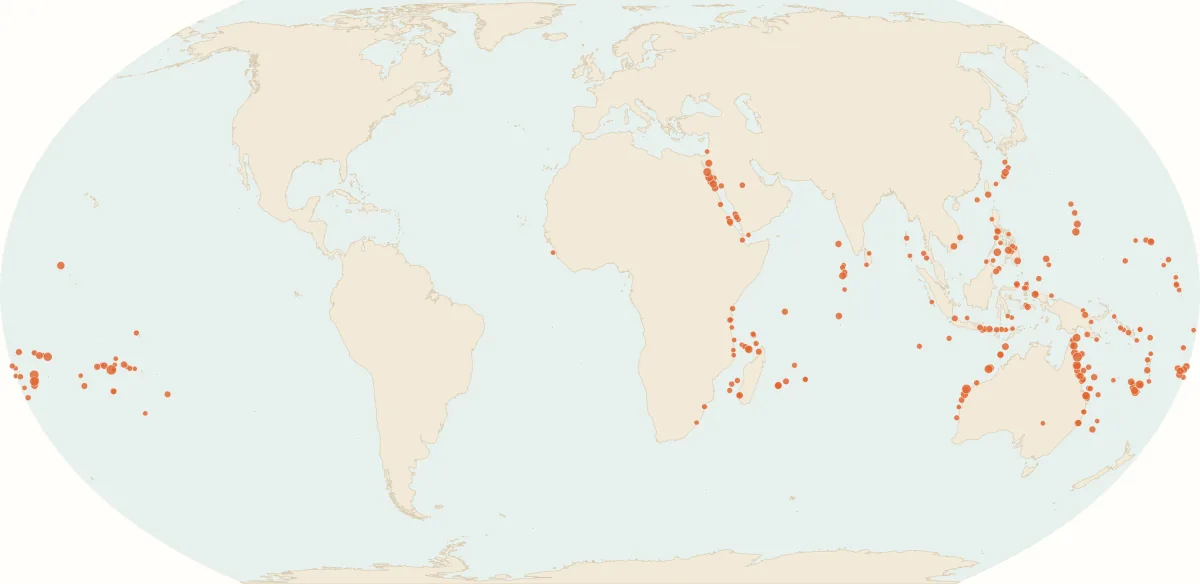
Records: GBIF.org (CC0 and CC BY 4.0 records, retrieved 2026-11-07). Map: Natural EarthSee the records on GBIF
Watch wild animals from a distance. Do not touch or feed them, and take care of the places where they live.
Names around the world
- 日本語
- デバスズメダイ
- 简体中文
- 蓝绿光鳃鱼
- 繁體中文
- 藍綠光鰓魚
- 한국어
- 그린크로미스
- Español
- Damisela verde
- Français
- Chromis vert
- Deutsch
- Grünes Schwalbenschwänzchen
- Português (Brasil)
- Donzela-esverdeada
- Italiano
- Damigella verde
- العربية
- جريين كروميس
- Bahasa Indonesia
- Betok hijau
Names come from Wikidata and iNaturalist records. Where a language has no recorded name, we use the scientific name.
Sources and how we check
- 沖縄美ら海水族館 — デバスズメダイChecked: 2026-11-03
- 鳥羽水族館 — デバスズメダイChecked: 2026-11-03
- Oregon Coast Aquarium — Blue-green ChromisChecked: 2026-11-07
- Nausicaá — La demoiselle bleu-vertChecked: 2026-11-07
We check each fact against its source. The illustrations simplify how the real animal looks.
The classification (class, order, family, genus) follows Wikidata records, checked against GBIF. Classifications can change as research goes on.
The basic data are the values given in each source. They vary with how the animal is measured, whether it is male or female, and whether it lives in the wild or in captivity.
This page was translated from the original Japanese with the help of AI.
Report a mistakeRELATIVES
Others in Pomacentridae


MORE TO MEET


