Superb brittle star
Amazing fact
Ophiolepis superba changes direction by switching which arm leads.
PubMed Central(米国国立医学図書館)
No sign-up needed. You can save notes on this device.
An illustration based on the real animal.
A little discovery to share.
A brittle star with a white body mottled with black, ring-like markings.
THE REAL WORLD
The real Superb brittle star
- Scientific name
- Ophiolepis superba
- Japanese name
- ワモンクモヒトデ
- Group
- Ocean animals
- Class
- Ophiuroidea
- Order
- Amphilepidida
- Family
- Ophiolepididae
- Genus
- Ophiolepis
It lives in seas from the Nansei Islands southward to the Indian Ocean and the western Pacific.
How the Superb brittle star lives
On the seafloor, it pushes against the ground with its flexible arms to move. Linked small bones inside its arms are moved by muscles. It can still move from place to place with arms missing.
PubMed Central(米国国立医学図書館)Basic data
- Range
- South of the Nansei Islands, Indian Ocean, and western Pacific Ocean
Where the Superb brittle star has been recorded
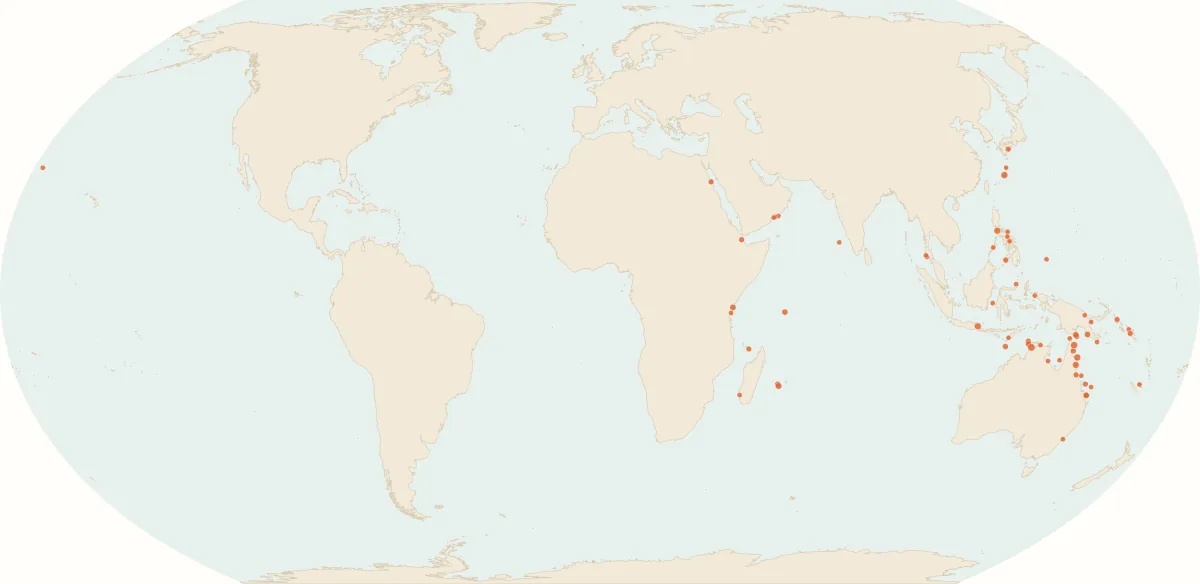
Records: GBIF.org (CC0 and CC BY 4.0 records, retrieved 2026-11-07). Map: Natural EarthSee the records on GBIF
Watch wild animals from a distance. Do not touch or feed them, and take care of the places where they live.
Names around the world
- 日本語
- ワモンクモヒトデ
- 简体中文
- 黄鳞蛇尾
- 繁體中文
- 黃鱗蛇尾
- Français
- Ophiure à anneaux pourpres
- Deutsch
- Gebänderter Schlangenstern
Names come from Wikidata and iNaturalist records. Where a language has no recorded name, we use the scientific name.
Sources and how we check
- 鳥羽水族館 — ワモンクモヒトデChecked: 2026-11-04
- PubMed Central(米国国立医学図書館) — A methodological exploration to study 2D arm kinematics in Ophiuroidea (Echinodermata)Checked: 2026-11-09
We check each fact against its source. The illustrations simplify how the real animal looks.
The classification (class, order, family, genus) follows Wikidata records, checked against GBIF. Classifications can change as research goes on.
The basic data are the values given in each source. They vary with how the animal is measured, whether it is male or female, and whether it lives in the wild or in captivity.
This page was translated from the original Japanese with the help of AI.
Report a mistakeRELATIVES
Others in Amphilepidida


MORE TO MEET


