Horse

No sign-up needed. You can save notes on this device.
An illustration based on the real animal.
A little discovery to share.
Horses can sleep while standing up.
THE REAL WORLD
The real Horse
- Scientific name
- Equus caballus
- Japanese name
- ウマ
- Group
- Land mammals
- Class
- Mammalia
- Order
- Perissodactyla
- Family
- Equidae
- Genus
- Equus
The horse is a domesticated animal.
Many breeds have been developed around the world for different jobs, such as carrying people, hauling loads and plowing fields.
In Japan, too, horses have been kept in many regions since long ago and have become local breeds known as Japanese native horses.
It mainly eats grass. Wild and feral horses live in herds with a ranking order.
How the Horse lives
In summer, they graze in the morning or evening to avoid midday heat. They also visit water sources at night. They sleep in short stretches throughout the day.
University of Michigan Animal Diversity WebBasic data
- Size
- Shoulder height: 110–130 cm上野動物園
- Lifespan
- up to 36 years in the wild, up to 61 years in captivityUniversity of Michigan Animal Diversity Web
- Active
- At dawn and duskUniversity of Michigan Animal Diversity Web
- Diet
- Grass上野動物園
Where the Horse has been recorded
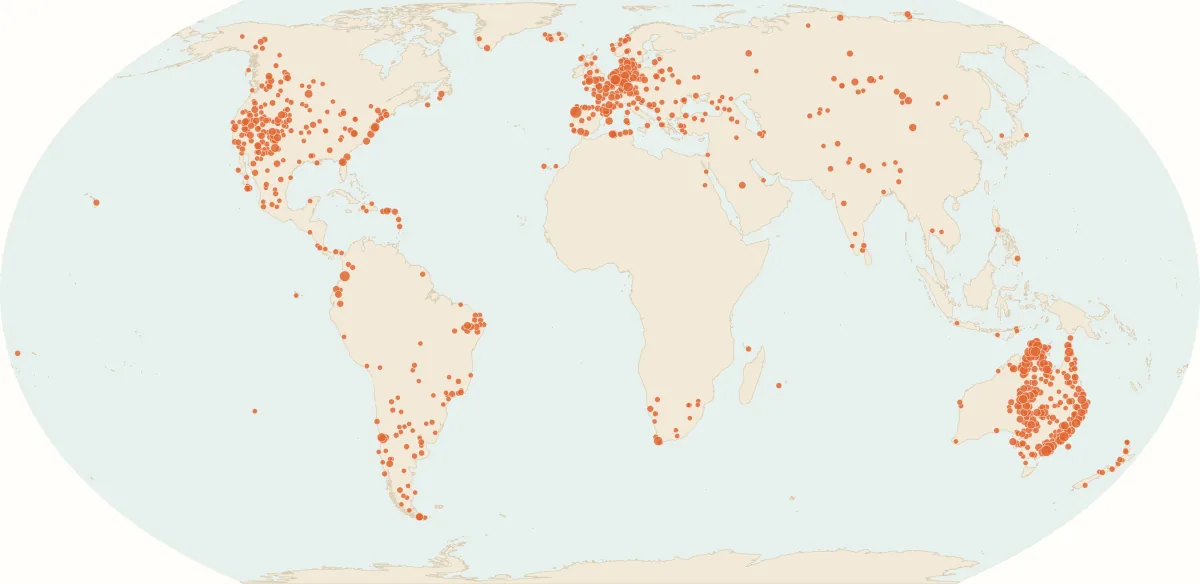
Records: GBIF.org (CC0 and CC BY 4.0 records, retrieved 2026-11-07). Map: Natural EarthSee the records on GBIF
Watch wild animals from a distance. Do not touch or feed them, and take care of the places where they live.
Names around the world
- 日本語
- ウマ
- 简体中文
- 马
- 繁體中文
- 馬
- 한국어
- 말
- Español
- Caballo
- Français
- Cheval
- Deutsch
- Hauspferd
- Português (Brasil)
- Cavalo
- Italiano
- Cavallo domestico
- العربية
- حصان
- Bahasa Indonesia
- Kuda
- Русский
- Домашняя Лошадь
- Türkçe
- At
- ไทย
- ม้า
Names come from Wikidata and iNaturalist records. Where a language has no recorded name, we use the scientific name.
Sources and how we check
- 上野動物園 — ウマChecked: 2026-11-03
- University of Michigan Animal Diversity Web — Equus caballusChecked: 2026-11-03
We check each fact against its source. The illustrations simplify how the real animal looks.
The classification (class, order, family, genus) follows Wikidata records, checked against GBIF. Classifications can change as research goes on.
The basic data are the values given in each source. They vary with how the animal is measured, whether it is male or female, and whether it lives in the wild or in captivity.
This page was translated from the original Japanese with the help of AI.
Report a mistakeWhen you meet the Horse, look for this
- Look for the long mane growing along the neck.
- Look for the whiskers around the nose and cheeks.
Animals do different things from day to day, so you may not always see this.
University of Michigan Animal Diversity WebEXHIBIT INFORMATION
Places that keep or show the Horse
Zoos, aquariums and other places whose official websites say they keep or show this animal.
Displays can change with the animals’ health and the seasons. Check each facility’s official website before you go.
RELATIVES
Others in Equidae


MORE TO MEET


