Chum salmon

No sign-up needed. You can save notes on this device.
An illustration based on the real animal.
A little discovery to share.
Chum salmon cover their spawning nests with gravel.
THE REAL WORLD
The real Chum salmon
- Scientific name
- Oncorhynchus keta
- Japanese name
- サケ(シロザケ)
- Group
- Ocean animals
- Order
- Salmoniformes
- Family
- Salmonidae
- Genus
- Oncorhynchus
It hatches in a river and grows up in the ocean. When it is ready to spawn, it returns to the river where it was born.
When it enters a river its colors change dramatically to bold red and black stripes, and males grow huge fang-like teeth.
All chum salmon die after spawning, and their bodies become a source of energy and nutrients for life in the river.
How the Chum salmon lives
Young chum salmon eat insects as they travel downriver. As it grows, it moves offshore across the North Pacific. Adults eat fish, squid and other animals.
NOAA FisheriesBasic data
- Range
- North Pacific Ocean, Arctic coast of Canada, and northern coasts of North America and Asia
Where the Chum salmon has been recorded
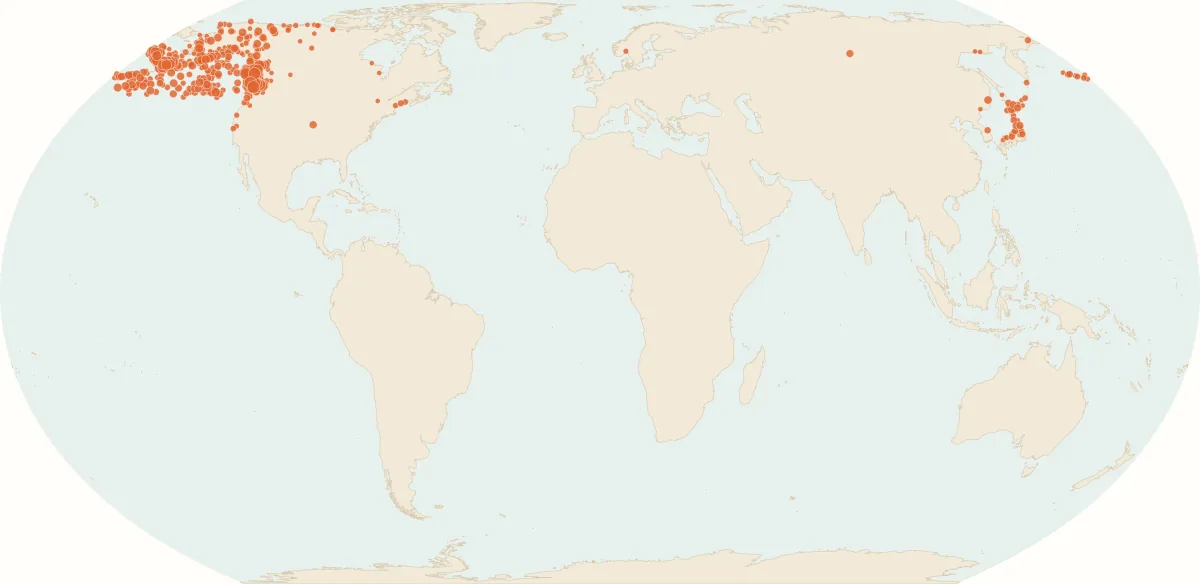
Records: GBIF.org (CC0 and CC BY 4.0 records, retrieved 2026-11-07). Map: Natural EarthSee the records on GBIF
Watch wild animals from a distance. Do not touch or feed them, and take care of the places where they live.
Names around the world
- 日本語
- サケ(シロザケ)
- 简体中文
- 大马哈鱼
- 繁體中文
- 大馬哈魚
- 한국어
- 연어
- Español
- Salmón chum
- Français
- Saumon kéta
- Deutsch
- Ketalachs
- Português (Brasil)
- Salmão-cão
- Italiano
- Salmone keta
- Tiếng Việt
- Cá hồi Chum
- Русский
- Кета
Names come from Wikidata and iNaturalist records. Where a language has no recorded name, we use the scientific name.
Sources and how we check
- NOAA Fisheries — Chum salmonChecked: 2026-11-03
We check each fact against its source. The illustrations simplify how the real animal looks.
The classification (class, order, family, genus) follows Wikidata records, checked against GBIF. Classifications can change as research goes on.
The basic data are the values given in each source. They vary with how the animal is measured, whether it is male or female, and whether it lives in the wild or in captivity.
This page was translated from the original Japanese with the help of AI.
Report a mistakeRELATIVES
Others in Salmonidae


MORE TO MEET


