Oscar
Amazing fact
An oscar’s eyes turn black when it loses a fight with another fish.
University of Michigan Animal Diversity Web
No sign-up needed. You can save notes on this device.
An illustration based on the real animal.
A little discovery to share.
An oscar’s eyes turn black when it loses a fight with another fish.
THE REAL WORLD
The real Oscar
- Scientific name
- Astronotus ocellatus
- Japanese name
- オスカー(アストロノータス)
- Group
- Freshwater animals
- Order
- Blenniiformes
- Family
- Cichlidae
- Genus
- Astronotus
A member of the cichlid family that lives in South American rivers such as the Amazon.
At the base of its dorsal fin it has eye-like spots that are black, ringed with orange and red.
The male and female clean the spot where the eggs are laid together, and guard the nest both before and after the eggs hatch.
How the Oscar lives
It lives in shallow, calm rivers and similar waters. It sucks snails, shrimp, insects and other food from the muddy riverbed. It displays its side to show an intruder its size.
University of Michigan Animal Diversity WebBasic data
- Size
- 30–40 cm, average 35 cm
- Weight
- average 1.58 kg
- Diet
- Snails, shrimp, insects, clams and detritus
- Range
- Amazon and Orinoco Rivers and tributaries in South America
Where the Oscar has been recorded
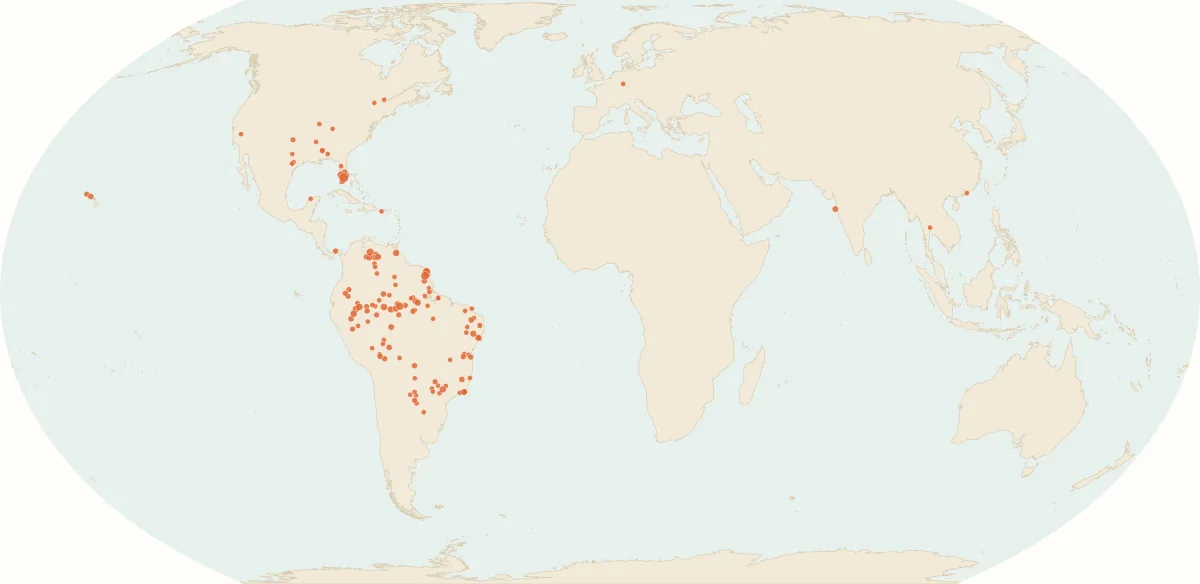
Records: GBIF.org (CC0 and CC BY 4.0 records, retrieved 2026-11-07). Map: Natural EarthSee the records on GBIF
Watch wild animals from a distance. Do not touch or feed them, and take care of the places where they live.
Names around the world
- 简体中文
- 地图鱼
- 繁體中文
- 地圖魚
- 한국어
- 오스카
- Español
- Óscar
- Français
- Oscar
- Deutsch
- Pfauenaugenbuntbarsch
- Português (Brasil)
- Acará-grande
- Italiano
- Oscar
- العربية
- أوسكار
- Bahasa Indonesia
- Ikan oskar
- Tiếng Việt
- Cá tai tượng châu Phi
- Русский
- Глазчатый астронотус
- Türkçe
- Astronot balığı
- ไทย
- ปลาออสการ์
Names come from Wikidata and iNaturalist records. Where a language has no recorded name, we use the scientific name.
Sources and how we check
- 鳥羽水族館 — オスカー(アストロノータス.オセレータス)Checked: 2026-11-04
- University of Michigan Animal Diversity Web — Astronotus ocellatusChecked: 2026-11-04
We check each fact against its source. The illustrations simplify how the real animal looks.
The classification (class, order, family, genus) follows Wikidata records, checked against GBIF. Classifications can change as research goes on.
The basic data are the values given in each source. They vary with how the animal is measured, whether it is male or female, and whether it lives in the wild or in captivity.
This page was translated from the original Japanese with the help of AI.
Report a mistakeRELATIVES
Others in Cichlidae


MORE TO MEET


