Jarbua terapon

No sign-up needed. You can save notes on this device.
An illustration based on the real animal.
A little discovery to share.
The crescent grunter is said to sometimes eat scales from other fish.
THE REAL WORLD
The real Jarbua terapon
- Scientific name
- Terapon jarbua
- Japanese name
- コトヒキ
- Group
- Ocean animals
- Order
- Perciformes
- Family
- Terapontidae
- Genus
- Terapon
Where the name “Jarbua terapon” comes from
Its Japanese name refers to the swim-bladder sound being like a koto, a Japanese string instrument.
公益財団法人 四万十川財団It lives along the coasts of Japan from Hokkaido to the Ryukyu Islands, and off China, Taiwan and across the Indian Ocean and western Pacific.
How the Jarbua terapon lives
Young fish enter rivers from midsummer to autumn. It eats fish, crustaceans and bristle worms. It often moves in groups. When it senses danger, it slips into gaps among stones or debris and presses its body against them.
公益財団法人 四万十川財団Basic data
- Range
- Seto Inland Sea, Tanegashima, Yakushima, Ryukyu Islands, Korean Peninsula coast, Taiwan, Indo-West Pacific, and elsewhere
Where the Jarbua terapon has been recorded
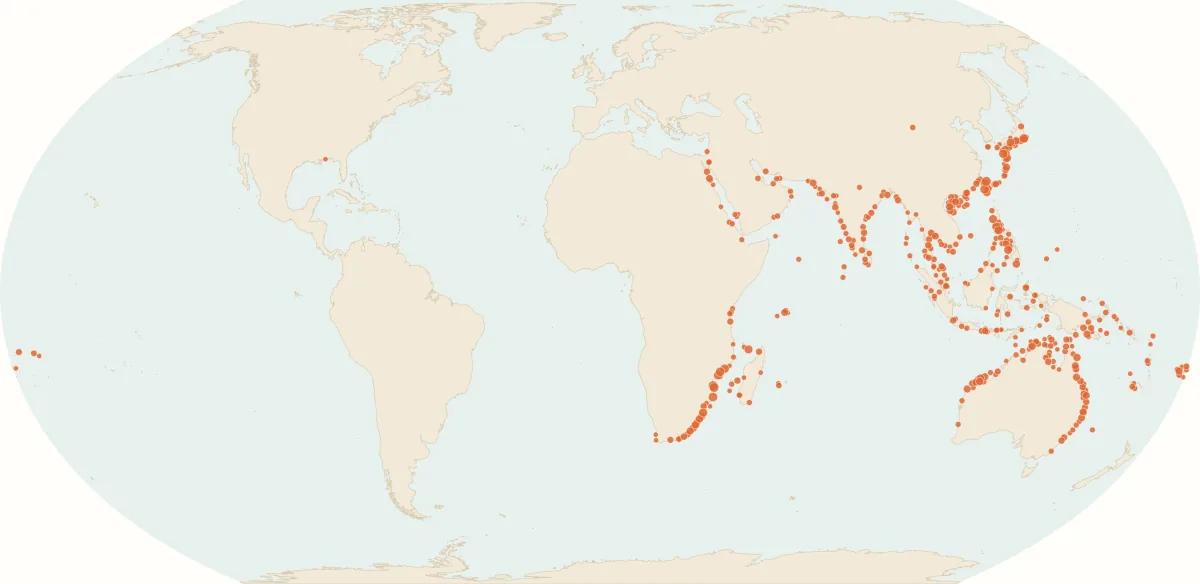
Records: GBIF.org (CC0 and CC BY 4.0 records, retrieved 2026-11-07). Map: Natural EarthSee the records on GBIF
Watch wild animals from a distance. Do not touch or feed them, and take care of the places where they live.
Names around the world
- 日本語
- コトヒキ
- 简体中文
- 花身鯻
- 繁體中文
- 花身鯻
- 한국어
- 살벤자리
- Español
- Jarbua terapon
- Français
- Violon jarbua
- Deutsch
- Dreistreifen-Tigerbarsch
- العربية
- سمكة برعم
- Bahasa Indonesia
- Kerong-kerong
- Tiếng Việt
- Cá ong
- Русский
- Трёхполосый терапон
Names come from Wikidata and iNaturalist records. Where a language has no recorded name, we use the scientific name.
Sources and how we check
- 鳥羽水族館 — コトヒキChecked: 2026-11-04
- 大阪府立環境農林水産総合研究所 — コトヒキChecked: 2026-11-07
- 公益財団法人 四万十川財団 — 四万十川の魚 93 コトヒキChecked: 2026-11-07
We check each fact against its source. The illustrations simplify how the real animal looks.
The classification (class, order, family, genus) follows Wikidata records, checked against GBIF. Classifications can change as research goes on.
The basic data are the values given in each source. They vary with how the animal is measured, whether it is male or female, and whether it lives in the wild or in captivity.
This page was translated from the original Japanese with the help of AI.
Report a mistakeRELATIVES
Others in Terapontidae


MORE TO MEET


