Black jack
Amazing fact
The black jack has pectoral fins longer than its head.
Smithsonian Tropical Research Institute
No sign-up needed. You can save notes on this device.
An illustration based on the real animal.
A little discovery to share.
The black jack has pectoral fins longer than its head.
THE REAL WORLD
The real Black jack
- Scientific name
- Caranx lugubris
- Japanese name
- カッポレ
- Group
- Ocean animals
- Order
- Carangiformes
- Family
- Carangidae
- Genus
- Caranx
A large member of the jack family that lives on coral reefs from the Pacific coast of southern Japan to the Ryukyu Islands and across the Indian and Pacific Oceans.
The hard scales along its sides, called scutes, are black, which makes it easy to recognize.
How the Black jack lives
It lives on outer reef slopes and where the seabed drops away steeply. It generally lives without forming a school.
Australian MuseumBasic data
- Range
- Pacific coast of southern Japan to the Ryukyu Islands, and the Indo-Pacific
Where the Black jack has been recorded
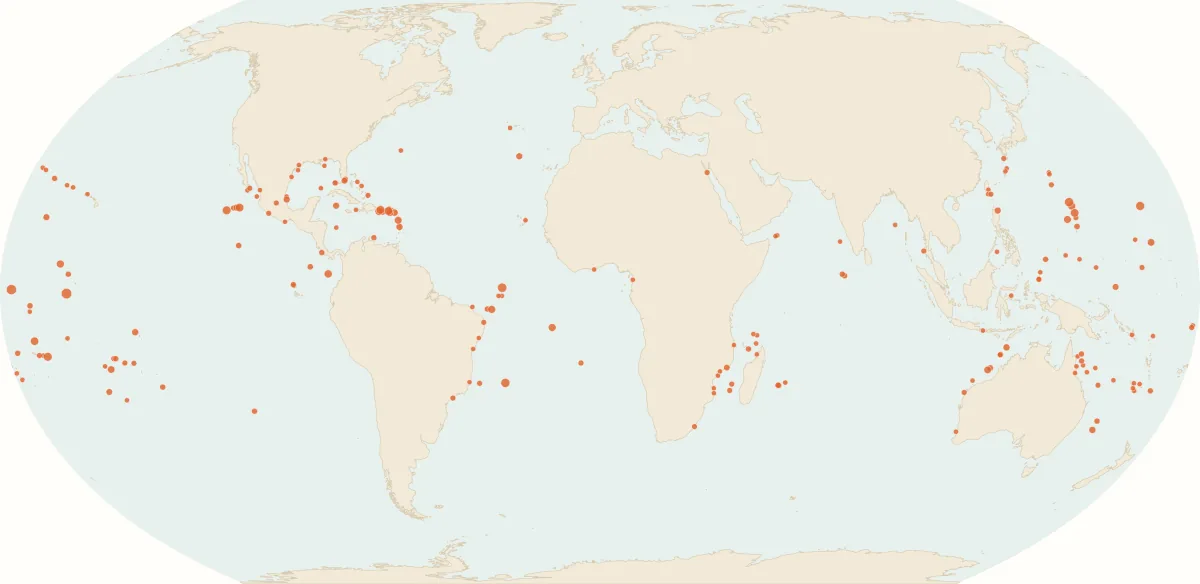
Records: GBIF.org (CC0 and CC BY 4.0 records, retrieved 2026-11-07). Map: Natural EarthSee the records on GBIF
Watch wild animals from a distance. Do not touch or feed them, and take care of the places where they live.
Names around the world
- 日本語
- カッポレ
- 简体中文
- 阔步鲹
- 繁體中文
- 闊步鰺
- Español
- Jurel negro
- Français
- Carangue noire
- Deutsch
- Schwarze Stachelmakrele
- Português (Brasil)
- Xaréu-preto
- العربية
- شيم حزين
- Русский
- Островной каранкс
Names come from Wikidata and iNaturalist records. Where a language has no recorded name, we use the scientific name.
Sources and how we check
- 鳥羽水族館 — カッポレChecked: 2026-11-04
- Australian Museum — Black Trevally, Caranx lugubris (Poey, 1860)Checked: 2026-11-07
- Smithsonian Tropical Research Institute — Species: Caranx lugubris, Black JackChecked: 2026-11-07
We check each fact against its source. The illustrations simplify how the real animal looks.
The classification (class, order, family, genus) follows Wikidata records, checked against GBIF. Classifications can change as research goes on.
The basic data are the values given in each source. They vary with how the animal is measured, whether it is male or female, and whether it lives in the wild or in captivity.
This page was translated from the original Japanese with the help of AI.
Report a mistakeRELATIVES
Others in Carangidae


MORE TO MEET


