Common snapping turtle
Amazing fact
A snapping turtle may bury itself in mud with its eyes and nostrils exposed to ambush prey.
University of Michigan Animal Diversity Web
No sign-up needed. You can save notes on this device.
An illustration based on the real animal.
A little discovery to share.
A snapping turtle may bury itself in mud with its eyes and nostrils exposed to ambush prey.
THE REAL WORLD
The real Common snapping turtle
- Scientific name
- Chelydra serpentina
- Japanese name
- カミツキガメ
- Group
- Amphibians and reptiles
- Class
- Reptilia
- Order
- Testudines
- Family
- Chelydridae
- Genus
- Chelydra
Originally a turtle of freshwater shores in North America. In Japan, some that were brought in as pets now live in the wild.
Its legs are thick and sturdy, with sharp claws. The shell on its belly side is small, so it cannot pull its legs and tail inside.
When taken out of the water it can become very fierce, but it calms down once it is put back in the water.
How the Common snapping turtle lives
It is active during the day. It eats fish and insects as well as aquatic plants. It uses smell, sight and touch to detect prey.
University of Michigan Animal Diversity Web井の頭自然文化園Basic data
- Size
- Carapace length: about 40 cm井の頭自然文化園
- Weight
- 4–16 kgUniversity of Michigan Animal Diversity Web
- Lifespan
- up to 47 years in captivityUniversity of Michigan Animal Diversity Web
- Active
- By day (diurnal)University of Michigan Animal Diversity Web
- Diet
- Fish, insects, crustaceans, waterbirds, aquatic plants, and other food井の頭自然文化園
- Range
- North America井の頭自然文化園
Where the Common snapping turtle has been recorded
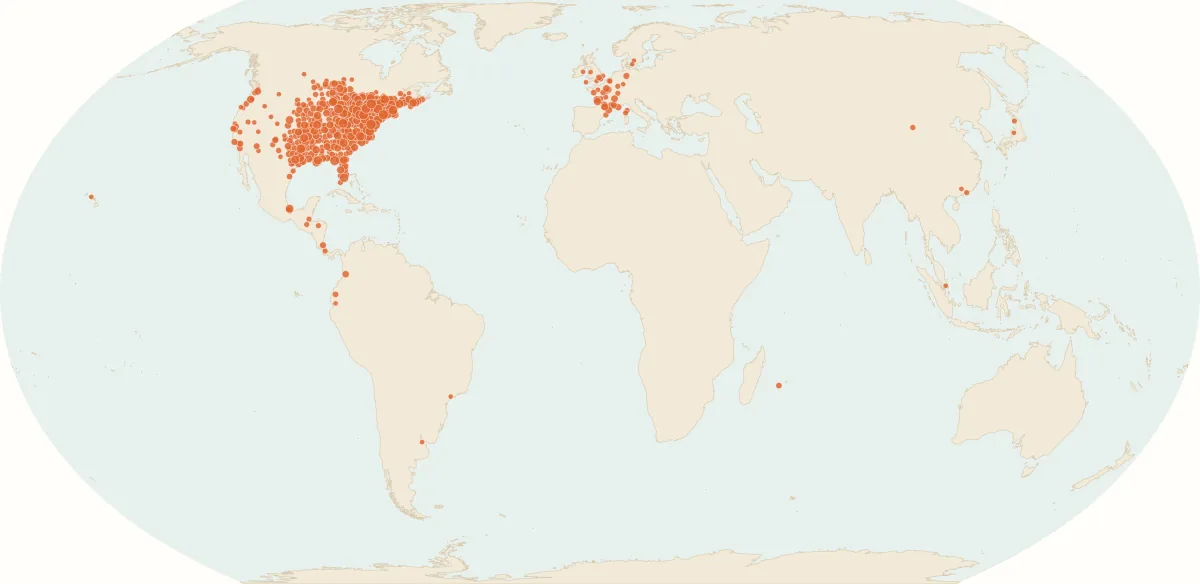
Records: GBIF.org (CC0 and CC BY 4.0 records, retrieved 2026-11-07). Map: Natural EarthSee the records on GBIF
Watch wild animals from a distance. Do not touch or feed them, and take care of the places where they live.
Names around the world
- 日本語
- カミツキガメ
- 简体中文
- 拟鳄龟
- 繁體中文
- 擬鱷龜
- 한국어
- 늑대거북
- Español
- Tortuga serpentina
- Français
- Tortue serpentine
- Deutsch
- Schnappschildkröte
- Português (Brasil)
- Tartaruga-mordedora
- Italiano
- Testuggine azzannatrice
- العربية
- سلحفاة نهاشة شائعة
- Русский
- Каймановая черепаха
- Türkçe
- Yılansı kapan kaplumbağa
Names come from Wikidata and iNaturalist records. Where a language has no recorded name, we use the scientific name.
Sources and how we check
- 井の頭自然文化園 — カミツキガメChecked: 2026-11-03
- University of Michigan Animal Diversity Web — Chelydra serpentinaChecked: 2026-11-03
We check each fact against its source. The illustrations simplify how the real animal looks.
The classification (class, order, family, genus) follows Wikidata records, checked against GBIF. Classifications can change as research goes on.
The basic data are the values given in each source. They vary with how the animal is measured, whether it is male or female, and whether it lives in the wild or in captivity.
This page was translated from the original Japanese with the help of AI.
Report a mistakeWhen you meet the Common snapping turtle, look for this
- Look for the saw-toothed ridges on its tail.
Animals do different things from day to day, so you may not always see this.
University of Michigan Animal Diversity WebEXHIBIT INFORMATION
Places that keep or show the Common snapping turtle
Zoos, aquariums and other places whose official websites say they keep or show this animal.
Kanto
Displays can change with the animals’ health and the seasons. Check each facility’s official website before you go.
RELATIVES
Others in Chelydridae

MORE TO MEET


