Tiger cowrie
Amazing fact
The tiger cowrie can cover its whole shell with a thin, translucent fold of flesh.
Aquarium La Rochelle
No sign-up needed. You can save notes on this device.
An illustration based on the real animal.
A little discovery to share.
The tiger cowrie can cover its whole shell with a thin, translucent fold of flesh.
THE REAL WORLD
The real Tiger cowrie
- Scientific name
- Cypraea tigris
- Japanese name
- ホシダカラ
- Group
- Ocean animals
- Class
- Gastropoda
- Order
- Littorinimorpha
- Family
- Cypraeidae
- Genus
- Cypraea
A cowrie that lives from south of the Miura Peninsula and northern Yamaguchi Prefecture across the Indo-West Pacific.
Its name is written with the kanji for "star" and "treasure," and its shell is scattered with black spots.
How the Tiger cowrie lives
It can be seen during both the day and the night. It uses a rough tongue to eat algae, small animals and animal carcasses. It is often found on colonies of living coral.
Aquarium La RochelleNational Parks BoardBasic data
- Range
- South of the Miura Peninsula and northern Yamaguchi Prefecture, and the Indian and western Pacific oceans
Where the Tiger cowrie has been recorded
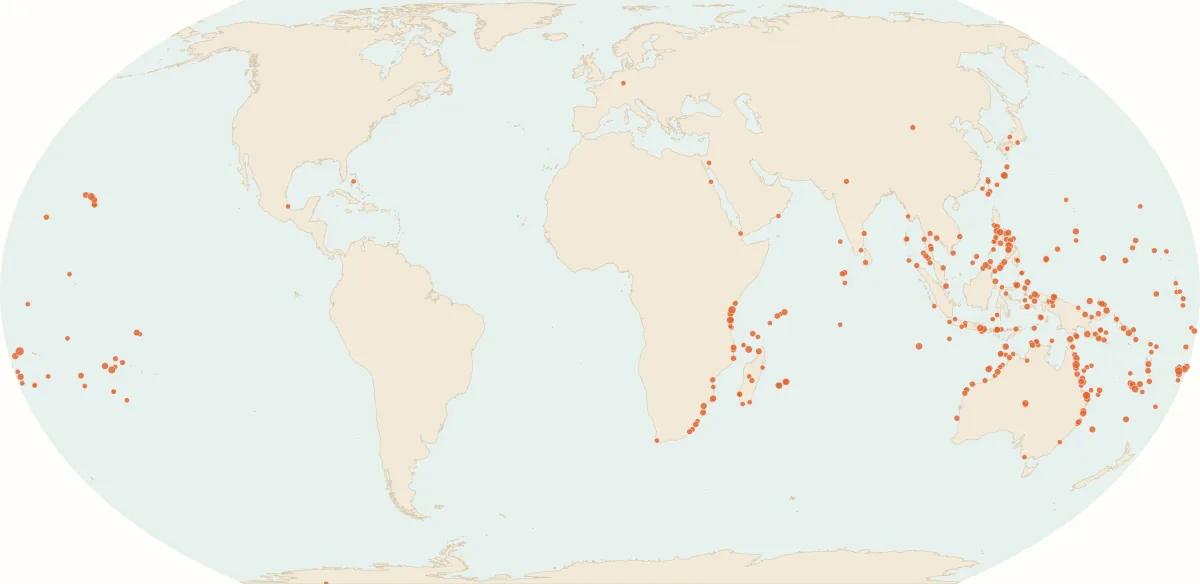
Records: GBIF.org (CC0 and CC BY 4.0 records, retrieved 2026-11-07). Map: Natural EarthSee the records on GBIF
Watch wild animals from a distance. Do not touch or feed them, and take care of the places where they live.
Names around the world
- 日本語
- ホシダカラ
- 简体中文
- 黑星宝螺
- 繁體中文
- 黑星寶螺
- Français
- Porcelaine tigrée
- Deutsch
- Tiger-Kaurie
- Português (Brasil)
- Búzio-tigre
- Italiano
- Ciprea tigrata
- Bahasa Indonesia
- Kuwuk macan
- Tiếng Việt
- Ốc sứ vân hổ
- Русский
- Тигровая ципрея
Names come from Wikidata and iNaturalist records. Where a language has no recorded name, we use the scientific name.
Sources and how we check
- 鳥羽水族館 — ホシダカラChecked: 2026-11-04
- Aquarium La Rochelle — Tiger CowrieChecked: 2026-11-07
- National Parks Board — Cypraea tigrisChecked: 2026-11-07
We check each fact against its source. The illustrations simplify how the real animal looks.
The classification (class, order, family, genus) follows Wikidata records, checked against GBIF. Classifications can change as research goes on.
The basic data are the values given in each source. They vary with how the animal is measured, whether it is male or female, and whether it lives in the wild or in captivity.
This page was translated from the original Japanese with the help of AI.
Report a mistakeRELATIVES
Others in Cypraeidae


MORE TO MEET


