Guppy

No sign-up needed. You can save notes on this device.
An illustration based on the real animal.
A little discovery to share.
A male guppy’s anal fin extends into a mating organ.
THE REAL WORLD
The real Guppy
- Scientific name
- Poecilia reticulata
- Japanese name
- グッピー
- Group
- Freshwater animals
- Order
- Cyprinodontiformes
- Family
- Poeciliidae
- Genus
- Poecilia
A fish that lives in warm streams and channels in places such as northern South America.
Females are larger than males, and males often have spots of many colors on their fins and sides.
It is a livebearer: the eggs hatch inside the mother, and she gives birth to young fish.
How the Guppy lives
They eat algae and small animals among other food. In Japan, they spread into places without hot spring influence in summer. In winter, they are found where hot spring water flows in.
国立環境研究所 侵入生物データベースBasic data
- Size
- Total length: males 3.5 cm, females 5 cm
- Diet
- Algae, small animals and organic matter in domestic wastewater
- Range
- Venezuela to the Guianas
Where the Guppy has been recorded
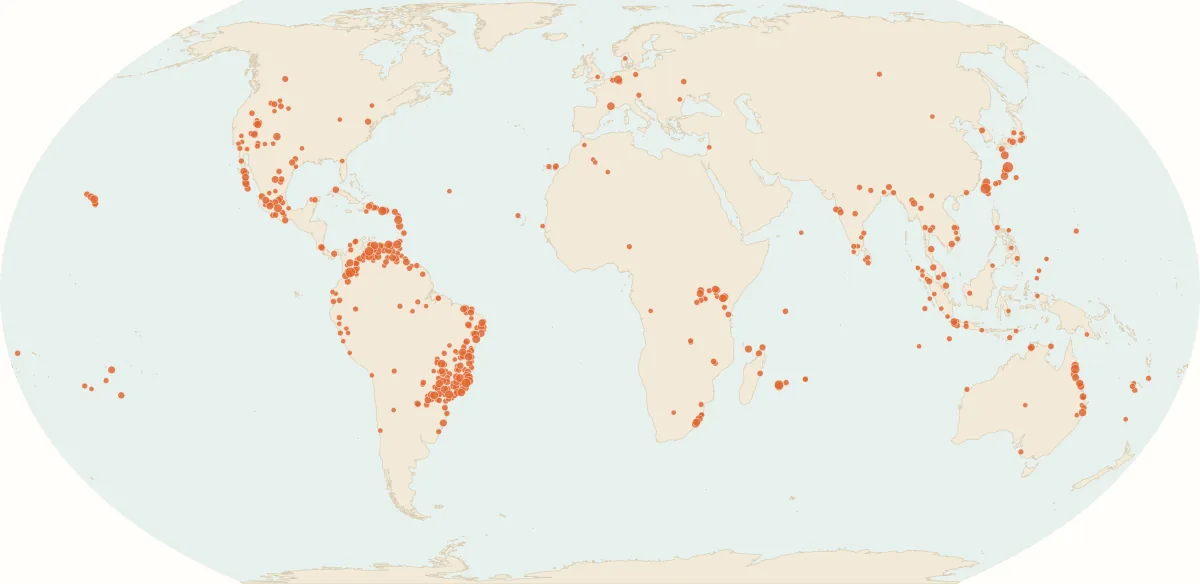
Records: GBIF.org (CC0 and CC BY 4.0 records, retrieved 2026-11-07). Map: Natural EarthSee the records on GBIF
Watch wild animals from a distance. Do not touch or feed them, and take care of the places where they live.
Names around the world
- 日本語
- グッピー
- 简体中文
- 孔雀鱼
- 繁體中文
- 虹鱂
- 한국어
- 구피
- Español
- Guppy
- Français
- Guppy
- Deutsch
- Guppy
- Português (Brasil)
- Guppy
- Italiano
- Guppy
- हिन्दी
- गप्पी मछली
- العربية
- غَبّي
- Bahasa Indonesia
- Gupi
- Tiếng Việt
- Cá bảy màu
- Русский
- Гуппи
- Türkçe
- Lepistes
- ไทย
- ปลาหางนกยูง
- বাংলা
- গাপ্পি
- اردو
- گپی مچھلی
Names come from Wikidata and iNaturalist records. Where a language has no recorded name, we use the scientific name.
Sources and how we check
- 国立環境研究所 侵入生物データベース — グッピーChecked: 2026-11-03
- USGS Nonindigenous Aquatic Species — Guppy (Poecilia reticulata)Checked: 2026-11-03
We check each fact against its source. The illustrations simplify how the real animal looks.
The classification (class, order, family, genus) follows Wikidata records, checked against GBIF. Classifications can change as research goes on.
The basic data are the values given in each source. They vary with how the animal is measured, whether it is male or female, and whether it lives in the wild or in captivity.
This page was translated from the original Japanese with the help of AI.
Report a mistakeMORE TO MEET


