
No sign-up needed. You can save notes on this device.
An illustration based on the real animal.
A little discovery to share.
A pig uses its round snout to root through dirt.
THE REAL WORLD
The real Pig
- Scientific name
- Sus scrofa domesticus
- Japanese name
- ブタ
- Group
- Land mammals
- Class
- Mammalia
- Order
- Artiodactyla
- Family
- Suidae
- Genus
- Sus
The pig is a domestic animal and is treated scientifically as a subspecies of the wild boar.
It is a farm animal that people tamed from the wild boar, and today it is kept all over the world.
Studies show that a mother pig uses her excellent sense of smell to tell her own piglets apart from other piglets.
How the Pig lives
Domestic pigs tend to be active by day and sleep at night. They eat both plants and animals. They wallow in mud to help regulate their body temperature.
Smithsonian's National Zoo and Conservation Biology InstituteSaginaw Children’s ZooWhere the Pig has been recorded
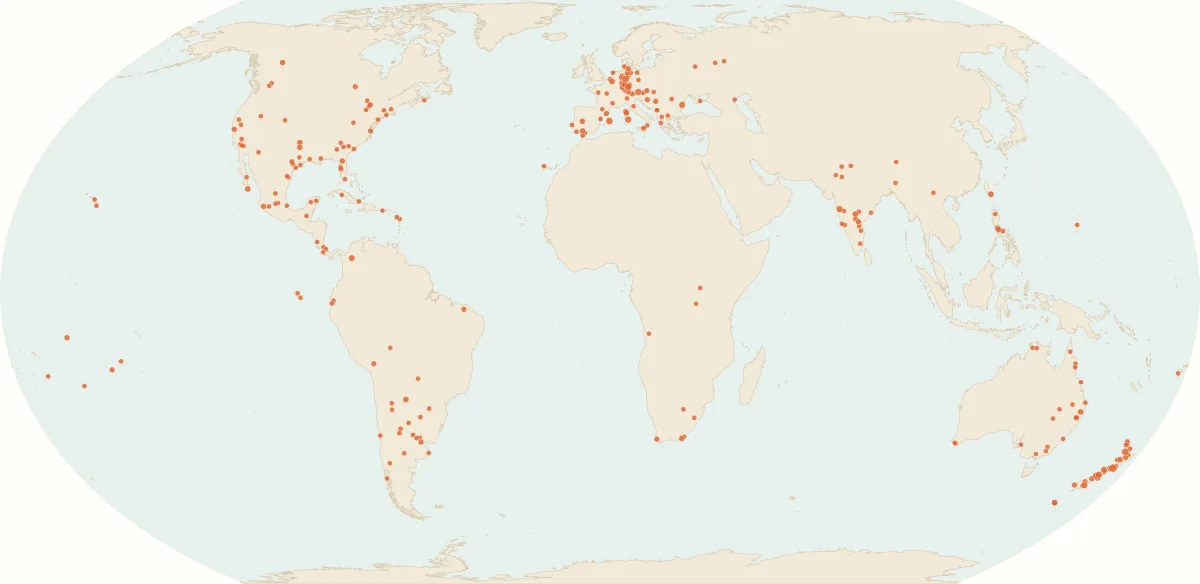
Records: GBIF.org (CC0 and CC BY 4.0 records, retrieved 2026-11-07). Map: Natural EarthSee the records on GBIF
Watch wild animals from a distance. Do not touch or feed them, and take care of the places where they live.
Names around the world
- 日本語
- ブタ
- 简体中文
- 家猪
- 繁體中文
- 家豬
- 한국어
- 돼지
- Español
- Cerdo
- Français
- Porc
- Deutsch
- Hausschwein
- Português (Brasil)
- Porco doméstico
- Italiano
- Maiale
- हिन्दी
- घरेलू सुअर
- العربية
- خنزير أليف
- Bahasa Indonesia
- Babi
- Tiếng Việt
- Lợn nhà
- Русский
- Свинья
- Türkçe
- Evcil domuz
- ไทย
- สุกร
- বাংলা
- শূকর
- اردو
- سؤر
Names come from Wikidata and iNaturalist records. Where a language has no recorded name, we use the scientific name.
Sources and how we check
- 金沢動物園 — ブタ(ミニブタ)Checked: 2026-11-03
- University of Michigan Animal Diversity Web — Sus scrofaChecked: 2026-11-03
- Saginaw Children’s Zoo — Domestic PigChecked: 2026-11-05
- Smithsonian's National Zoo and Conservation Biology Institute — Kunekune pigChecked: 2026-11-05
We check each fact against its source. The illustrations simplify how the real animal looks.
The classification (class, order, family, genus) follows Wikidata records, checked against GBIF. Classifications can change as research goes on.
This page was translated from the original Japanese with the help of AI.
Report a mistakeRELATIVES
Others in Suidae

MORE TO MEET


