Bolivian squirrel monkey
Amazing fact
Bolivian squirrel monkeys put urine on their hands, feet and bodies, leaving a scent trail as they travel.
University of Michigan Animal Diversity Web
No sign-up needed. You can save notes on this device.
An illustration based on the real animal.
A little discovery to share.
Bolivian squirrel monkeys put urine on their hands, feet and bodies, leaving a scent trail as they travel.
THE REAL WORLD
The real Bolivian squirrel monkey
- Scientific name
- Saimiri boliviensis
- Japanese name
- ボリビアリスザル
- Group
- Land mammals
- Class
- Mammalia
- Order
- Primates
- Family
- Cebidae
- Genus
- Saimiri
It is a monkey of the upper Amazon, in countries such as Bolivia, Brazil and Peru, that lives in large troops.
Its head is blackish, its eye area and ears are white, and its hands and feet are yellow. Its tail is longer than its body but cannot grip things.
It often leaps as it moves through the trees, and it mainly eats insects and fruit.
How the Bolivian squirrel monkey lives
They are active during the day. They look for food at the ends of branches. They sometimes come down from the treetops to look for food in low shrubs or on the forest floor. They give calls that warn of predators.
University of Michigan Animal Diversity Web日本モンキーセンターBasic data
- Diet
- Insects and fruit
- Range
- Upper Amazon basin in Bolivia, Brazil, Peru, and elsewhere
Where the Bolivian squirrel monkey has been recorded
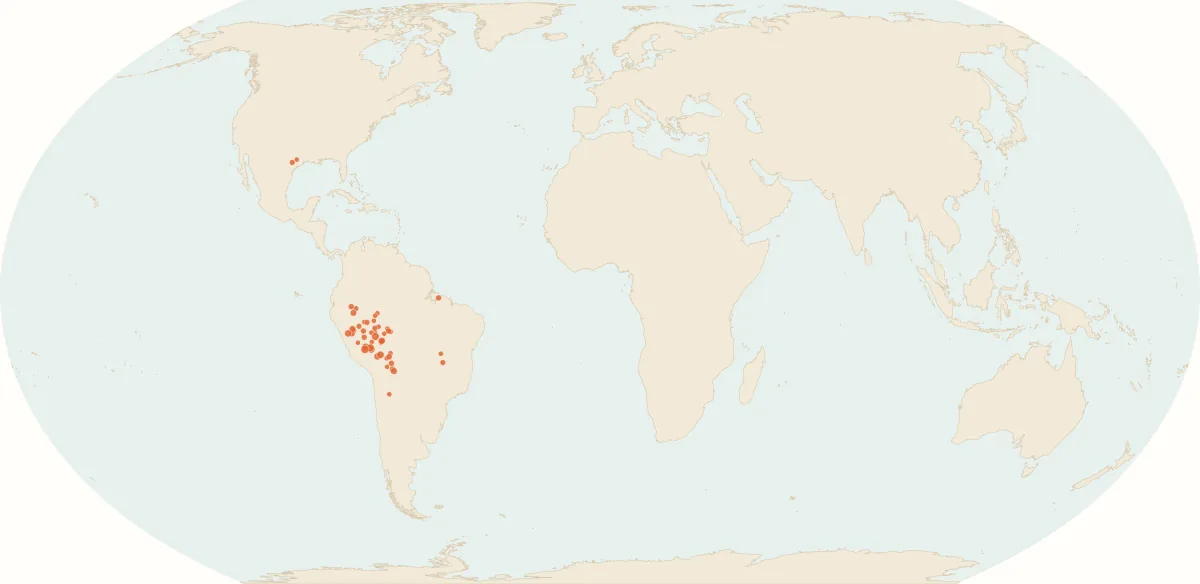
Records: GBIF.org (CC0 and CC BY 4.0 records, retrieved 2026-11-07). Map: Natural EarthSee the records on GBIF
Watch wild animals from a distance. Do not touch or feed them, and take care of the places where they live.
Names around the world
- 日本語
- ボリビアリスザル
- 简体中文
- 亚马孙松鼠猴
- 繁體中文
- 黑冠松鼠猴
- 한국어
- 검은머리다람쥐원숭이
- Español
- Mono ardilla boliviano
- Français
- Saïmiri de Bolivie
- Deutsch
- Bolivianischer Totenkopfaffe
- Português (Brasil)
- Macaco-esquilo-Boliviano
- Italiano
- Saimiri boliviano
- العربية
- سعدان سنجابي أسود التاج
- Русский
- Боливийский саймири
Names come from Wikidata and iNaturalist records. Where a language has no recorded name, we use the scientific name.
Sources and how we check
- 日本モンキーセンター — ボリビアリスザルChecked: 2026-11-03
- University of Michigan Animal Diversity Web — Saimiri boliviensisChecked: 2026-11-03
We check each fact against its source. The illustrations simplify how the real animal looks.
The classification (class, order, family, genus) follows Wikidata records, checked against GBIF. Classifications can change as research goes on.
The basic data are the values given in each source. They vary with how the animal is measured, whether it is male or female, and whether it lives in the wild or in captivity.
This page was translated from the original Japanese with the help of AI.
Report a mistakeRELATIVES
Others in Cebidae

MORE TO MEET


