Siamese fighting fish
Amazing fact
A Siamese fighting fish gets its body color from the skin beneath its mostly colorless scales.
University of Michigan Animal Diversity Web
No sign-up needed. You can save notes on this device.
An illustration based on the real animal.
A little discovery to share.
A Siamese fighting fish gets its body color from the skin beneath its mostly colorless scales.
THE REAL WORLD
The real Siamese fighting fish
- Scientific name
- Betta splendens
- Japanese name
- ベタ
- Group
- Freshwater animals
- Order
- Anabantiformes
- Family
- Osphronemidae
- Genus
- Betta
A fish from Thailand that lives in weedy ponds, rice paddies and other very slow-moving waters.
Its mouth points upward, and it scoops up food such as insects that have fallen onto the water's surface.
The male makes a nest of bubbles by blowing them out at the water's surface, and guards it until the eggs hatch.
How the Siamese fighting fish lives
In the dry season, many bettas bury themselves in the bottom and stay in moist hollows until rain refills their habitat. Between larger meals, they take small snacks such as algae. During courtship, they circle each other and nudge each other in the sides with their snouts. As the pale eggs laid by the female sink, the male catches them in his mouth.
University of Michigan Animal Diversity WebBasic data
- Size
- average 7.5 cm
- Diet
- Insects that have fallen into the water
- Range
- Thailand
Where the Siamese fighting fish has been recorded
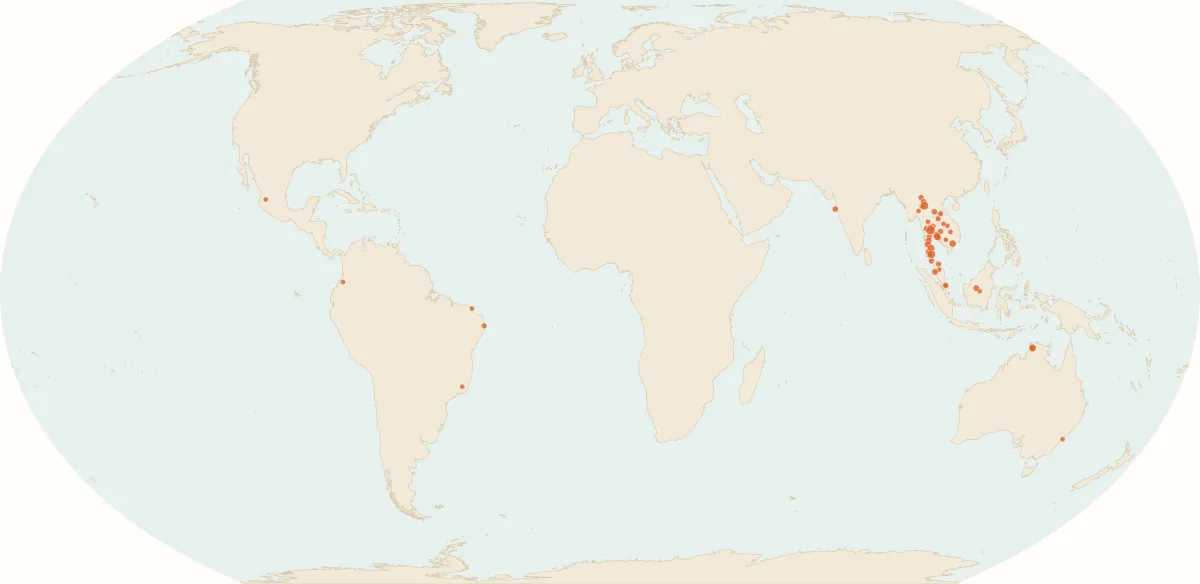
Records: GBIF.org (CC0 and CC BY 4.0 records, retrieved 2026-11-07). Map: Natural EarthSee the records on GBIF
Watch wild animals from a distance. Do not touch or feed them, and take care of the places where they live.
Names around the world
- 日本語
- ベタ
- 简体中文
- 泰国斗鱼
- 繁體中文
- 泰國鬥魚
- 한국어
- 베타
- Español
- Pez betta
- Français
- Combattant
- Deutsch
- Siamesischer Kampffisch
- Português (Brasil)
- Beta-siamês
- Italiano
- Pesce combattente
- العربية
- سمك الفايتر
- Tiếng Việt
- Cá xiêm
- Русский
- Бойцовая рыбка
- Türkçe
- Beta
- ไทย
- ปลากัด
- বাংলা
- সিয়ামিজ লড়াকু মাছ
Names come from Wikidata and iNaturalist records. Where a language has no recorded name, we use the scientific name.
Sources and how we check
- University of Michigan Animal Diversity Web — Betta splendensChecked: 2026-11-03
We check each fact against its source. The illustrations simplify how the real animal looks.
The classification (class, order, family, genus) follows Wikidata records, checked against GBIF. Classifications can change as research goes on.
The basic data are the values given in each source. They vary with how the animal is measured, whether it is male or female, and whether it lives in the wild or in captivity.
This page was translated from the original Japanese with the help of AI.
Report a mistakeRELATIVES
Others in Osphronemidae


MORE TO MEET


