Ayu sweetfish

No sign-up needed. You can save notes on this device.
An illustration based on the real animal.
A little discovery to share.
Ayu darken in color during the spawning season.
THE REAL WORLD
The real Ayu sweetfish
- Scientific name
- Plecoglossus altivelis
- Japanese name
- アユ
- Group
- Freshwater animals
- Order
- Osmeriformes
- Family
- Plecoglossidae
- Genus
- Plecoglossus
This page covers the ayu as a species; those living in Honshu, Shikoku, Kyushu and nearby areas are treated as the subspecies ayu.
A fish that lives in rivers, lakes and the sea. Young fish that hatch in a river go down to the sea and swim back up the river the following spring.
Fish that hold a territory get a yellow patch behind the pectoral fin, and the tip of their small adipose fin turns bright orange.
Once it settles in a river, it keeps a territory around a stone that serves as its feeding spot, and eats things such as algae growing on stones.
How the Ayu sweetfish lives
They travel in schools as they swim upstream. They also eat zooplankton and aquatic insects. Most die after laying eggs in autumn.
国立環境研究所 侵入生物データベース新潟県Basic data
- Size
- Total length: 10–30 cm
- Diet
- Attached algae, zooplankton and aquatic insects
- Range
- Korean Peninsula to coastal mainland China and northern Vietnam, Taiwan and Japan
Where the Ayu sweetfish has been recorded
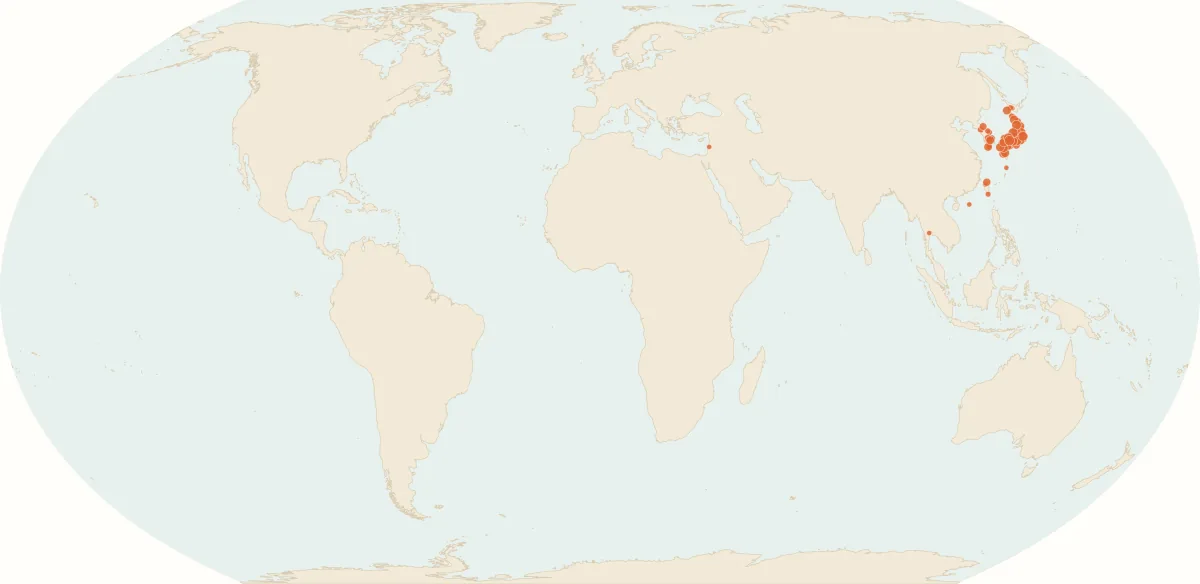
Records: GBIF.org (CC0 and CC BY 4.0 records, retrieved 2026-11-07). Map: Natural EarthSee the records on GBIF
Watch wild animals from a distance. Do not touch or feed them, and take care of the places where they live.
Names around the world
- 日本語
- アユ
- 简体中文
- 香鱼
- 繁體中文
- 香魚
- 한국어
- 은어
- Español
- Ayu
- Deutsch
- Ayu
- Italiano
- Ayu
- العربية
- آيو
- Bahasa Indonesia
- Ikan ayu
- Русский
- Аю
- ไทย
- ปลาอายุ
Names come from Wikidata and iNaturalist records. Where a language has no recorded name, we use the scientific name.
Sources and how we check
- 国立環境研究所 侵入生物データベース — アユChecked: 2026-11-03
- 新潟県 — 新潟県に生息している淡水魚たちChecked: 2026-11-03
We check each fact against its source. The illustrations simplify how the real animal looks.
The classification (class, order, family, genus) follows Wikidata records, checked against GBIF. Classifications can change as research goes on.
The basic data are the values given in each source. They vary with how the animal is measured, whether it is male or female, and whether it lives in the wild or in captivity.
This page was translated from the original Japanese with the help of AI.
Report a mistakeMORE TO MEET


