Japanese rat snake

No sign-up needed. You can save notes on this device.
An illustration based on the real animal.
A little discovery to share.
A Japanese ratsnake can release a strong smell from near its rear end.
THE REAL WORLD
The real Japanese rat snake
- Scientific name
- Elaphe climacophora
- Japanese name
- アオダイショウ
- Group
- Amphibians and reptiles
- Class
- Reptilia
- Order
- Squamata
- Family
- Colubridae
- Genus
- Elaphe
Apart from Okinawa, it is a very large snake for Japan. It lives in woods, fields, and around people's houses.
Adults have faint lengthwise stripes, but young snakes have a ladder-like pattern and are often mistaken for mamushi (Japanese pit vipers).
It is a good climber and sometimes raids birds' nests in trees. It eats birds and their eggs, mice, and other small mammals.
How the Japanese rat snake lives
It is often active on the ground as well as in trees. Young snakes eat frogs and lizards, among other prey. Females lay their eggs in places such as under stones or straw.
京都市動物園東京都建設局国土交通省中国地方整備局Basic data
- Size
- Total length: 1–2.5 m, up to about 3 m
- Diet
- Birds and their eggs, mice, and other small mammals
- Range
- Hokkaido, Honshu, Shikoku, Kyushu, Kunashiri, Izu Islands, Tsushima, and Satsunan Islands
Where the Japanese rat snake has been recorded
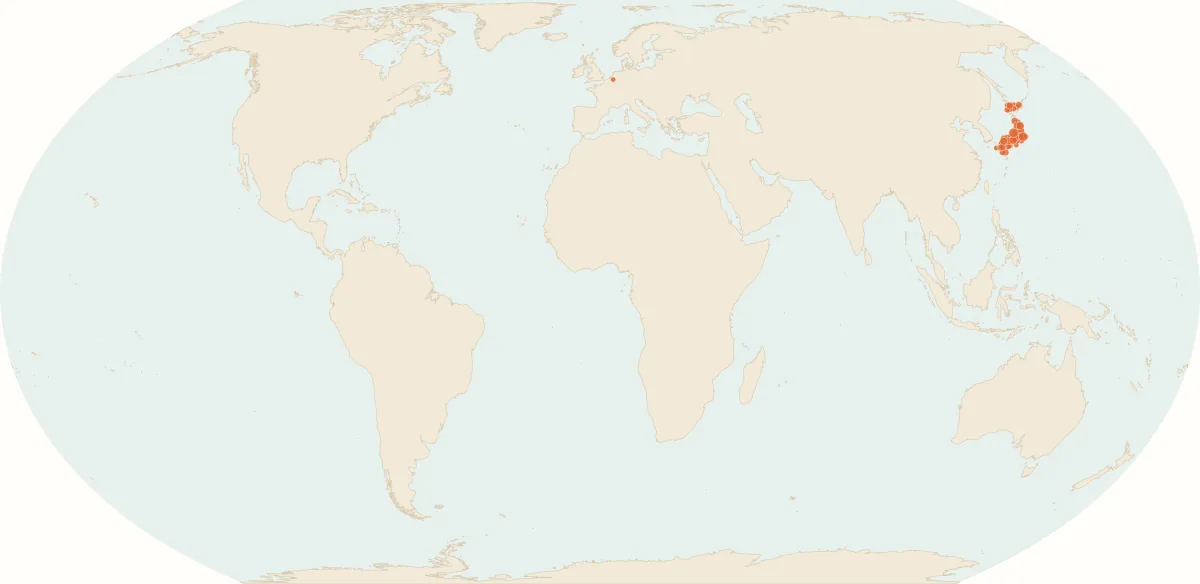
Records: GBIF.org (CC0 and CC BY 4.0 records, retrieved 2026-11-07). Map: Natural EarthSee the records on GBIF
Watch wild animals from a distance. Do not touch or feed them, and take care of the places where they live.
Names around the world
- 日本語
- アオダイショウ
- 简体中文
- 日本锦蛇
- 繁體中文
- 日本錦蛇
- 한국어
- 청대장
- Deutsch
- Insel-Kletternatter
- Português (Brasil)
- Cobra-rateira-japonesa
- Русский
- Островной полоз
Names come from Wikidata and iNaturalist records. Where a language has no recorded name, we use the scientific name.
Sources and how we check
- 上野動物園 — アオダイショウChecked: 2026-11-03
- 京都市動物園 — アオダイショウChecked: 2026-11-05
- 東京都建設局 — アオダイショウChecked: 2026-11-05
- 国土交通省中国地方整備局 — アオダイショウChecked: 2026-11-05
We check each fact against its source. The illustrations simplify how the real animal looks.
The classification (class, order, family, genus) follows Wikidata records, checked against GBIF. Classifications can change as research goes on.
The basic data are the values given in each source. They vary with how the animal is measured, whether it is male or female, and whether it lives in the wild or in captivity.
This page was translated from the original Japanese with the help of AI.
Report a mistakeWhen you meet the Japanese rat snake, look for this
- Look at its large black eyes and round pupils.
Animals do different things from day to day, so you may not always see this.
国土交通省中国地方整備局EXHIBIT INFORMATION
Places that keep or show the Japanese rat snake
Zoos, aquariums and other places whose official websites say they keep or show this animal.
Displays can change with the animals’ health and the seasons. Check each facility’s official website before you go.
RELATIVES
Others in Colubridae


MORE TO MEET


