Aye-aye
Amazing fact
An aye-aye taps wood with its middle finger to search for hollows beneath the bark.
University of Michigan Animal Diversity Web
No sign-up needed. You can save notes on this device.
An illustration based on the real animal.
A little discovery to share.
An aye-aye taps wood with its middle finger to search for hollows beneath the bark.
THE REAL WORLD
The real Aye-aye
- Scientific name
- Daubentonia madagascariensis
- Japanese name
- アイアイ
- Group
- Land mammals
- Class
- Mammalia
- Order
- Primates
- Family
- Daubentoniidae
- Genus
- Daubentonia
Where the name “Aye-aye” comes from
The name aye-aye may come from a call it makes while fleeing its nest.
University of Michigan Animal Diversity WebIt is a primitive kind of primate that lives in Madagascar. It is active at night and has a long tail and big ears.
The middle finger of its front hand is long and thin, which helps it pull insects out from inside wood to eat.
With its sharp front teeth, it gnaws holes in branches where insects hide and eats the insides of hard nuts.
How the Aye-aye lives
It spends most of the day sleeping in an oval nest high in the trees. It pierces fruit skin with its middle finger and scoops out the contents. It often clings upside down to branches.
University of Michigan Animal Diversity WebBasic data
- Size
- Head and body length: 50–60 cm
- Weight
- males 2.6 kg, females 2.4 kg
- Active
- At night (nocturnal)
- Diet
- Seeds, insect larvae, fruit, flowers, nectar and other foods
- Range
- Nearly all coastal areas of Madagascar
Where the Aye-aye has been recorded
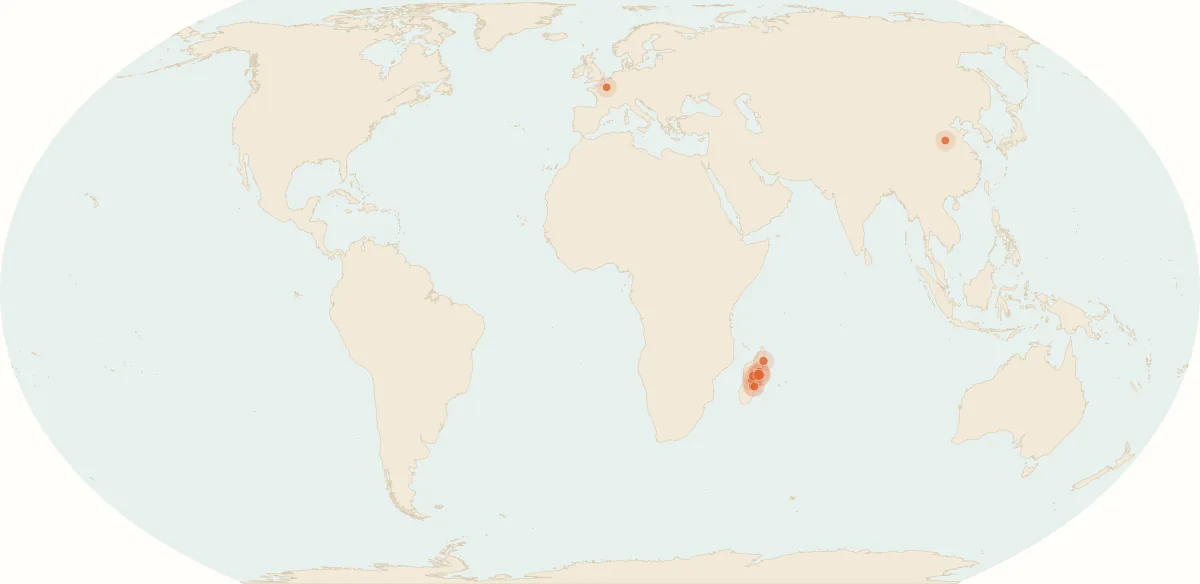
Records: GBIF.org (CC0 and CC BY 4.0 records, retrieved 2026-11-07). Map: Natural EarthSee the records on GBIF
Watch wild animals from a distance. Do not touch or feed them, and take care of the places where they live.
Names around the world
- 日本語
- アイアイ
- 简体中文
- 指猴
- 繁體中文
- 指猴
- 한국어
- 아이아이
- Español
- Aye-aye
- Français
- Aye-aye
- Deutsch
- Fingertier
- Português (Brasil)
- Aie-aie
- Italiano
- Aye-aye
- العربية
- آيآي
- Bahasa Indonesia
- Aye-aye
- Tiếng Việt
- Khỉ Aye-aye
- Русский
- Мадагаскарская руконожка
- Türkçe
- Ay-ay
- ไทย
- อาย-อาย
Names come from Wikidata and iNaturalist records. Where a language has no recorded name, we use the scientific name.
Sources and how we check
- 上野動物園 — アイアイChecked: 2026-11-03
- University of Michigan Animal Diversity Web — Daubentonia madagascariensisChecked: 2026-11-03
We check each fact against its source. The illustrations simplify how the real animal looks.
The classification (class, order, family, genus) follows Wikidata records, checked against GBIF. Classifications can change as research goes on.
The basic data are the values given in each source. They vary with how the animal is measured, whether it is male or female, and whether it lives in the wild or in captivity.
This page was translated from the original Japanese with the help of AI.
Report a mistakeWhen you meet the Aye-aye, look for this
- Look for the dark markings around its eyes.
Animals do different things from day to day, so you may not always see this.
University of Michigan Animal Diversity WebEXHIBIT INFORMATION
Places that keep or show the Aye-aye
Zoos, aquariums and other places whose official websites say they keep or show this animal.
Displays can change with the animals’ health and the seasons. Check each facility’s official website before you go.
RELATIVES
Others in Primates


MORE TO MEET


