Yellow and blueback fusilier
Amazing fact
The yellow and blueback fusilier may change color as a way to defend itself against enemies.
葛西臨海水族園
No sign-up needed. You can save notes on this device.
An illustration based on the real animal.
A little discovery to share.
The yellow and blueback fusilier may change color as a way to defend itself against enemies.
THE REAL WORLD
The real Yellow and blueback fusilier
- Scientific name
- Caesio teres
- Japanese name
- ウメイロモドキ
- Group
- Ocean animals
- Order
- Perciformes
- Family
- Caesionidae
- Genus
- Caesio
It swims in large schools around rocky shores and coral reefs. It eats many kinds of food, including plankton.
Its body is blue, with yellow running from the back to the tail fin. At night it turns a reddish-purple color.
How the Yellow and blueback fusilier lives
It lives in midwater where there is a current.
葛西臨海水族園Basic data
- Size
- Total length: 35 cm
- Diet
- Small plankton
- Range
- Western Pacific from central Honshu southward
Where the Yellow and blueback fusilier has been recorded
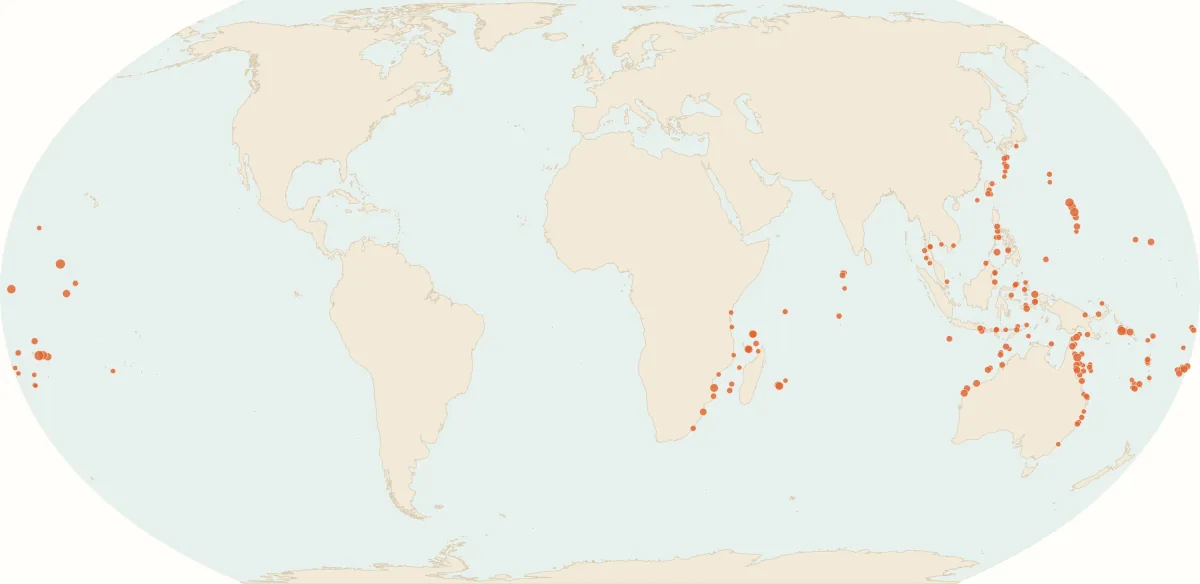
Records: GBIF.org (CC0 and CC BY 4.0 records, retrieved 2026-11-07). Map: Natural EarthSee the records on GBIF
Watch wild animals from a distance. Do not touch or feed them, and take care of the places where they live.
Names around the world
- 日本語
- ウメイロモドキ
- 简体中文
- 黄蓝背乌尾鮗
- 繁體中文
- 黃藍背烏尾鮗
- Español
- Fusilero de cola dorada
- Français
- Fusilier à dos jaune et bleu
- Deutsch
- Gelbschwanz-Füsilier
- Português (Brasil)
- Fuzileiro-de-cauda-amarela
- Italiano
- Pesce fuciliere
- Bahasa Indonesia
- Lolosi cantik
Names come from Wikidata and iNaturalist records. Where a language has no recorded name, we use the scientific name.
Sources and how we check
- 葛西臨海水族園 — ウメイロモドキChecked: 2026-11-03
We check each fact against its source. The illustrations simplify how the real animal looks.
The classification (class, order, family, genus) follows Wikidata records, checked against GBIF. Classifications can change as research goes on.
The basic data are the values given in each source. They vary with how the animal is measured, whether it is male or female, and whether it lives in the wild or in captivity.
This page was translated from the original Japanese with the help of AI.
Report a mistakeEXHIBIT INFORMATION
Places that keep or show the Yellow and blueback fusilier
Zoos, aquariums and other places whose official websites say they keep or show this animal.
Kanto
Displays can change with the animals’ health and the seasons. Check each facility’s official website before you go.
RELATIVES
Others in Caesionidae


MORE TO MEET


